
CLAT 2027 Application Form Out; Apply Online, Registration Link & Last Date
What's New in CLAT?
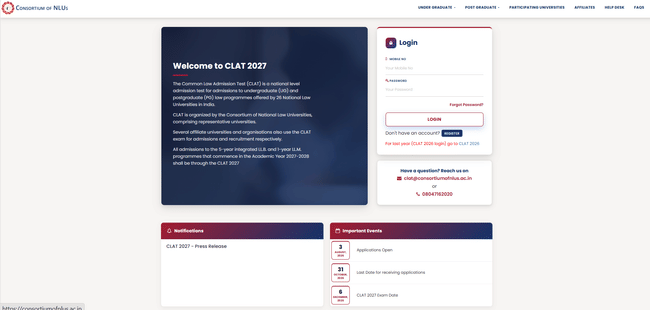
- August 3, 2026: CLAT 2027 registration has commenced on August 3, 2026. Eligible candidates can now apply online for UG and PG law programmes offered by participating NLUs through the official Consortium of NLUs website until October 31, 2026. Apply Online
CLAT 2027 Application Process has commenced on 3 August 2027 through the official website of the Consortium of National Law Universities (consortiumofnlus.ac.in). Eligible candidates seeking admission to five-year Integrated UG Law and LLM programmes can complete the online registration, fill in the application form, upload the required documents, and pay the prescribed application fee before the last date, 31 October 2027. Applicants are advised to carefully verify their eligibility and all details entered in the application form before final submission.
Apply Online for CLAT 2027 (Link Active)
What is CLAT Exam
CLAT 2027 is a national-level law entrance exam conducted by the Consortium of National Law Universities (NLUs) for admission to 5-year integrated LLB and LLM programmes. Candidates can refer to the overview table below for the key details, including the conducting body, official website, exam mode, and important dates.
CLAT 2027 Highlights
| Particular | Details |
|---|---|
| Exam Name | Common Law Admission Test (CLAT) |
| Conducting Body | Consortium of National Law Universities (NLUs) |
| Official Website | consortiumofnlus.ac.in |
| Exam Mode | Offline (Pen and Paper) |
| Exam Date | 6 December 2027 (Tentative) |
| Registration Starts | 3 August, 2027 |
| Last Date to Apply | 31 October, 2027 |
| Admit Card Release | Late November 2027 (Expected) |
| Result Declaration | Third Week of December 2027 (Expected) |
| Courses Offered |
UG (5-Year Integrated LLB) PG (LLM) |
| Helpline Email | clat@consortiumofnlus.ac.in |
| Helpline Number |
08047162020 (10:00 AM to 5:00 PM) |
CLAT 2027 Important Dates
CLAT 2027 important dates include the complete admission schedule, from the release of the notification to the counselling process.
CLAT 2027 Exam Schedule
| Event | Tentative Date |
|---|---|
| Notification Release | 20 July 2027 |
| Online Application Starts | 3 August 2027 |
| Last Date to Submit Application | 31 October 2027 |
| Admit Card Release | Late November 2027 |
| CLAT 2027 Exam Date | 6 December 2027 |
| Provisional Answer Key | December 2027 |
| Final Answer Key | December 2027 |
| Result Declaration | Third Week of December 2027 |
| Counselling Registration Begins | Last Week of December 2027 |
CLAT 2027 Notification
Consortium of National Law Universities (NLUs) has officially released the CLAT 2027 Notification on its official website. The notification contains complete details regarding the registration process, important dates, eligibility criteria, exam pattern, syllabus, application fee, reservation policy, counselling process, and other admission guidelines. Candidates can download the CLAT 2027 Notification PDF from the official website and are advised to read it carefully before applying online.
Download CLAT 2027 Short Notice PDF
How to Apply for CLAT 2027?
CLAT 2027 application forms are now available online on the official website of the Consortium of National Law Universities. Eligible candidates can complete the registration process from August 3, 2026, to October 31, 2026, by following the step-by-step application procedure provided below.
- Visit the official website, consortiumofnlus.ac.in, and click on the CLAT 2027 registration link.
- Complete the registration using a valid email ID and mobile number to generate your login credentials.
- Sign in to your account and enter the required personal, educational, and contact information.
- Upload your recent photograph, signature, and other necessary documents in the prescribed format and size.
- Pay the application fee through the available online payment modes, such as UPI, net banking, debit card, or credit card.
- Verify all the details before submitting the application form, then download and save the confirmation page for future reference.
CLAT 2027 Application Fee
CLAT aspirants can check the table below for CLAT application fee 2027 details:
| Category | Application Fee |
|---|---|
| General / OBC / PWD / NRI / PIO / OCI | ₹4,000 |
| SC / ST / BPL | ₹3,500 |
CLAT Eligibility Criteria 2027
CLAT 2027 eligibility criteria are prescribed by the Consortium of National Law Universities (NLUs) and include requirements related to educational qualifications, age limit, and nationality. Candidates must fulfil the eligibility conditions before applying for the exam.
CLAT 2027 UG Eligibility Criteria
- Candidates must have completed Class 12 or an equivalent exam from a recognised board.
- General/OBC/PwD category candidates must secure at least 45% marks in the qualifying exam.
- SC/ST category candidates must obtain a minimum of 40% marks.
- Students appearing for their Class 12 final exam in 2027 are also eligible to apply.
CLAT 2027 PG Eligibility Criteria
- Candidates must hold an LLB degree or an equivalent qualification from a recognised university.
- General category candidates require a minimum of 50% marks in their LLB degree.
- SC/ST category candidates must secure at least 45% marks.
- Candidates appearing in the final year of their LLB programme can also apply.
CLAT Exam Pattern 2027
CLAT 2027 exam pattern explains the structure of the question paper, including the number of questions, marking scheme, exam duration, and subjects covered. The exam pattern differs for UG and PG programmes, which candidates must check before starting their preparation.
CLAT UG 2027 Exam Pattern
| Particulars | Details | Description |
|---|---|---|
| Mode of Exam | Offline | Pen and Paper-based Test |
| Duration | 2 Hours (120 Minutes) | Single session |
| Total Questions | 120 | Multiple Choice Questions (MCQs) |
| Total Marks | 120 | 1 mark |
| Negative Marking | -0.25 mark | For each incorrect response |
| Sections in UG | 5 | English Language, Current Affairs including GK, Legal Reasoning, Logical Reasoning, Quantitative Techniques |
| Sections in PG | 1 | Constitutional Law and Other Areas of Law (Jurisprudence, Contract, Torts, Criminal Law, International Law, etc.) |
CLAT 2027 PG Exam Pattern
| Particulars | Details |
|---|---|
| Exam Mode | Offline (Pen and Paper Based) |
| Duration | 2 Hours |
| Total Questions | 120 Questions |
| Maximum Marks | 120 Marks |
| Question Type | Multiple Choice Questions (MCQs) |
| Medium | English |
| Marking Scheme | +1/ -0.25 |
| Subjects Covered | Constitutional Law and other areas of law |
CLAT 2027 Syllabus
CLAT Syllabus 2027 curated by the Consortium of NLUs, which checks candidates’ comprehension, reasoning, and analytical skills across five key sections. Check the table below for both UG and PG levels.
CLAT UG Syllabus 2027
CLAT UG 2027 syllabus is structured to test candidates’ proficiency in reading comprehension, logical thinking, and analytical ability. Check the table below for the detailed CLAT UG syllabus:
| Subjects | Details |
|---|---|
| English Language | Passages of around 450 words from modern or historical fiction and non-fiction. Tests reading comprehension, inference, summarisation, vocabulary, and comparison of viewpoints. |
| Current Affairs (including General Knowledge) | Passages up to 450 words from news and journalistic sources. Covers Indian and international events, arts, culture, historical events, and general awareness. |
| Legal Reasoning | Passages based on legal issues, policies, and moral questions. Tests understanding and application of legal principles and reasoning. No prior legal knowledge required. |
| Logical Reasoning | Short passages testing argument identification, reasoning patterns, inferences, analogies, contradictions, and evaluation of conclusions. |
| Quantitative Techniques | Based on short factual or numerical sets. Includes Class 10-level math topics such as ratios, algebra, mensuration, and basic statistics. Tests data interpretation and calculation ability. |
CLAT PG Syllabus 2027
CLAT 2027 PG syllabus has one section that evaluates candidates’ understanding of core law subjects, emphasising comprehension of legal texts, case laws, and their practical application. Check the table below for the detailed CLAT PG syllabus:
| Subjects | Details |
|---|---|
| Constitutional Law | Covers important provisions, doctrines, and landmark judgments. |
| Jurisprudence | Focuses on legal theories, principles, and the interpretation of laws. |
| Administrative Law | Includes topics like powers of authorities and judicial review. |
| Law of Contract | Covers contract formation, breach, remedies, and consideration. |
| Torts | Questions on negligence, nuisance, defamation, and legal liability. |
| Family Law | Related to marriage, divorce, succession, and inheritance. |
| Criminal Law | Based on IPC, general principles, and key case laws. |
| Property Law | Covers ownership, possession, and transfer of property. |
| Company Law | Topics on incorporation, management, and governance. |
| Public International Law | Deals with treaties, state relations, and global organisations. |
| Tax Law | Covers principles of taxation and major tax provisions. |
| Environmental Law | Focuses on environmental protection acts and sustainable development. |
| Labour & Industrial Law | Includes employee rights, trade unions, and labour welfare laws. |
CLAT 2027 Selection Process
CLAT Selection Process 2027 is based on candidates’ performance in the entrance exam conducted by the Consortium of NLUs. After the result, shortlisted candidates participate in centralised counselling and seat allocation based on their All India Rank (AIR). Document verification and fee payment are mandatory to confirm admission; failure to comply may lead to seat cancellation.
CLAT Answer Key 2027
CLAT 2027 answer key will be released by the Consortium of National Law Universities after the exam on its official website, consortiumofnlus.ac.in. Candidates can use the provisional answer key to check their responses, estimate scores, and raise objections (if required) within the given timeline. The final answer key will be released after reviewing all objections.
- Visit the official website of the Consortium of NLUs at consortiumofnlus.ac.in.
- Click on the link for the CLAT 2027 Provisional Answer Key
- Log in using your registered mobile number and password.
- Select the answer key for your respective programme (UG or PG) and download it.
- Candidates can raise objections against any answer within the specified period by paying the applicable objection fee.
- After reviewing the submitted challenges, the Consortium will publish the final answer key before declaring the CLAT 2027 result.
Candidates may raise objections to specific questions by paying the prescribed fee per challenge. After reviewing all objections, the Consortium will release the final answer key before announcing CLAT 2027 result.
CLAT Cut-Off (Expected)
CLAT 2027 cut off will be released by the Consortium of National Law Universities (NLUs) after the declaration of results and completion of counselling rounds. The cutoff indicates the minimum rank and score required by candidates to secure admission in participating NLUs. It may vary depending on factors such as exam difficulty level, number of candidates, seat availability, and category-wise reservations.
Expected CLAT 2027 UG Cut Off (NLU-wise)
| NLU Name | Expected Score Range | Expected Rank Range |
|---|---|---|
| NLSIU Bengaluru | 90–100 | 1–100 |
| NALSAR Hyderabad | 85–90 | 100–170 |
| WBNUJS Kolkata | 80–85 | 170–250 |
| NLIU Bhopal | 75–80 | 250–350 |
| NLU Jodhpur | 75–80 | 250–350 |
| GNLU Gandhinagar | 70–75 | 350–450 |
| MNLU Mumbai | 65–70 | 400–500 |
| RMLNLU Lucknow | 65–70 | 500–650 |
| HNLU Raipur | 65–70 | 650–750 |
| RGNUL Patiala | 60–65 | 750–850 |
| CNLU Patna | 60–65 | 850–950 |
| NUALS Kochi | 60–65 | 950–1050 |
| DSNLU Visakhapatnam | 58–62 | 1050–1150 |
| TNNLU Tiruchirappalli | 58–62 | 1150–1250 |
| MNLU Nagpur | 55–60 | 1250–1350 |
| MNLU Aurangabad | 55–60 | 1350–1450 |
| DNLU Jabalpur | 55–60 | 1200–1300 |
| HPNLU Shimla | 55–60 | 1300–1400 |
| NLU Assam (AUSLR) | 50–55 | 1450–1550 |
| DBRANLU Haryana | 50–55 | 1400–1500 |
| GNLU Silvassa Campus | 48–55 | 1500–1600 |
| NLU Tripura | 48–55 | 1500–1600 |
| NLU Meghalaya | 48–55 | 1600–1700 |
Best Books for CLAT 2027 Preparation
CLAT 2027 preparation requires reliable study material that helps candidates understand concepts, practise questions, and improve section-wise performance.
| Section | Recommended Books | Author/Publisher |
|---|---|---|
| English Language | Word Power Made Easy | Norman Lewis |
| English Grammar | High School English Grammar and Composition | Wren & Martin |
| Current Affairs & GK | Manorama Yearbook | Malayala Manorama |
| General Knowledge | Lucent’s General Knowledge | Lucent Publication |
| Legal Reasoning | Legal Awareness and Legal Reasoning | A.P. Bhardwaj |
| Legal Aptitude | Universal’s Guide to CLAT & LLB Entrance Exam | Universal |
| Logical Reasoning | Analytical Reasoning | M.K. Pandey |
| Logical Reasoning | A Modern Approach to Logical Reasoning | R.S. Aggarwal |
| Quantitative Techniques | Quantitative Aptitude for Competitive Exam | R.S. Aggarwal |
Why Should Students Prepare for CLAT 2027?
CLAT 2027 is a national-level law entrance exam for admission to UG and PG programmes at NLUs and other participating institutes. A valid CLAT score helps candidates enter reputed law colleges and develop skills like legal reasoning, analytical thinking, comprehension, and current affairs awareness for careers in corporate law, litigation, judiciary, and legal consultancy.
CLAT 2027 aspirants should focus on completing the application process, preparing as per the latest exam pattern, and tracking official updates from the Consortium of NLUs. After the exam, the answer key, result, and counselling schedule will be released.
CLAT 2027 FAQs
Ques: What happens after qualifying CLAT 2027?
Ans: After qualifying CLAT 2027, candidates can participate in the centralised counselling process conducted by the Consortium of NLUs. Seats are allotted based on rank, preferences, category, and availability.
Ques: How can candidates select their preferred NLU through CLAT 2027?
Ans: Candidates can choose their preferred NLUs during the counselling process. The final seat allotment depends on their CLAT rank, category, available seats, and preference order.
Ques: What is the CLAT 2027 counselling process?
Ans: CLAT 2027 counselling includes registration, choice filling, seat allotment, document verification, and fee payment. Candidates must complete each step within the given schedule to confirm admission.
Ques: Are CLAT 2027 marks and rank the same?
Ans: No, CLAT 2027 marks represent the score obtained by a candidate in the exam, while rank indicates their position compared to other candidates based on overall performance.
Ques: What are the career options after completing a law degree through CLAT?
Ans: Candidates completing law programmes through CLAT can explore careers in fields such as corporate law, litigation, judiciary, legal consultancy, and public sector legal services.
Download the PREPP App and attempt FREE CLAT Mock Tests and get complete study material!


Comments