UPSC CSE Mains Admit Card 2026 Out; Check Exam Schedule & Download Link
UPSC CSE Mains 2026 is scheduled to be conducted from 21 to 30 August 2026 for candidates who qualified in the Civil Services Preliminary Exam. The Detailed Application Form-I (DAF-I) submission process has already concluded. UPSC CSE Mains Admit Card 2026 has been released on the official website. Registered candidates will be able to download their e-Admit Card using their Registration ID or Roll Number before the commencement of the Exam.
UPSC CSE Mains 2026 Exam Schedule
UPSC Civil Services (Main) Exam 2026 will be conducted from 21 to 30 August 2026 in two sessions each day. Candidates can check the paper-wise schedule, exam dates, and timings below.
| Date | Day | Forenoon Session (9:00 AM–12:00 Noon) | Afternoon Session (2:30 PM–5:30 PM) |
|---|---|---|---|
| 21 August 2026 | Friday | Paper I – Essay | No Paper |
| 22 August 2026 | Saturday | Paper II – General Studies I | Paper III – General Studies II |
| 23 August 2026 | Sunday | Paper IV – General Studies III | Paper V – General Studies IV |
| 29 August 2026 | Saturday | Paper A – Indian Language | Paper B – English |
| 30 August 2026 | Sunday | Paper VI – Optional Subject Paper I | Paper VII – Optional Subject Paper II |
Table of Contents
- UPSC 2026 Notification 2026
-
- UPSC 2026 Vacancy Details
- UPSC Eligibility Criteria for UPSC CSE 2026
- How to Apply for UPSC 2026 Application Form
- UPSC 2026 Selection Process
- UPSC 2026 Exam Pattern
- UPSC 2026 Syllabus for Prelims & Mains
- UPSC 2026 Optional Subjects List
- UPSC 2026 Admit Card & Exam Centres
- UPSC 2026 Cut Off
- UPSC CSE 2026 FAQs
UPSC IAS Notification 2026 - Key Highlights
The UPSC IAS Notification 2026 has been officially released, detailing everything aspirants need to know about the Civil Services exam 2026. Candidates aiming for the IAS Exam 2026 can check the key highlights below to stay updated and plan their preparation effectively
| Particulars | Details |
|---|---|
| Exam Name | UPSC Civil Services Exam 2026 (IAS Exam) |
| Conducting Authority | Union Public Service Commission (UPSC) |
| UPSC Notification 2026 Release Date | February 04 2026 |
| UPSC CSE 2026 Application Starts | February 04 2026, to February 27 2026 |
| Mode of Application | Online |
| UPSC Prelims Exam Date 2026 | May 24, 2026 (Sunday) |
| UPSC Mains Exam Date 2026 | 21-30 August 2026 |
| Total Vacancies | 933 |
| Exam Level | National (All-India) |
| Selection Process |
Prelims Mains Interview |
| Official Websites | upsc.gov.in, upsconline.nic.in |
UPSC CSE 2026 New Guideline – No Second Attempt Rule
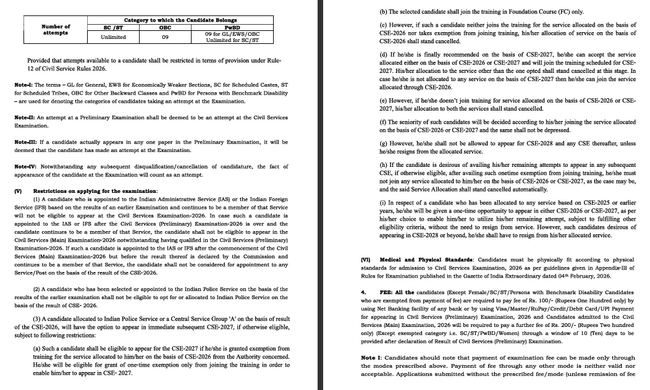
As per the latest notification issued by the Union Public Service Commission, candidates who are already selected and serving in services such as IAS or IFS will not be allowed to appear again in UPSC CSE 2026 at any stage unless they resign from their current service, while serving IPS officers cannot re-attempt to opt for IPS. This rule effectively ends the practice of repeated attempts by appointed officers for rank or service upgradation, though normal category-wise attempt limits remain unchanged for fresh aspirants.
UPSC CSE Notification 2026
UPSC CSE Notification 2026 was officially released on February 4, 2026, by the Union Public Service Commission, starting the UPSC Civil Services exam (CSE) 2026 process. The notification includes key information on UPSC 2026 exam dates, vacancies, UPSC eligibility criteria 2026, age limit, number of attempts, UPSC application form 2026, exam pattern, and syllabus. Aspirants targeting IAS, IPS, IFS, IRS, and other services should review the notification carefully to plan UPSC 2026 preparation as per the official schedule.
UPSC 2026 Important Dates
Candidates preparing for the UPSC Civil Services exam 2026 can refer to the table below to track all important UPSC CSE exam dates 2026 at a glance. Keeping these UPSC 2026 notification, application, prelims, and mains dates in mind will help aspirants plan their preparation strategy and avoid missing any critical deadline.
| UPSC CSE 2026 Events | Dates |
|---|---|
| UPSC Notification 2026 Release Date | February 04 2026 |
| UPSC Application Form 2026 Start Date | February 04 2026 |
| Last Date to Apply for UPSC CSE 2026 | |
| UPSC Prelims Exam Date 2026 | May 24 2026 |
| UPSC Mains Exam Date 2026 | From 21 August 2026 |
UPSC 2026 Vacancy Details
| Year | Total UPSC CSE Vacancies |
|---|---|
| UPSC 2026 | 933 |
| UPSC 2025 | 979 |
| UPSC 2024 | 1,056 |
| UPSC 2023 | 1,105 |
| UPSC 2022 | 1,022 |
Note: As per the official UPSC Notification 2026 released on February 4, 2026, it includes vacancies across IAS, IPS, IFS, IRS and other Group A & B services with reservations as per government norms.
Understanding UPSC Eligibility Criteria for UPSC CSE 2026
Before diving deeper into preparation, every aspirant must clearly understand the UPSC Eligibility Criteria for CSE 2026-
UPSC Nationality Criteria 2026
The UPSC nationality criteria 2026 vary depending on the service applied for. Candidates must carefully check whether they meet the citizenship requirements laid down by the Commission.
Services Requiring Indian Citizenship
To apply for the following services, Indian citizenship is mandatory:
- Indian Administrative Service (IAS)
- Indian Foreign Service (IFS)
- Indian Police Service (IPS)
Nationality Criteria for Other Civil Services
For all other services under UPSC CSE 2026, a candidate must belong to any one of the categories below:
- Citizen of India
- Subject of Nepal
- Subject of Bhutan
- Tibetan refugee who migrated to India before 1 January 1962 with the intent of permanent settlement
- A person of Indian origin (PIO) who has migrated from Pakistan, Myanmar (Burma), Sri Lanka, or East African countries such as Kenya, Uganda, Tanzania, Zambia, Malawi, Zaire, Ethiopia, and Vietnam with the intention of permanently settling in India
Educational Qualification for UPSC CSE 2026
The UPSC educational qualification for CSE 2026 is straightforward and inclusive.
- Candidates must hold a Bachelor’s degree from a recognised university or institution.
- Final-year graduation students are allowed to apply provisionally, provided they submit proof of passing before the Personality Test (Interview).
- There is no restriction on the discipline or stream- arts, science, commerce, engineering, and medical graduates are equally eligible.
UPSC Age Limit & Number of Attempts 2026
| Category | Age Limit (Including Relaxation) | Maximum Attempts |
|---|---|---|
| General / EWS | 21–32 Years | 6 attempts |
| OBC | Up to 35 Years (3-year relaxation) | 9 attempts |
| SC / ST | Up to 37 Years (5-year relaxation) | Unlimited (within age limit) |
| PwBD | Up to 42 Years (10-year relaxation) | General/OBC: 9 attempts |
| PwBD (SC/ST) | Up to 42 Years | Unlimited (within age limit) |
Additional Relaxation: Ex-Servicemen and J&K domicile candidates are entitled to extra age relaxation as per applicable government norms.
How to Apply for UPSC CSE 2026
UPSC CSE Application Form 2026 is released on February 4, 2026, by the Union Public Service Commission along with the Civil Services Notification 2026. The online application process is open till February 27, 2026, and candidates must apply through the UPSC One Time Registration (OTR) portal only.
Step 1: Visit the official UPSC website and complete One Time Registration (OTR) using a valid email ID and mobile number.
Step 2: Log in with OTR credentials and select the Civil Services exam 2026 from the active exams list.
Step 3: Fill in personal details, educational qualifications, and choose preferred exam centres carefully.
Step 4: Upload a recent photograph and signature in the prescribed format.
Step 5: Pay the application fee (if applicable) through online or offline mode.
Step 6: Review the application form, submit it, and download the confirmation page for future reference.
UPSC IAS Application Fee 2026
| Category | Application Fee |
|---|---|
| General / EWS / OBC (Male) | ₹100 |
| SC / ST Candidates | Exempted (No Fee) |
| Persons with Benchmark Disabilities (PwBD) | Exempted (No Fee) |
| Female Candidates (All Categories) | Exempted (No Fee) |
UPSC 2026 Selection Process
The UPSC 2026 Selection Process for the Civil Services exam (CSE) 2026 is conducted by the Union Public Service Commission in three structured stages to evaluate candidates for IAS, IPS, IFS, IRS, and other Group A & B services. Understanding the selection process is crucial for planning UPSC 2026 preparation effectively.
Stage 1: UPSC Prelims 2026
The UPSC Prelims exam 2026 is a qualifying screening test comprising General Studies Paper I and CSAT Paper II. Marks scored in Prelims are used only to shortlist candidates for the Mains exam and are not counted in the final merit.
Stage 2: UPSC Mains 2026
The UPSC Mains exam 2026 is a descriptive written exam with Essay, General Studies Papers, and Optional Subject papers. Marks obtained in Mains play a decisive role in the final ranking.
Stage 3: UPSC Interview 2026
The UPSC Personality Test / Interview 2026 assesses candidates’ leadership qualities, decision-making ability, and suitability for civil services. The final UPSC merit list 2026 is prepared based on Mains and Interview marks combined.
UPSC Exam Pattern 2026
UPSC Civil Services Exam Pattern 2026 follows a three-stage selection process designed to test a candidate’s knowledge, analytical ability, writing skills, and personality traits required for top administrative roles. Candidates must clear each stage- Prelims, Mains, and Interview to move forward in the UPSC CSE recruitment process.
UPSC CSE Prelims Exam Pattern
The UPSC Prelims Exam Pattern consists of two objective-type papers, conducted on the same day. This stage acts as a screening test for Mains.
| Paper | Subject | Nature | Questions | Duration | Marks |
|---|---|---|---|---|---|
| Paper I | General Studies | Merit-based | 100 | 2 Hours | 200 |
| Paper II | CSAT | Qualifying | 80 | 2 Hours | 200 |
Key Highlights:
- Objective (MCQ) format
- One-third negative marking
- CSAT requires 33% minimum marks to qualify
- Prelims merit is decided only by GS Paper I
UPSC CSE Mains exam
The UPSC Mains Exam 2026 is a descriptive test consisting of 9 papers, each of 3 hours duration. It evaluates depth of understanding and written expression.
| Paper | Subject | Marks |
|---|---|---|
| Paper 1 | Indian Language (Qualifying) | 300 |
| Paper 2 | English (Qualifying) | 300 |
| Paper 3 | Essay | 250 |
| Paper 4 | GS I | 250 |
| Paper 5 | GS II | 250 |
| Paper 6 | GS III | 250 |
| Paper 7 | GS IV | 250 |
| Paper 8 | Optional Paper I | 250 |
| Paper 9 | Optional Paper II | 250 |
Note:
- Language papers require 25% minimum marks
- Only marks of merit papers are counted in the final ranking
UPSC CSE Personality Test (Interview)
The UPSC Interview 2026 is the final stage and carries 275 marks. There is no fixed syllabus, as the board assesses personality traits such as leadership, integrity, decision-making, and suitability for civil services.
Note: Understanding the UPSC Exam Pattern for IAS 2026 is crucial for building a focused preparation strategy and aligning efforts with what truly matters in the final merit list.
UPSC CSE Syllabus 2026
The UPSC 2026 Syllabus for the Civil Services exam (CSE) is officially prescribed by the Union Public Service Commission. Understanding the syllabus in a structured format helps aspirants plan UPSC Prelims 2026 and UPSC Mains 2026 preparation efficiently and improve topic-wise coverage for high-scoring areas.
UPSC Prelims Syllabus 2026
| Paper | Subjects / Topics |
|---|---|
| General Studies Paper I | Current Affairs (National & International), History of India & Indian National Movement, Indian & World Geography, Indian Polity & Governance, Economic & Social Development, Environment, Ecology & Climate Change, General Science |
| CSAT Paper II (Qualifying) | Comprehension, Interpersonal & Communication Skills, Logical Reasoning & Analytical Ability, Decision Making & Problem Solving, Basic Numeracy (Class X level), Data Interpretation |
UPSC Mains Syllabus 2026
| Paper | Syllabus Topics |
|---|---|
| Essay | Essay writing on multiple topics of national and international relevance |
| General Studies I | Indian Heritage & Culture, History, World History, Indian & World Geography |
| General Studies II | Constitution, Polity, Governance, Social Justice, International Relations |
| General Studies III | Indian Economy, Agriculture, Science & Technology, Environment, Disaster Management, Internal Security |
| General Studies IV | Ethics, Integrity, Aptitude, Case Studies |
| Optional Subject | One optional subject chosen by the candidate (Paper I & II) |
This UPSC 2026 syllabus table ensures focused preparation for IAS, IPS, IFS, IRS, and other services by aligning study plans with official exam requirements.
UPSC CSE Optional Subjects List 2026
The UPSC 2026 Optional Subjects are prescribed by the Union Public Service Commission for the Civil Services Mains exam 2026. Candidates must choose one optional subject, which consists of Paper 1 and Paper 2, each carrying 250 marks. Selecting the right optional plays a crucial role in improving the UPSC Mains 2026 score and overall rank.
| Literature Optional Subjects | Non-Literature Optional Subjects |
|---|---|
| Assamese | Agriculture |
| Bengali | Animal Husbandry & Veterinary Science |
| Bodo | Anthropology |
| Dogri | Botany |
| Gujarati | Chemistry |
| Hindi | Civil Engineering |
| Kannada | Commerce & Accountancy |
| Kashmiri | Economics |
| Konkani | Electrical Engineering |
| Maithili | Geography |
| Malayalam | Geology |
| Manipuri | History |
| Marathi | Law |
| Nepali | Management |
| Odia | Mathematics |
| Punjabi | Mechanical Engineering |
| Sanskrit | Medical Science |
| Santhali | Philosophy |
| Sindhi | Physics |
| Tamil | Political Science & International Relations |
| Telugu | Psychology |
| Urdu | Public Administration |
| English | Sociology |
| — | Statistics |
| — | Zoology |
UPSC CSE Prelims Preparation Strategy 2026
Cracking the UPSC CSE 2026 is all about strategy, precision, and consistency. With increasing competition and an unpredictable question trend, aspirants need a UPSC CSE preparation strategy 2026 that goes beyond random studying. A focused plan aligned with the latest UPSC Prelims exam pattern, syllabus, and UPSC PYQs can significantly improve your chances of qualifying.
| Preparation Area | Strategy to Follow | Key UPSC Focus |
|---|---|---|
| UPSC Prelims Syllabus 2026 | Go through the GS and CSAT syllabus line by line before starting | Avoid studying outside the syllabus |
| Standard UPSC Books | Use limited and standard books only | Multiple revisions are more effective than new sources |
| Previous Year Questions (PYQs) | Solve 10–15 years of UPSC Prelims PYQs | Understand question trends and recurring topics |
| Current Affairs 2025–26 | Cover current affairs with static subject linkage | Focus on Polity, Economy, Environment, and Science |
| Mock Tests Practice | Attempt full-length Prelims mock tests regularly | Analyse mistakes and improve accuracy |
| Revision Strategy | Revise core subjects multiple times | Use short notes, mind maps, and one-pagers |
| CSAT Preparation | Practice comprehension, reasoning, and basic maths | Target well above the 33% qualifying mark |
| Time Management | Practice solving papers in exam-like conditions | Improve speed and decision-making |
What Aspirants Should Do After UPSC CSE Notification 2026
After the release of the UPSC 2026 Notification by the Union Public Service Commission, aspirants should move into focused execution mode with a clear and exam-oriented approach. Early action at this stage is critical for success in the UPSC Civil Services exam 2026.
- Read the UPSC 2026 Notification carefully to confirm eligibility, age limit, number of attempts, vacancies, and exam dates
- Complete UPSC One Time Registration (OTR) and submit the UPSC 2026 application form well before the deadline
- Download and thoroughly analyse the UPSC 2026 syllabus for Prelims and Mains to understand topic-wise weightage
- Start solving UPSC Previous Year Papers (PYQs) for both Prelims and Mains (last 10–15 years) to identify recurring themes, important areas, and question trends
- Create a realistic and time-bound study plan integrating static subjects, current affairs, revision, and UPSC Mock Tests
- Begin Prelims-oriented preparation with a strong focus on GS Paper I and CSAT qualifying strategy
- Link current affairs with PYQs to improve conceptual clarity and retention
- Initiate answer writing practice early, using previous year Mains questions for a smooth transition after Prelims
- Track the UPSC 2026 exam calendar and set monthly and weekly targets accordingly
Consistent study, regular PYQ practice, and disciplined execution after the UPSC 2026 notification build a strong foundation for cracking IAS, IPS, IFS, and other civil services.
UPSC CSE Admit Card 2026
The UPSC 2026 Admit Card will be released online by the Union Public Service Commission for Prelims, Mains, and Interview stages. The UPSC Prelims Admit Card 2026 is expected in May 2026, while the UPSC Mains Admit Card 2026 will be issued in September 2026. The admit card contains essential details such as exam date, reporting time, and venue, and is mandatory for entry into the exam hall., Steps to Download UPSC Admit Card 2026-
Step 1: Visit the official UPSC website.
Step 2: Click on the UPSC CSE 2026 Admit Card link.
Step 3: Log in using Registration ID or Roll Number.
Step 4: Download and print the admit card for exam day use.
Note: Candidates should check the exact UPSC Exam Centre address and reporting time on their admit card and plan travel accordingly.
UPSC CSE Cut Off 2026
The UPSC 2026 Cut Off is one of the most searched topics among Civil Services aspirants, as it sets the real benchmark for qualifying Prelims, Mains, and the final merit list. While the official UPSC cut-off 2026 will be released only after the final results, aspirants can make informed preparation decisions by analysing the expected cut-off for UPSC 2026 along with previous years’ cut-off trends.
Note: CSAT is qualifying in nature; candidates must score at least 33%.
UPSC CSE Previous Year Cut Off 2026
The UPSC final cut off represents the total marks (Mains + Interview) required to secure a rank.
| Category | 2023 | 2022 |
|---|---|---|
| General | 953 | 960 |
| EWS | 923 | 926 |
| OBC | 923 | 932 |
| SC | 890 | 893 |
| ST | 891 | 900 |
UPSC IAS 2026 Salary
One of the most attractive aspects of a career in IAS is the salary and perks. The starting salary for an IAS officer is approximately ₹56,100 (Basic Pay), with additional allowances like:
- Dearness Allowance (DA)
- House Rent Allowance (HRA)
- Travel Allowance (TA)
- Official Residence
| Component | Details |
|---|---|
| Starting Salary (Basic Pay) | Rs. 56,100 (excluding DA, TA, HRA, etc.) |
| Highest Salary (Cabinet Secretary) (Basic Pay) | Rs. 2,50,000 |
| Allowances & Benefits |
|
UPSC IAS 2026 exam is undoubtedly one of the most challenging and competitive exams in India. However, with proper planning, consistent study, the right UPSC Courses, and a focused approach, you can achieve your dream of becoming an IAS officer.
UPSC CSE 2026 FAQs
Ques: What is the application mode for UPSC CSE 2026?
Ans: The UPSC CSE 2026 application process is completely online. Candidates must apply through the UPSC OTR (One Time Registration) system on the official portal upsconline.nic.in. Offline applications are not accepted.
Ques: What is the age limit for UPSC CSE 2026?
Ans: The UPSC age limit 2026 is calculated as of 1 August 2026:
- General Category: 21 to 32 years
- OBC Category: 21 to 35 years
- SC/ST Category: 21 to 37 years
- PwBD (General/OBC): Up to 42 years
Age relaxation is applicable for reserved categories as per UPSC norms.
Ques: How many attempts are allowed in UPSC CSE 2026?
Ans: The UPSC CSE 2026 attempt limit is:
- General Category: 6 attempts
- OBC Category: 9 attempts
- SC/ST Category: Unlimited attempts (within age limit)
- PwBD (General/OBC): 9 attempts
- PwBD (SC/ST): Unlimited attempts
An attempt is counted only when a candidate appears in the UPSC Prelims exam.
Ques: What is the selection process for UPSC CSE 2026?
Ans: The UPSC CSE 2026 selection process consists of three stages:
- Prelims exam: Objective-type papers (GS Paper I & CSAT)
- Main exam: Descriptive papers including Essay, General Studies, and Optional Subject
- Personality Test (Interview): Assessment of personality, leadership, awareness, and communication skills
Final merit is based on Mains + Interview marks.
Ques: Is there negative marking in UPSC Prelims 2026?
Ans: Yes, negative marking is applicable in UPSC Prelims 2026. For every incorrect answer, one-third (1/3rd) of the marks allotted to the question are deducted in both GS Paper I and CSAT.
Ques: Can I choose any optional subject in UPSC Mains 2026?
Ans: Yes, candidates can choose one optional subject for UPSC Mains from the list prescribed by UPSC (Papers VI & VII). Popular UPSC optional subjects include Geography, History, Sociology, Political Science, and Public Administration. Selecting the right optional plays a crucial role in final selection.
Ques: What is the UPSC CSE 2026 application fee?
Ans: The UPSC application fee 2026 is:
- General/OBC (Male): ₹100
- SC/ST/Female/PwBD: Exempted
The fee can be paid online via UPI, Debit Card, Credit Card, or Net Banking.
Ques: Will the UPSC CSE 2026 syllabus change?
Ans: As of now, no official changes have been announced in the UPSC CSE syllabus 2026. The exam is expected to follow the existing syllabus covering General Studies, Essay, Ethics, Optional Subjects, and Current Affairs. Candidates should rely on the official notification for any updates.
Ques: How to download the UPSC CSE 2026 Notification PDF?
Ans: Candidates can download the UPSC CSE 2026 Notification PDF from the official UPSC website. Visit the “exams” section and click on the Civil Services exam 2026 notification link to access complete details.
Ques: When will UPSC CSE 2026 Prelims result be declared?
Ans: The UPSC Prelims Result 2026 is expected to be announced 3–4 weeks after the exam. The result PDF will list the roll numbers of candidates qualified for the UPSC Mains 2026.
Ques: What is the expected cutoff for UPSC CSE 2026?
Ans: The UPSC CSE 2026 cutoff will depend on factors like exam difficulty, vacancies, and candidate performance. Based on previous years’ trends, the Prelims cutoff for the General category is expected to range between 95–105 marks.
Download the PREPP App and attempt FREE IAS Exam Mock Tests and get complete study material!
UPSC IAS : CSAT - Mini Live Test

Live Test : UPSC CSE Prelims CSAT (Paper-II) (Oct 20 - 23)
Full Test - 04: UPSC CSE Prelims CSAT (Paper-II)
Full Test - 03: UPSC CSE Prelims CSAT (Paper-II)
UPSC CSE Prelims 2026 GS Paper 1 Question Paper (24-May-2026)
UPSC CSE Prelims 2026 CSAT Paper 2 Question Paper (24-May-2026)

17 February 2025 | The Hindu Must Read Articles | Current Affairs

16 February 2026 | The Hindu Must Read Articles | Current Affairs

13 February 2026 | The Hindu Must Read Articles | Current Affairs









Comments