
- May 06, 2026: NTA has released NEET UG 2026 provisional answer key on May 6, allowing candidates to estimate their scores. Download PDF
- April 27, 2026: NTA has released NEET UG Admit Card 2026, and candidates can now download their hall tickets for the exam scheduled on May 3, 2026. Download Admit Card
- February 8, 2026: NEET UG 2026 notification released by NTA on February 8 2026. Candidates can check registration dates and apply online. Download PDF
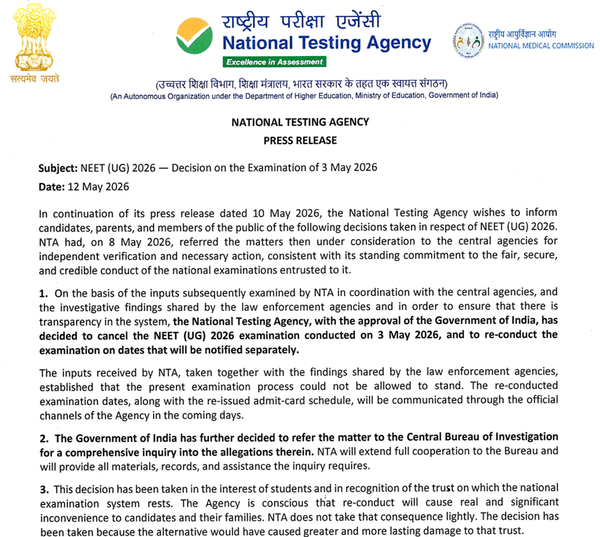
NEET UG 2026 Exam Cancelled; NTA to Conduct Re-Exam Soon
What's New in NEET?
...Read More
National Testing Agency has cancelled NEET UG 2026 exam conducted on May 3, 2026, as per the official notice released on May 12, 2026. The decision was taken after reviewing inputs from central agencies and findings shared by law enforcement authorities regarding alleged irregularities in the exam process. NTA has confirmed that the NEET UG 2026 exam will now be re-conducted, and the revised exam dates will be announced separately through the official website.
What is NEET Exam?
National Eligibility cum Entrance Test or NEET is a national-level entrance examination conducted by National Testing Agency (NTA) for admission to undergraduate medical courses like MBBS, BDS and AYUSH across India. The exam tests students on their knowledge in Physics, Chemistry, and Biology based on NCERT curriculum for Classes 11 and 12. NEET functions as a selection test for all government and private medical colleges in India, standardizing the admission process and ensuring merit-based selection.
NEET 2026 Highlights
NEET 2026 highlights below provide key information about the exam that would help candidates understand the basic exam structure and rules before starting preparation.
| Features | Details |
|---|---|
| Exam Name | National Eligibility cum Entrance Test (NEET) 2026 |
| Conducting Body | National Testing Agency (NTA) |
| Exam Mode | Offline Mode (Pen and Paper Mode) |
| Time Duration | 3 hours |
| Exam Frequency | Once a year in May. |
| Attempts Allowed | No limit; subject to age and eligibility criteria |
| Official Website | neet.nta.nic.in |
NEET 2026 Exam Dates
NTA has not yet officially released NEET 2026 exam dates, but the following are the tentative dates based on previous patterns.
| Event | Dates |
|---|---|
| NEET 2026 Notification Release Date | February 8 2026 |
| NEET 2026 Application Starts | February 8 2026 |
| Last Date to Apply for NEET 2026 | March 8 2026 |
| NEET 2026 Correction Window Opens | March 10th to 12th 2026 |
| NEET 2026 Announcement of City Intimation | Mid/Late April 2026 |
| NEET 2026 Admit Card Release Date | April 27, 2026 |
| NEET 2026 Exam Date | May 3, 2026 (First Sunday of May) |
| NEET 2026 Answer Key Release Date | May 07, 2026 |
| NEET 2026 Result Declaration | June 2026 |
NEET Exam Date
| NEET Exam Events | NEET Exam Dates |
|---|---|
| NEET UG 2026 Exam Date | May 3, 2026 |
NEET Notification 2026
NEET 2026 notification has been released on February 8 2026, by National Testing Agency (NTA). This notification has provided comprehensive details regarding the examination, such as eligibility criteria, important dates, syllabus, application process, and other essential instructions.
NEET Eligibility Criteria 2026
To appear for NEET 2026, candidates must meet the minimum age, educational and subject requirements specified by NTA. NEET 2026 eligibility criteria are mentioned in detail below:
- Candidates must have completed 17 years of age at the time of admission or will complete that age on or before 31 December of the year of his/her admission to the first year of the Undergraduate Medical Course. There is no upper age limit.
- Candidates must have passed or be appearing in Class 12 or equivalent examination with Physics, Chemistry, Biology/Biotechnology, and English as core subjects. Students appearing for their Class 12 board exams can apply but must pass with the required percentage before the first round of counselling. The qualifying exam must be recognised by an official education board (CBSE, ISC or state boards).
- A minimum of 50% aggregate marks in Physics, Chemistry, and Biology/Biotechnology (40% for SC/ST/OBC/PwD candidates) must be obtained.
- Overseas Citizens of India (OCI), Persons of Indian Origin (PIO), or Foreign Nationals are also eligible.
- The NRI and OCI Applicants/Candidates have to upload a Certificate from the concerned Indian Diplomatic Mission in the country of their residence in support of their claim as an NRI/OCI Candidate.
- A foreign applicant also uploads Documentary Proof (e.g. relevant pages of a valid passport or a Certificate from the Competent Authority in the country of his/her nationality regarding his/her citizenship status) in support of his/her Nationality
- Foreign-educated students must have passed Class 12 or equivalent with 50% in Physics, Chemistry, Biology and English, and their qualification must be recognised as equivalent by the Association of Indian Universities (AIU) and accepted by the National Medical Commission (NMC) or the concerned university.
NEET Application Process 2026
NEET 2026 application window has started from February 8 2026. Candidates can follow the following steps to apply online:
Step 1: Visit the official website.
Step 2: Register for the Online Application Form by creating a password and filling up the required details. Note down the system-generated Application Number, which will be required for all future reference/correspondence.
Step 3: Log in with the system-generated Application Number and Password to complete the Application Form, which includes filling up personal details, choosing the Question Paper medium, Examination Cities and providing the details of Educational Qualifications.
Step 4: Upload scanned images of the candidate’s recent passport-size photograph, Signature, left and Right hand Fingers and Thumb impression, Citizenship Certificate (if applicable), Social Category Certificate/Applied for Application, Class X Marksheet and Passing Certificate or equivalency certificate for conversion of CGPA/Grades, DOB proof and Category PwBD/PwD Certificate if applicable.
Step 5: Pay the prescribed application fee through online modes such as credit/debit card, net banking, or UPI.
Step 6: Download the confirmation page.
NEET 2026 Application Fees
For NEET 2026 registration, candidates will have to pay the registration fee which differs depending on the candidate’s category and whether the center is in India or not.
| Category | Centers in India | Centers Outside India |
|---|---|---|
| General | ₹1700 | ₹9500 |
| Gen-EWS/OBC-NCL | ₹1600 | |
| ST/SC/PwD/Third Gender | ₹1000 |
NEET Admit Card 2026
Candidates can download NEET 2026 admit card once it is released by following the steps below. Once downloaded, it is important to check and verify all details, including exam centre, roll number, and personal information, to ensure they are correct before the exam day. To download NEET 2026 admit card:
Step 1: Visit the official website.
Step 2: Click on “Download NEET(UG)-2026 Admit Card link”
Step 3: Enter your application number, password and captcha.
Step 4: Download and print the admit card.
NEET Exam Pattern 2026
NEET 2026 exam will comprise of 180 multiple-choice questions distributed across Physics, Chemistry and Biology, with a total score of 720 marks. The assessment follows a standardised marking scheme, awarding 4 marks for each correct response and imposing a negative 1 mark for each incorrect answer. There is no penalty for un-attempted questions. The outline of NEET 2026 exam pattern is detailed below.
| Particulars | Details |
|---|---|
| Subjects | Physics, Chemistry, and Biology (Botany & Zoology) |
| Question Types | Multiple Choice Questions (MCQs) with four options each |
| Total Marks | 720 marks |
| Total Questions | 180 questions |
| Question Distribution | 45 questions each in Physics, Chemistry, and 90 in Biology |
| Time Duration | 3 hours |
| Exam Mode | Offline |
| Marking Scheme |
|
| Medium of Exam | English, Hindi, Assamese, Bengali, Gujarati, Malayalam, Marathi, Odia, Punjabi, Tamil, Telugu, Urdu, and Kannada |
NEET Syllabus 2026
NEET 2026 syllabus encompasses the core concepts of Physics, Chemistry and Biology from the NCERT syllabus of Classes 11 and 12. Based on previous trends and papers, the following topics will cover NEET syllabus:
- Physics: Physics and Measurement, Kinematics, Laws of Motion, Work, Energy and Power, Rotational Motion, Gravitation, Properties of Solids and Liquids, Thermodynamics, Kinetic Theory of Gases, Oscillations and Waves, Electrostatics, Current Electricity, Magnetic Effects of Current and Magnetism, Electromagnetic Induction and Alternating Currents, Electromagnetic Waves, Optics, Dual Nature Of Matter and Radiation, Atoms and Nuclei, Electronic Devices, Experimental Skills.
- Chemistry: Basic Concepts, Atomic Structure, Chemical Bonding and Molecular Structure, Chemical Thermodynamics, Solutions, Equilibrium, Redox Reactions and Electrochemistry, Chemical Kinetics, Classification of Elements and Periodicity in Properties, Block Elements, Co-ordination Compounds, Organic Compounds, Basic Principles of Organic Chemistry, Hydrocarbons, Biomolecules, Practical Chemistry.
- Biology: Diversity in the Living World, Structural Organisation in Animals and Plants, Cell Structure and Function, Plant Physiology, Human Physiology, Reproduction, Genetics and Evolution, Biology and Human Welfare, Biotechnology and its Applications, Ecology and Environment.
| NEET UG Syllabus 2026 | PDF Links |
|---|---|
| NEET UG Physics Syllabus 2026 | Download PDF |
| NEET UG Chemistry Syllabus 2026 | Download PDF |
| NEET UG Biology Syllabus 2026 | Download PDF |
NEET 2026 Topic-wise Weightage
The table below contains the average topic-wise weightage for NEET 2026, based on the previous syllabus and question papers. Overall, Biology has the highest number of questions with a 50% weightage, while Physics and Chemistry each hold approximately 25% weightage.
NEET Physics Syllabus and Weightage 2026
| Class | Chapters | Weightage | Avg. Questions |
|---|---|---|---|
| Class 11 | Kinematics | 10% | 2-3 |
| Laws of Motion | 8% | 1-2 | |
| Work, Energy & Power | 8% | 1-2 | |
| Rotational Motion | 14% | 3-4 | |
| Properties of Matter & Fluids | 10% | 2-3 | |
| Thermodynamics | 8% | 1-2 | |
| Oscillations & Waves | 12% | 2-3 | |
| Class 12 | Electrostatics | 10% | 2-3 |
| Current Electricity | 10% | 2-3 | |
| Magnetic Effects & Electromagnetic Induction | 15% | 4-5 | |
| Optics | 12% | 3-4 | |
| Modern Physics | 15% | 4-5 |
NEET Chemistry Syllabus and Weightage 2026
| Class | Chapters | Weightage | Avg. Questions |
|---|---|---|---|
| Class 11 | Some Basic Concepts of Chemistry | 4% | 1 |
| Atomic Structure | 6% | 1-2 | |
| Chemical Bonding & Molecular Structure | 10% | 2-3 | |
| States of Matter | 5% | 1 | |
| Thermodynamics | 8% | 2 | |
| Equilibrium | 8% | 2 | |
| Hydrocarbons | 7% | 1-2 | |
| Class 12 | Solid State | 4% | 1 |
| Solutions | 4% | 1 | |
| Electrochemistry | 6% | 1-2 | |
| Aldehydes, Ketones & Carboxylic Acids | 10% | 2-3 | |
| Alcohols, Phenols & Ethers | 8% | 2 | |
| Biomolecules & Polymers | 6% | 1-2 |
NEET Biology Syllabus and Weightage 2026
| Class | Chapters | Weightage | Avg. Questions |
|---|---|---|---|
| Class 11 | Diversity of Life | 10% | 3-4 |
| Structural Organisation in Animals | 6% | 2 | |
| Cell Structure & Function | 12% | 3-4 | |
| Plant Physiology | 10% | 3-4 | |
| Human Physiology | 20% | 7-8 | |
| Class 12 | Reproduction in Organisms | 6% | 2 |
| Genetics & Evolution | 18% | 6-7 | |
| Biotechnology | 8% | 2-3 | |
| Ecology | 10% | 3-4 | |
| Human Health & Diseases | 10% | 3-4 |
NEET Answer Key 2026
NEET 2026 answer key has been officially released by National Testing Agency (NTA) after the exam to ensure transparency in the evaluation process. A provisional answer key is first made available, inviting challenges from candidates within a given period. After reviewing all objections, NTA publishes the final answer key.
The following steps will guide the candidate in downloading NEET 2026 answer key:
Step 1: Visit the official website.
Step 2: Click on “Final/ Provisional Answer Keys for NEET(UG)-2026” link. The answer key will be displayed.
NEET Result 2026
NEET 2026 result will be declared online by National Testing Agency (NTA) in the form of a scorecard containing the candidate’s subject-wise marks, total marks, percentile score, and All India Rank (AIR). The result is prepared based on the final answer key.
To check NEET 2026 result:
Step 1: Visit the official website.
Step 2: Click on the “NEET-2026 Result is LIVE!” link.
Step 3: Click on the “NEET-2026 Result” link.
Step 4: Enter your application number, password and captcha.
Step 4: Download and print the result.
NEET Counselling Process 2026
NEET 2026 counselling process will begin shortly after the declaration of results. It is conducted separately for All India Quota (AIQ) seats and State Quota seats.
- All India Quota (AIQ) Counselling is conducted by the Medical Counselling Committee (MCC) for 15% of government college seats, along with seats in centrally deemed universities, AIIMS, and JIPMER institutions.
- State Quota Counselling is conducted by the respective state counselling authorities for 85% of government college seats and all private medical colleges within the state.
- The counselling is expected to take place in four rounds for AIQ and deemed universities. Round 1 is for fresh registration, choice filling, and seat allotment. Round 2 is for unallotted candidates and upgradation of seats for already allotted candidates, next is the Mop-Up Round for vacant seats after Round 2, and lastly, the Stray Vacancy Round conducted by respective institutes for remaining unfilled seats.
NEET 2026 Counselling process will involve the following steps that every candidate is compulsorily required to follow.
Step 1: Register on the official MCC website or the respective state counselling portal. Pay the non-refundable registration fee and refundable security deposit online.
Step 2: Select preferred colleges in order of preference. Once choices are locked, no further changes can be made.
Step 3: Seats are allotted based on NEET rank, reservation category, preferences, and seat availability. The allotment result is released online, and candidates can download their provisional allotment letter.
Step 4: Candidates must report to the allotted college within the given time frame. They must confirm admission by submitting documents and paying the admission fee. Failure to report may result in the cancellation of the seat.
Step 5: Candidates who wish to upgrade can participate in the next round by choosing “willing to upgrade” during reporting. If a better option is allotted, the previous seat is automatically cancelled.
NEET 2026 Preparation Tips
Preparing for NEET 2026 requires a balance of concept clarity, precision, and consistent revision across all three subjects: Physics, Chemistry, and Biology. Below are some practical strategies to help candidates prepare effectively:
- Begin your preparation early and build a strong foundation. This will provide you time to understand each concept deeply instead of relying on last-minute memorization. It also allows enough time for regular revisions and practice tests.
- Focus on building your NCERT knowledge first, as many direct questions are given from them. Use NCERT as your core material and build from there with standard reference books.
- Design a timetable that balances all three subjects while also allowing time for breaks and relaxation. Consistency matters more than the number of hours spent. Include short daily revisions and weekly assessments in your plan.
- Prioritise Conceptual Clarity Over Rote Learning. NEET questions often test conceptual understanding rather than surface-level facts. Focus on mastering the “why” and “how” behind each concept.
- Take advantage of free and paid online resources like mock tests, practice apps, and video lectures. Many platforms provide topic-wise quizzes and performance analytics to help identify weak areas. Regular online practice also helps in adapting to computer-based testing environments.
- Attempt topic-wise tests every week and full-length mock tests every 10–15 days. Evaluate your performance thoroughly to identify weak areas, improve accuracy, and manage time effectively under exam-like pressure.
- Keep a record of common mistakes and misconceptions. Revisiting these regularly will help avoid repetition and refine your approach.
- Focus on Time Management During Practice. NEET is as much about speed as it is about accuracy. Attempt timed mock tests, and learn to quickly decide whether to attempt or skip a question to avoid negative marking.
NEET 2026 FAQs
Ques: Can I appear for NEET 2026 if I am studying from an Open School or as a private candidate?
Ans: No, candidates from Open School or private boards are not eligible for NEET 2026. Only students from recognised regular or equivalent boards, with Physics, Chemistry, Biology/Biotechnology, and English as core subjects, can apply.
Ques: How are tie-breaks resolved in NEET 2026 results?
Ans: If two or more candidates score the same marks, the tie-break criteria include: higher marks in Biology, then Chemistry, followed by Physics. If the tie continues, the candidate with a lower proportion of incorrect answers compared to correct answers in all subjects will be given a better rank.
Ques: How difficult is NEET compared to board exams?
Ans: NEET is significantly more challenging than board exams because it tests conceptual understanding and application skills rather than memorisation. While the syllabus overlaps with Class 11 and 12 NCERTs, the question framing is more analytical and time-bound.
Ques: What should I do if I make a mistake while filling NEET 2026 application form?
Ans: NTA provides a correction window after the application deadline. Candidates can correct limited details like personal information, choice of exam centre, or category. Changes to critical documents are usually not allowed.
Ques: Can I change my exam centre after submitting NEET application form?
Ans: Usually, exam centres cannot be changed after form submission. Limited changes may be allowed during the correction window, depending on NTA guidelines.
Ques: Are students who completed their education abroad eligible for NEET 2026?
Ans: Yes, foreign-educated students can apply if they have studied Physics, Chemistry, Biology/Biotechnology, and English in Class 12 and their qualification is equivalent to the Indian Class 12, as certified by the Association of Indian Universities (AIU).
Ques: Can students with a gap year appear for NEET 2026?
Ans: Yes, candidates who have taken a gap year are eligible, provided they satisfy the year of passing criteria and other eligibility requirements specified by NTA.
Ques. How many times can I appear for NEET?
Ans. There is no restriction on the number of NEET attempts. Candidates can appear as many times as they wish, provided they meet the eligibility criteria.
Ques: Is NEET 2026 going to be more difficult than 2025?
Ans: The difficulty level varies slightly each year, but overall NEET remains moderate to difficult. Since competition increases annually, it is important to focus on mastering the entire syllabus instead of predicting the paper’s difficulty.
Ques. What is the age limit to appear for NEET 2026?
Ans: To be eligible for NEET 2026, candidates must be at least 17 years old by December 31, 2026. There is no upper age limit, so candidates of any age can apply.
Download the PREPP App and attempt FREE NEET Mock Tests and get complete study material!
*The article might have information for the previous academic years, please refer the official website of the exam.
How likely are you to recommend Prepp.in to a friend or a colleague?
Not so likely
Highly likely
Also Check


Comments