CDS English Question Paper 2025 with Answer Key (Sept 14, 2025): Check CDS Solution PDF
CDS 2025 English Question Paper with Answer Key and Detailed Solution is available here to Download in PDF format. The exam has been conducted by UPSC on September 14, 2025 from 09:00 AM to 11:00 AM. Aspirants can download CDS 2 Answer Key 2025.
| CDS 2 Maths Question Paper 2025 with Answer Key PDF | CDS 2 GK Question Paper 2025 with Answer Key PDF |
CDS English Question Paper 2025 and Answer Key PDF (September 14, 2025)
| Question Paper PDF | Answer Key PDF | Detailed Solution |
|---|---|---|
CDS 2 2025 English Question Paper and Answer Key PDF |
Download PDF | Attempt Now |
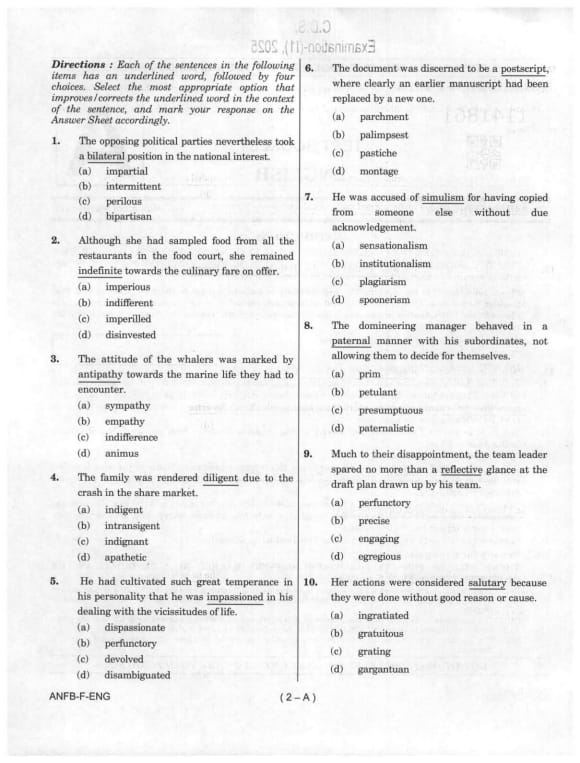
Directions: Each of the sentences in the following items has an underlined word, followed by four choices. Select the most appropriate option that improves/corrects the underlined word in the context of the sentence, and mark your response on the Answer Sheet accordingly.
Ques. 1 The opposing political parties nevertheless took a bilateral position in the national interest.
(a) impartial
(b) intermittent
(c) perilous
(d) bipartisan
Ans. (d)
Ques. 2 Although she had sampled food from all the restaurants in the food court, she remained indefinite towards the culinary fare on offer.
(a) imperious
(b) indifferent
(c) imperilled
(d) disinvested
Ans. (b)
Ques. 3 The attitude of the whalers was marked by antipathy towards the marine life they had to encounter.
(a) sympathy
(b) empathy
(c) indifference
(d) animus
Ans. (d)
Ques. 4 The family was rendered diligent due to the crash in the share market.
(a) indigent
(b) intransigent
(c) indignant
(d) apathetic
Ans. (a)
Ques. 5 He had cultivated such great temperance in his personality that he was impassioned in his dealing with the vicissitudes of life.
(a) dispassionate
(b) perfunctory
(c) devolved
(d) disambiguated
Ans. (a)
Ques. 6 The document was discerned to be a postscript, where clearly an earlier manuscript had been replaced by a new one.
(a) parchment
(b) palimpsest
(c) pastiche
(d) montage
Ans. (b)
Ques. 7 He was accused of simulism for having copied from someone else without due acknowledgement.
(a) sensationalism
(b) institutionalism
(c) plagiarism
(d) spoonerism
Ans. (c)
Ques. 8 The domineering manager behaved in a paternal manner with his subordinates, not allowing them to decide for themselves.
(a) prim
(b) petulant
(c) presumptuous
(d) paternalistic
Ans. (d)
Ques. 9 Much to their disappointment, the team leader spared no more than a reflective glance at the draft plan drawn up by his team.
(a) perfunctory
(b) precise
(c) engaging
(d) egregious
Ans. (a)
Ques. 10 Her actions were considered salutary because they were done without good reason or cause.
(a) ingratiated
(b) gratuitous
(c) grating
(d) gargantuan
Ans. (b)
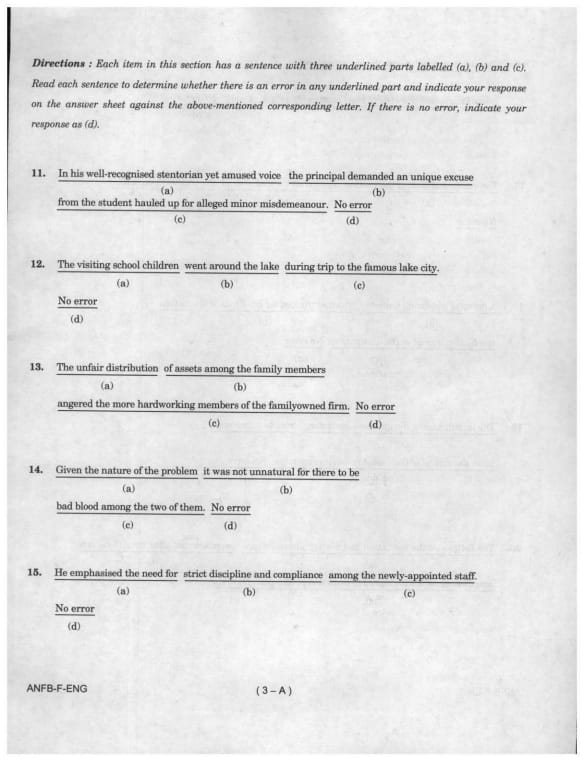
Directions: Each item in this section has a sentence with three underlined parts labelled (a), (b) and (c). Read each sentence to determine whether there is an error in any underlined part and indicate your response on the answer sheet against the above-mentioned corresponding letter. If there is no error, indicate your response as (d).
Ques. 11 In his well-recognised stentorian yet amused voice the principal demanded an unique excuse
(a) In his well-recognised stentorian yet amused voice
(b) the principal demanded an unique excuse
(c) from the student hauled up for alleged minor misdemeanour.
(d) No error
Ans. (b)
Ques. 12
The visiting school children went around the lake during trip to the famous lake city.
(a) The visiting school children
(b) went around the lake
(c) during trip to the famous lake city.
(d) No error
Ans. (c)
Ques. 13 The unfair distribution of assets among the family members
(a) The unfair distribution
(b) of assets among the family members
(c) angered the more hardworking members of the familyowned firm.
(d) No error
Ans. (c)
Ques. 14 Given the nature of the problem it was not unnatural for there to be
(a) Given the nature of the problem
(b) it was not unnatural for there to be
(c) bad blood among the two of them.
(d) No error
Ans. (c)
Ques. 15 He emphasised the need for strict discipline and compliance among the newly-appointed staff.
(a) He emphasised the need for
(b) strict discipline and compliance
(c) among the newly-appointed staff.
(d) No error
Ans. (d)
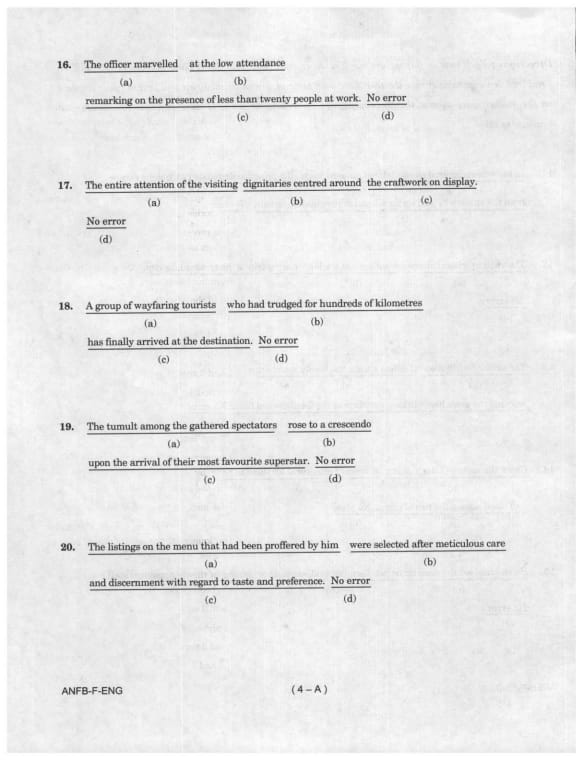
Ques. 16 The officer marvelled at the low attendance
(a) The officer marvelled
(b) at the low attendance
(c) remarking on the presence of less than twenty people at work.
(d) No error
Ans. (c)
Ques. 17 The entire attention of the visiting dignitaries centred around the craftwork on display.
(a) The entire attention of the visiting dignitaries
(b) centred around
(c) the craftwork on display.
(d) No error
Ans. (b)
Ques. 18 A group of wayfaring tourists who had trudged for hundreds of kilometres
(a) A group of wayfaring tourists
(b) who had trudged for hundreds of kilometres
(c) has finally arrived at the destination.
(d) No error
Ans. (d)
Ques. 19 The tumult among the gathered spectators rose to a crescendo
(a) The tumult among the gathered spectators
(b) rose to a crescendo
(c) upon the arrival of their most favourite superstar.
(d) No error
Ans. (c)
Ques. 20 The listings on the menu that had been proffered by him
(a) The listings on the menu that had been proffered by him
(b) were selected after meticulous care
(c) and discernment with regard to taste and preference.
(d) No error
Ans. (d)
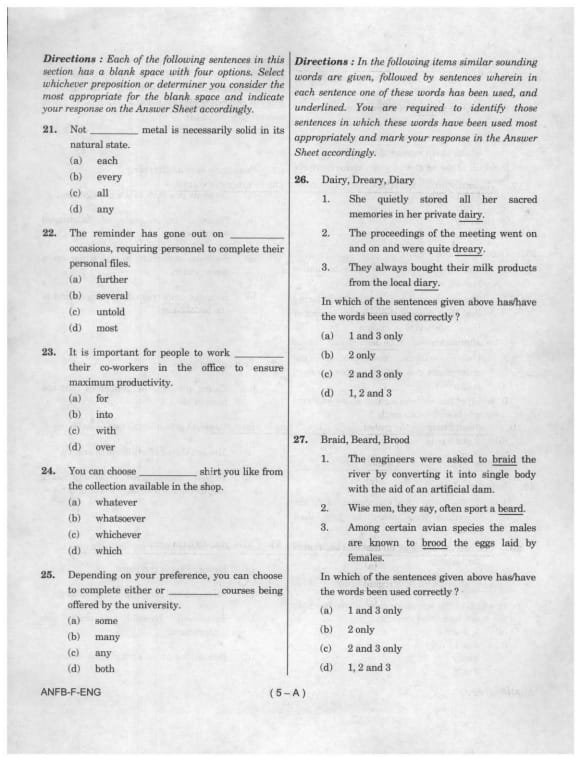
Directions: Each of the following sentences in this section has a blank space with four options. Select whichever preposition or determiner you consider the most appropriate for the blank space and indicate your response on the Answer Sheet accordingly.
Ques. 21 Not __________ metal is necessarily solid in its natural state.
(a) each
(b) every
(c) all
(d) any
Ans. (c)
Ques. 22 The reminder has gone out on __________ occasions, requiring personnel to complete their personal files.
(a) further
(b) several
(c) untold
(d) most
Ans. (b)
Ques. 23 It is important for people to work __________ their co-workers in the office to ensure maximum productivity.
(a) for
(b) into
(c) with
(d) over
Ans. (c)
Ques. 24 You can choose __________ shirt you like from the collection available in the shop.
(a) whatever
(b) whatsoever
(c) whichever
(d) which
Ans. (c)
Ques. 25 Depending on your preference, you can choose to complete either or __________ courses being offered by the university.
(a) some
(b) many
(c) any
(d) both
Ans. (d)
Directions: In the following items similar sounding words are given, followed by sentences wherein in each sentence one of these words has been used, and underlined. You are required to identify those sentences in which these words have been used most appropriately and mark your response in the Answer Sheet accordingly.
Ques. 26 Dairy, Dreary, Diary
1. She quietly stored all her sacred memories in her private dairy.
2. The proceedings of the meeting went on and on and were quite dreary.
3. They always bought their milk products from the local diary.
In which of the sentences given above has/have the words been used correctly?
(a) 1 and 3 only
(b) 2 only
(c) 2 and 3 only
(d) 1, 2 and 3
Ans. (b)
Ques. 27 Braid, Beard, Brood
1. The engineers were asked to braid the river by converting it into single body with the aid of an artificial dam.
2. Wise men, they say, often sport a beard.
3. Among certain avian species the males are known to brood the eggs laid by females.
In which of the sentences given above has/have the words been used correctly?
(a) 1 and 3 only
(b) 2 only
(c) 2 and 3 only
(d) 1, 2 and 3
Ans. (c)
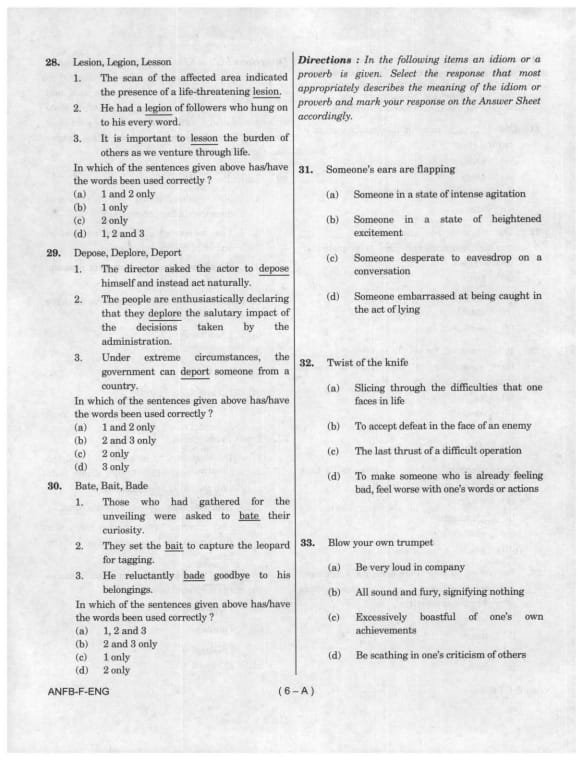
Ques. 28 Lesion, Legion, Lesson
1. The scan of the affected area indicated the presence of a life-threatening lesion.
2. He had a legion of followers who hung on to his every word.
3. It is important to lesson the burden of others as we venture through life.
In which of the sentences given above has/have the words been used correctly?
(a) 1 and 2 only
(b) 1 only
(c) 2 only
(d) 1, 2 and 3
Ans. (a)
Ques. 29 Depose, Deplore, Deport
1. The director asked the actor to depose himself and instead act naturally.
2. The people are enthusiastically declaring that they deplore the salutary impact of the decisions taken by the administration.
3. Under extreme circumstances, the government can deport someone from a country.
In which of the sentences given above has/have the words been used correctly?
(a) 1 and 2 only
(b) 2 and 3 only
(c) 2 only
(d) 3 only
Ans. (d)
Ques. 30 Bate, Bait, Bade
1. Those who had gathered for the unveiling were asked to bate their curiosity.
2. They set the bait to capture the leopard for tagging.
3. He reluctantly bade goodbye to his belongings.
In which of the sentences given above has/have the words been used correctly?
(a) 1, 2 and 3
(b) 2 and 3 only
(c) 1 only
(d) 2 only
Ans. (a)
Directions: In the following items an idiom or a proverb is given. Select the response that most appropriately describes the meaning of the idiom or proverb and mark your response on the Answer Sheet accordingly.
Ques. 31 Someone's ears are flapping
(a) Someone in a state of intense agitation
(b) Someone in a state of heightened excitement
(c) Someone desperate to eavesdrop on a conversation
(d) Someone embarrassed at being caught in the act of lying
Ans. (c)
Ques. 32 Twist of the knife
(a) Slicing through the difficulties that one faces in life
(b) To accept defeat in the face of an enemy
(c) The last thrust of a difficult operation
(d) To make someone who is already feeling bad, feel worse with one's words or actions
Ans. (d)
Ques. 33 Blow your own trumpet
(a) Be very loud in company
(b) All sound and fury, signifying nothing
(c) Excessively boastful of one's own achievements
(d) Be scathing in one's criticism of others
Ans. (c)
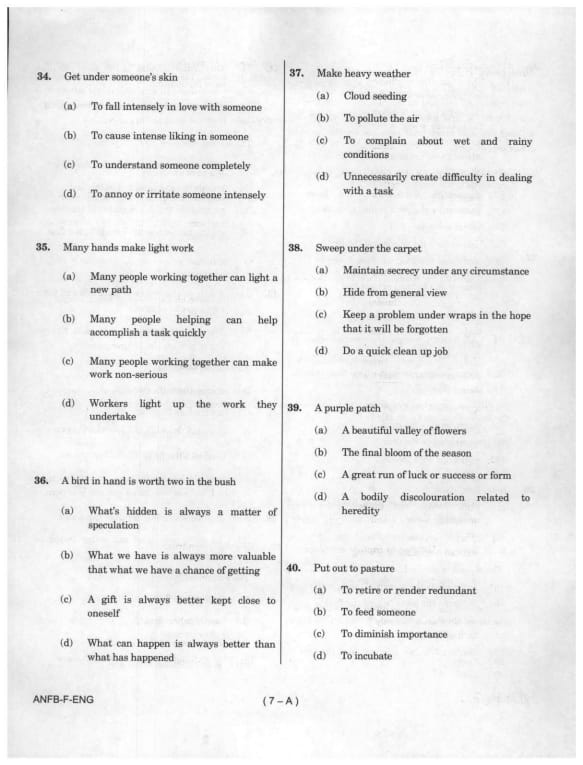
Ques. 34 Get under someone's skin
(a) To fall intensely in love with someone
(b) To cause intense liking in someone
(c) To understand someone completely
(d) To annoy or irritate someone intensely
Ans. (d)
Ques. 35 Many hands make light work
(a) Many people working together can light a new path
(b) Many people helping can help accomplish a task quickly
(c) Many people working together can make work non-serious
(d) Workers light up the work they undertake
Ans. (b)
Ques. 36 A bird in hand is worth two in the bush
(a) What's hidden is always a matter of speculation
(b) What we have is always more valuable that what we have a chance of getting
(c) A gift is always better kept close to oneself
(d) What can happen is always better than what has happened
Ans. (b)
Ques. 37 Make heavy weather
(a) Cloud seeding
(b) To pollute the air
(c) To complain about wet and rainy conditions
(d) Unnecessarily create difficulty in dealing with a task
Ans. (d)
Ques. 38 Sweep under the carpet
(a) Maintain secrecy under any circumstance
(b) Hide from general view
(c) Keep a problem under wraps in the hope that it will be forgotten
(d) Do a quick clean up job
Ans. (c)
Ques. 39 A purple patch
(a) A beautiful valley of flowers
(b) The final bloom of the season
(c) A great run of luck or success or form
(d) A bodily discolouration related to heredity
Ans. (c)
Ques. 40 Put out to pasture
(a) To retire or render redundant
(b) To feed someone
(c) To diminish importance
(d) To incubate
Ans. (a)
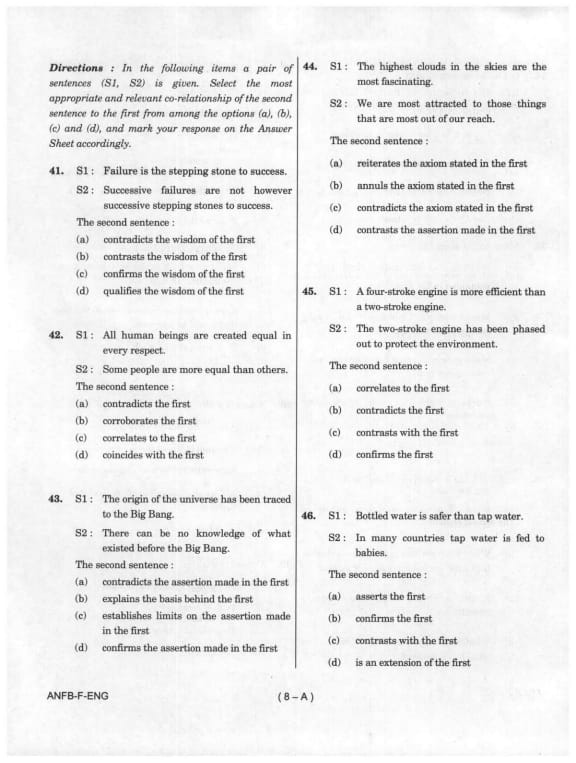
Directions: In the following items a pair of sentences (S1, S2) is given. Select the most appropriate and relevant co-relationship of the second sentence to the first from among the options (a), (b), (c) and (d), and mark your response on the Answer Sheet accordingly.
Ques. 41 S1: Failure is the stepping stone to success.
S2: Successive failures are not however successive stepping stones to success.
The second sentence:
(a) contradicts the wisdom of the first
(b) contrasts the wisdom of the first
(c) confirms the wisdom of the first
(d) qualifies the wisdom of the first
Ans. (d)
Ques. 42 S1: All human beings are created equal in every respect.
S2: Some people are more equal than others.
The second sentence:
(a) contradicts the first
(b) corroborates the first
(c) correlates to the first
(d) coincides with the first
Ans. (a)
Ques. 43 S1: The origin of the universe has been traced to the Big Bang.
S2: There can be no knowledge of what existed before the Big Bang.
The second sentence:
(a) contradicts the assertion made in the first
(b) explains the basis behind the first
(c) establishes limits on the assertion made in the first
(d) confirms the assertion made in the first
Ans. (c)
Ques. 44 S1: The highest clouds in the skies are the most fascinating.
S2: We are most attracted to those things that are most out of our reach.
The second sentence:
(a) reiterates the axiom stated in the first
(b) annuls the axiom stated in the first
(c) contradicts the axiom stated in the first
(d) contrasts the assertion made in the first
Ans. (a)
Ques. 45 S1: A four-stroke engine is more efficient than a two-stroke engine.
S2: The two-stroke engine has been phased out to protect the environment.
The second sentence:
(a) correlates to the first
(b) contradicts the first
(c) contrasts with the first
(d) confirms the first
Ans. (a)
Ques. 46 S1: Bottled water is safer than tap water.
S2: In many countries tap water is fed to babies.
The second sentence:
(a) asserts the first
(b) confirms the first
(c) contrasts with the first
(d) is an extension of the first
Ans. (c)
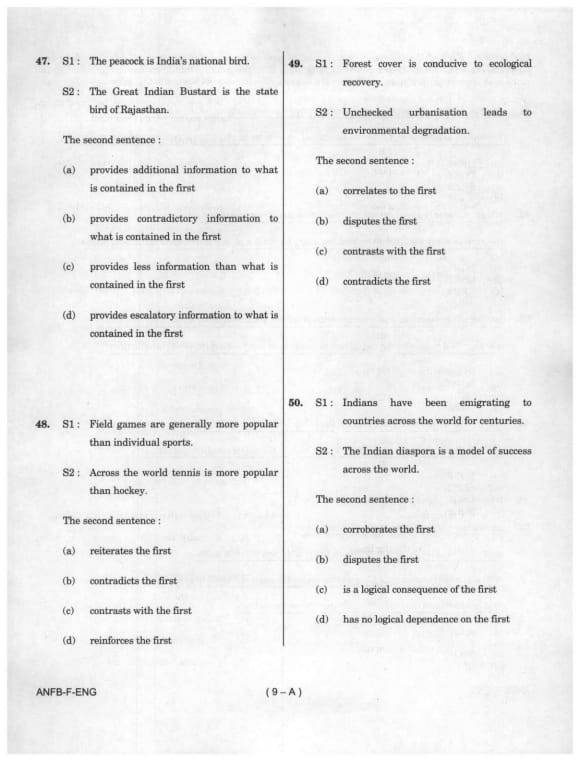
Ques. 47 S1: The peacock is India's national bird.
S2: The Great Indian Bustard is the state bird of Rajasthan.
The second sentence:
(a) provides additional information to what is contained in the first
(b) provides contradictory information to what is contained in the first
(c) provides less information than what is contained in the first
(d) provides escalatory information to what is contained in the first
Ans. (a)
Ques. 48 S1: Field games are generally more popular than individual sports.
S2: Across the world tennis is more popular than hockey.
The second sentence :
(a) reiterates the first
(b) contradicts the first
(c) contrasts with the first
(d) reinforces the first
Ans. (b)
Ques. 49 S1: Forest cover is conducive to ecological recovery.
S2: Unchecked urbanisation leads to environmental degradation.
The second sentence:
(a) correlates to the first
(b) disputes the first
(c) contrasts with the first
(d) contradicts the first
Ans. (c)
Ques. 50 S1: Indians have been emigrating to countries across the world for centuries.
S2: The Indian diaspora is a model of success across the world.
The second sentence:
(a) corroborates the first
(b) disputes the first
(c) is a logical consequence of the first
(d) has no logical dependence on the first
Ans. (c)
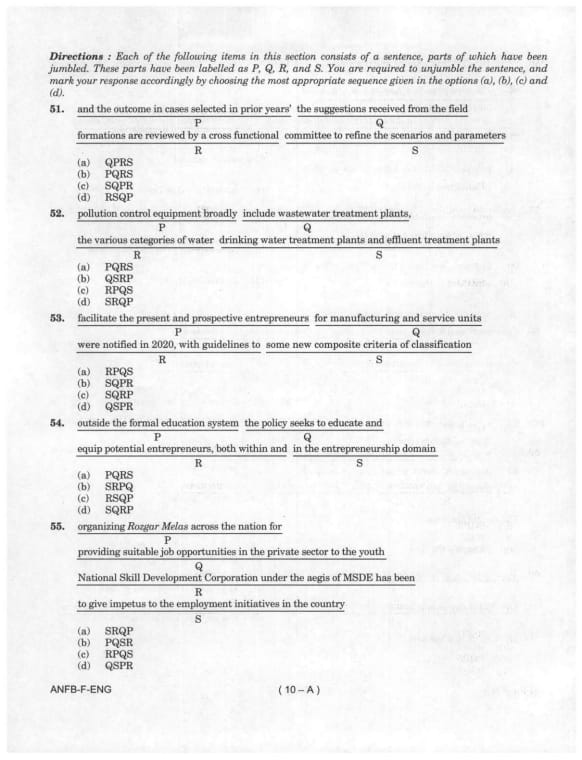
Directions: Each of the following items in this section consists of a sentence, parts of which have been jumbled. These parts have been labelled as P, Q, R, and S. You are required to unjumble the sentence, and mark your response accordingly by choosing the most appropriate sequence given in the options (a), (b), (c) and (d).
Ques. 51
(P) and the outcome in cases selected in prior years'
(Q) the suggestions received from the field
(R) formations are reviewed by a cross functional
(S) committee to refine the scenarios and parameters
(a) QPRS
(b) PQRS
(c) SQPR
(d) RSQP
Ans. (b)
Ques. 52
(P) pollution control equipment broadly
(Q) include wastewater treatment plants,
(R) the various categories of water
(S) drinking water treatment plants and effluent treatment plants
(a) PQRS
(b) QSRP
(c) RPQS
(d) SRQP
Ans. (b)
Ques. 53
(P) facilitate the present and prospective entrepreneurs
(Q) for manufacturing and service units
(R) were notified in 2020, with guidelines to
(S) some new composite criteria of classification
(a) RPQS
(b) SQPR
(c) SQRP
(d) QSPR
Ans. (b)
Ques. 54
(P) outside the formal education system
(Q) the policy seeks to educate and
(R) equip potential entrepreneurs, both within and
(S) in the entrepreneurship domain
(a) PQRS
(b) SRPQ
(c) RSQP
(d) SQRP
Ans. (c)
Ques. 55
(P) organizing Rozgar Melas across the nation for
(Q) providing suitable job opportunities in the private sector to the youth
(R) National Skill Development Corporation under the aegis of MSDE has been
(S) to give impetus to the employment initiatives in the country
(a) SRQP
(b) PQSR
(c) RPQS
(d) QSPR
Ans. (d)
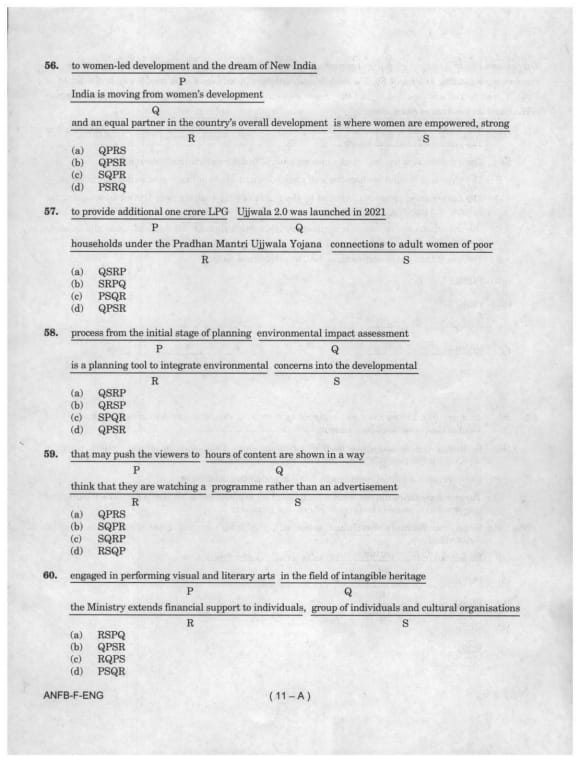
Ques. 56
(P) to women-led development and the dream of New India
(Q) India is moving from women's development
(R) and an equal partner in the country's overall development
(S) is where women are empowered, strong
(a) QPRS
(b) QPSR
(c) SQPR
(d) PSRQ
Ans. (a)
Ques. 57
(P) to provide additional one crore LPG
(Q) Ujjwala 2.0 was launched in 2021
(R) households under the Pradhan Mantri Ujjwala Yojana
(S) connections to adult women of poor
(a) QSRP
(b) SRPQ
(c) PSQR
(d) QPSR
Ans. (a)
Ques. 58
(P) process from the initial stage of planning
(Q) environmental impact assessment
(R) is a planning tool to integrate environmental
(S) concerns into the developmental
(a) QSRP
(b) QRSP
(c) SPQR
(d) QPSR
Ans. (b)
Ques. 59
(P) that may push the viewers to
(Q) hours of content are shown in a way
(R) think that they are watching a
(S) programme rather than an advertisement
(a) QPRS
(b) SQPR
(c) SQRP
(d) RSQP
Ans. (b)
Ques. 60
(P) engaged in performing visual and literary arts
(Q) in the field of intangible heritage
(R) the Ministry extends financial support to individuals,
(S) group of individuals and cultural organisations
(a) RSPQ
(b) QPSR
(c) RQPS
(d) PSQR
Ans. (c)
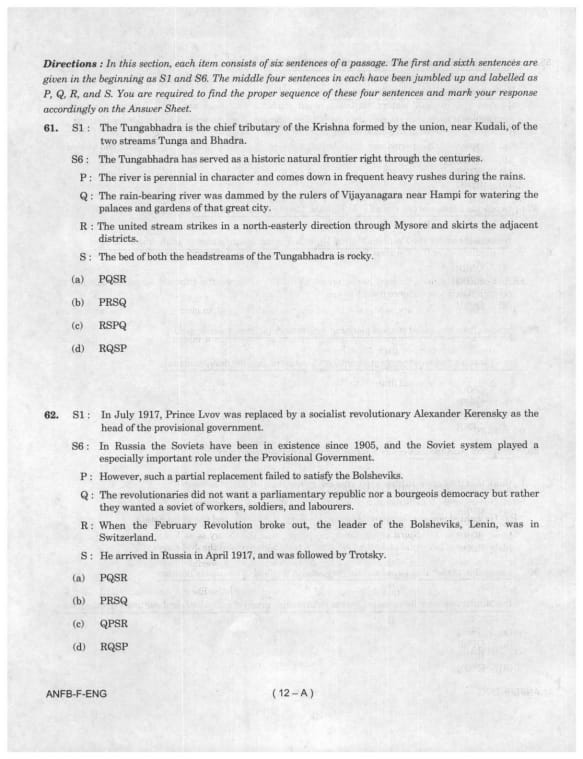
Directions: In this section, each item consists of six sentences of a passage. The first and sixth sentences are given in the beginning as S1 and S6. The middle four sentences in each have been jumbled up and labelled as P, Q, R, and S. You are required to find the proper sequence of these four sentences and mark your response accordingly on the Answer Sheet.
Ques. 61
S1: The Tungabhadra is the chief tributary of the Krishna formed by the union, near Kudali, of the two streams Tunga and Bhadra.
S6 : The Tungabhadra has served as a historic natural frontier right through the centuries.
P: The river is perennial in character and comes down in frequent heavy rushes during the rains.
Q : The rain-bearing river was dammed by the rulers of Vijayanagara near Hampi for watering the palaces and gardens of that great city.
R : The united stream strikes in a north-easterly direction through Mysore and skirts the adjacent districts.
S: The bed of both the headstreams of the Tungabhadra is rocky.
(a) PQSR
(b) PRSQ
(c) RSPQ
(d) RQSP
Ans. (c)
Ques. 62
S1: In July 1917, Prince Lvov was replaced by a socialist revolutionary Alexander Kerensky as the head of the provisional government.
S6: In Russia the Soviets have been in existence since 1905, and the Soviet system played a especially important role under the Provisional Government.
P: However, such a partial replacement failed to satisfy the Bolsheviks.
Q: The revolutionaries did not want a parliamentary republic nor a bourgeois democracy but rather they wanted a soviet of workers, soldiers, and labourers.
R: When the February Revolution broke out, the leader of the Bolsheviks, Lenin, was in Switzerland.
S: He arrived in Russia in April 1917, and was followed by Trotsky.
(a) PQSR
(b) PRSQ
(c) QPSR
(d) RQSP
Ans. (d)
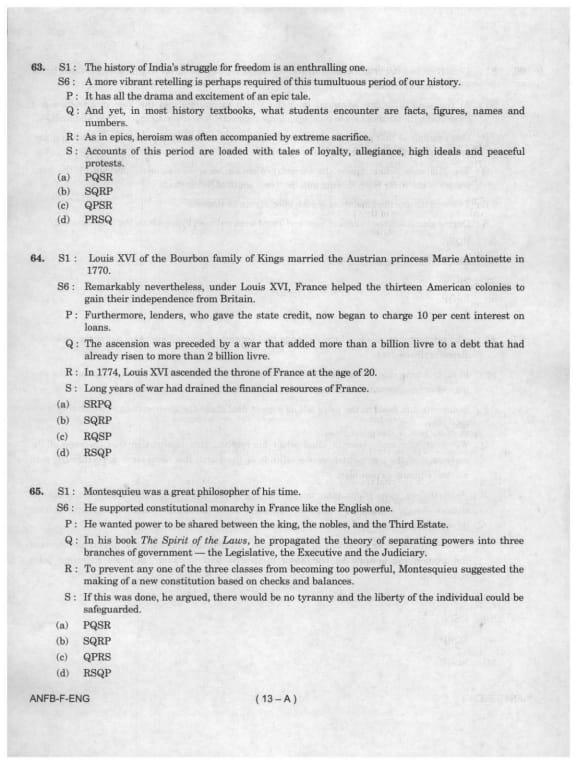
Ques. 63
S1: The history of India's struggle for freedom is an enthralling one.
S6: A more vibrant retelling is perhaps required of this tumultuous period of our history.
P: It has all the drama and excitement of an epic tale.
Q: And yet, in most history textbooks, what students encounter is facts, figures, names and numbers.
R: As in epics, heroism was often accompanied by extreme sacrifice.
S: Accounts of this period are loaded with tales of loyalty, allegiance, high ideals and peaceful protests.
(a) PQSR
(b) SQRP
(c) QPSR
(d) PRSQ
Ans. (d)
Ques. 64
S1: Louis XVI of the Bourbon family of Kings married the Austrian princess Marie Antoinette in 1770.
S6: Remarkably nevertheless, under Louis XVI, France helped the thirteen American colonies to gain their independence from Britain.
P: Furthermore, lenders, who gave the state credit, now began to charge 10 per cent interest on loans.
Q: The ascension was preceded by a war that added more than a billion livre to a debt that had already risen to more than 2 billion livre.
R: In 1774, Louis XVI ascended the throne of France at the age of 20.
S: Long years of war had drained the financial resources of France.
(a) SRPQ
(b) SQRP
(c) RQSP
(d) RSQP
Ans. (d)
Ques. 65
S1: Montesquieu was a great philosopher of his time.
S6: He supported constitutional monarchy in France like the English one.
P: He wanted power to be shared between the king, the nobles, and the Third Estate.
Q: In his book The Spirit of the Laws, he propagated the theory of separating powers into three branches of government the Legislative, the Executive and the Judiciary.
R: To prevent any one of the three classes from becoming too powerful, Montesquieu suggested the making of a new constitution based on checks and balances.
S: If this was done, he argued, there would be no tyranny and the liberty of the individual could be safeguarded.
(a) PQSR
(b) SQRP
(c) QPRS
(d) RSQP
Ans. (c)
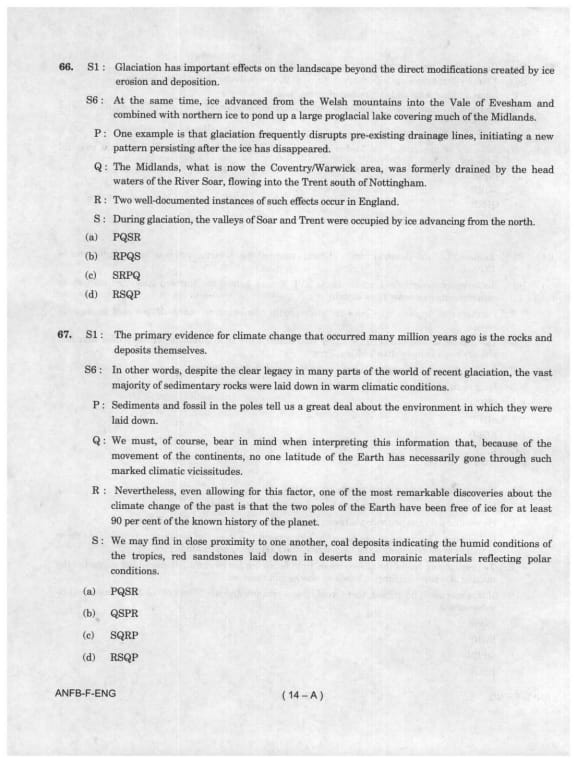
Ques. 66
S1: Glaciation has important effects on the landscape beyond the direct modifications created by ice erosion and deposition.
S6: At the same time, ice advanced from the Welsh mountains into the Vale of Evesham and combined with northern ice to pond up a large proglacial lake covering much of the Midlands.
P: One example is that glaciation frequently disrupts pre-existing drainage lines, initiating a new pattern persisting after the ice has disappeared.
Q: The Midlands, what is now the Coventry/Warwick area, was formerly drained by the head waters of the River Soar, flowing into the Trent south of Nottingham.
R: Two well-documented instances of such effects occur in England.
S: During glaciation, the valleys of Soar and Trent were occupied by ice advancing from the north.
(a) PQSR
(b) RPQS
(c) SRPQ
(d) RSQP
Ans. (a)
Ques. 67
S1: The primary evidence for climate change that occurred many million years ago is the rocks and deposits themselves.
S6: In other words, despite the clear legacy in many parts of the world of recent glaciation, the vast majority of sedimentary rocks were laid down in warm climatic conditions.
P: Sediments and fossil in the poles tell us a great deal about the environment in which they were laid down.
Q: We must, of course, bear in mind when interpreting this information that, because of the movement of the continents, no one latitude of the Earth has necessarily gone through such marked climatic vicissitudes.
R: Nevertheless, even allowing for this factor, one of the most remarkable discoveries about the climate change of the past is that the two poles of the Earth have been free of ice for at least 90 per cent of the known history of the planet.
S: We may find in close proximity to one another, coal deposits indicating the humid conditions of the tropics, red sandstones laid down in deserts and morainic materials reflecting polar conditions.
(a) PQSR
(b) QSPR
(c) SQRP
(d) RSQP
Ans. (b)
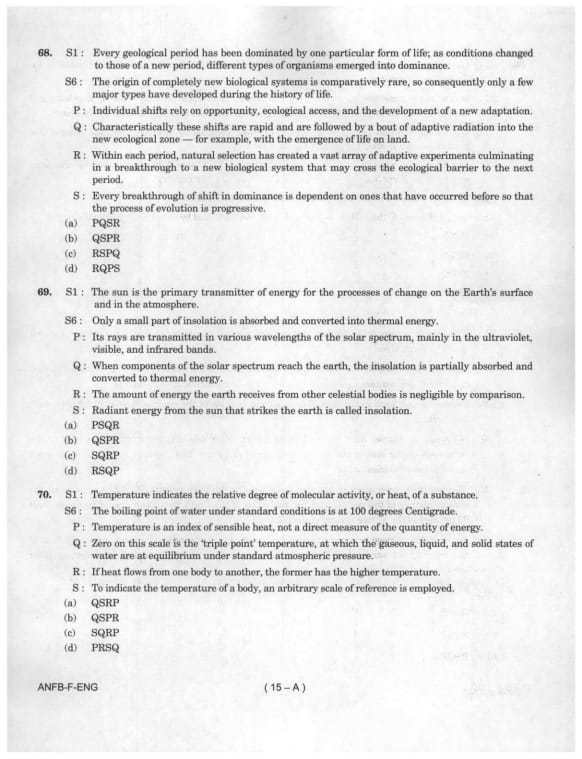
Ques. 68
S1: Every geological period has been dominated by one particular form of life; as conditions changed to those of a new period, different types of organisms emerged into dominance.
S6: The origin of completely new biological systems is comparatively rare, so consequently only a few major types have developed during the history of life.
P: Individual shifts rely on opportunity, ecological access, and the development of a new adaptation.
Q: Characteristically these shifts are rapid and are followed by a bout of adaptive radiation into the new ecological zone for example, with the emergence of life on land.
R: Within each period, natural selection has created a vast array of adaptive experiments culminating in a breakthrough to a new biological system that may cross the ecological barrier to the next period.
S: Every breakthrough of shift in dominance is dependent on ones that have occurred before so that the process of evolution is progressive.
(a) PQSR
(b) QSPR
(c) RSPQ
(d) RQPS
Ans. (c)
Ques. 69
S1: The sun is the primary transmitter of energy for the processes of change on the Earth's surface and in the atmosphere.
S6: Only a small part of insolation is absorbed and converted into thermal energy.
P: Its rays are transmitted in various wavelengths of the solar spectrum, mainly in the ultraviolet, visible, and infrared bands.
Q: When components of the solar spectrum reach the earth, the insolation is partially absorbed and converted to thermal energy.
R: The amount of energy the earth receives from other celestial bodies is negligible by comparison.
S: Radiant energy from the sun that strikes the earth is called insolation.
(a) PSQR
(b) QSPR
(c) SQRP
(d) RSQP
Ans. (d)
Ques. 70
S1: Temperature indicates the relative degree of molecular activity, or heat, of a substance.
S6: The boiling point of water under standard conditions is at 100 degrees Centigrade.
P: Temperature is an index of sensible heat, not a direct measure of the quantity of energy.
Q: Zero on this scale is the 'triple point' temperature, at which the gaseous, liquid, and solid states of water are at equilibrium under standard atmospheric pressure.
R: If heat flows from one body to another, the former has the higher temperature.
S: To indicate the temperature of a body, an arbitrary scale of reference is employed.
(a) QSRP
(b) QSPR
(c) SQRP
(d) PRSQ
Ans. (d)
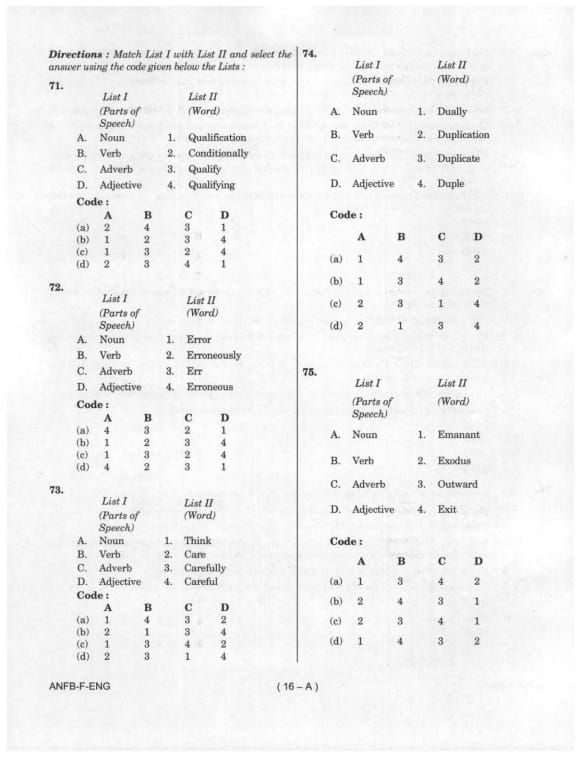
Directions: Match List I with List II and select the answer using the code given below the Lists:
Ques. 71
| List I (Parts of Speech) |
List II (Word) |
| A. Noun | 1. Qualification |
| B. Verb | 2. Conditionally |
| C. Adverb | 3. Qualify |
| D. Adjective | 4. Qualifying |
Code:
A B C D
(a) 2 4 3 1
(b) 1 2 3 4
(c) 1 3 2 4
(d) 2 3 4 1
Ans. (c)
Ques. 72
| List I (Parts of Speech) |
List II (Word) |
| A. Noun | 1. Error |
| B. Verb | 2. Erroneously |
| C. Adverb | 3. Err |
| D. Adjective | 4. Erroneous |
Code:
A B C D
(a) 4 3 2 1
(b) 1 2 3 4
(c) 1 3 2 4
(d) 4 2 3 1
Ans. (c)
Ques. 73
| List I (Parts of Speech) |
List II (Word) |
| A. Noun | 1. Think |
| B. Verb | 2. Care |
| C. Adverb | 3. Carefully |
| D. Adjective | 4. Careful |
Code:
A B C D
(a) 1 4 3 2
(b) 2 1 3 4
(c) 1 3 4 2
(d) 2 3 1 4
Ans. (b)
Ques. 74
| List I (Parts of Speech) |
List II (Word) |
| A. Noun | 1. Dually |
| B. Verb | 2. Duplication |
| C. Adverb | 3. Duplicate |
| D. Adjective | 4. Duple |
Code:
A B C D
(a) 1 4 3 2
(b) 1 3 4 2
(c) 2 3 1 4
(d) 2 1 3 4
Ans. (c)
Ques. 75
| List I (Parts of Speech) |
List II (Word) |
| A. Noun | 1. Emanant |
| B. Verb | 2. Exodus |
| C. Adverb | 3. Outward |
| D. Adjective | 4. Exit |
Code:
A B C D
(a) 1 3 4 2
(b) 2 4 3 1
(c) 2 3 4 1
(d) 1 4 3 2
Ans. (b)
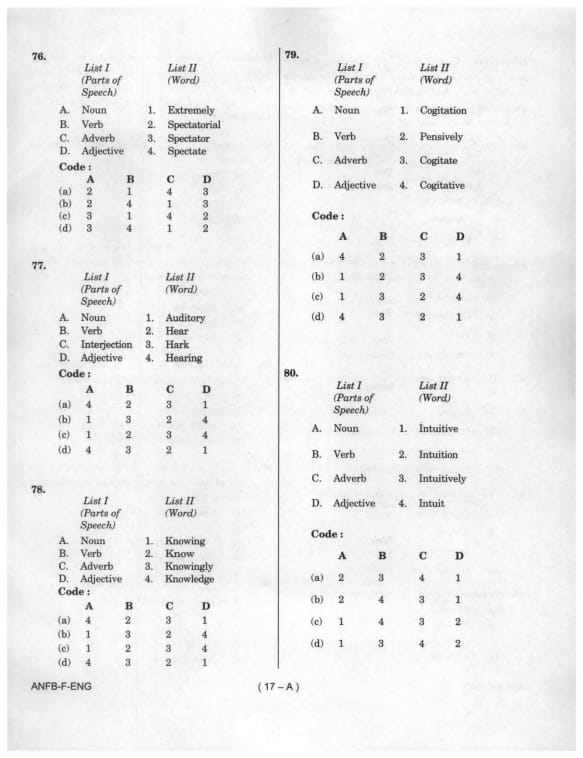
Ques. 76
| List I (Parts of Speech) |
List II (Word) |
| A. Noun | 1. Extremely |
| B. Verb | 2. Spectatorial |
| C. Adverb | 3. Spectator |
| D. Adjective | 4. Spectate |
Code:
A B C D
(a) 2 1 4 3
(b) 2 4 1 3
(c) 3 1 4 2
(d) 3 4 1 2
Ans. (d)
Ques. 77
| List I (Parts of Speech) |
List II (Word) |
| A. Noun | 1. Auditory |
| B. Verb | 2. Hear |
| C. Interjection | 3. Hark |
| D. Adjective | 4. Hearing |
Code:
A B C D
(a) 4 2 3 1
(b) 1 3 2 4
(c) 1 2 3 4
(d) 4 3 2 1
Ans. (a)
Ques. 78
| List I (Parts of Speech) |
List II (Word) |
| A. Noun | 1. Knowing |
| B. Verb | 2. Know |
| C. Adverb | 3. Knowingly |
| D. Adjective | 4. Knowledge |
Code:
A B C D
(a) 1 4 3 2
(b) 1 3 2 4
(c) 1 2 3 4
(d) 4 3 2 1
Ans. (d)
Ques. 79
| List I (Parts of Speech) |
List II (Word) |
| A. Noun | 1. Cogitation |
| B. Verb | 2. Pensively |
| C. Adverb | 3. Cogitate |
| D. Adjective | 4. Cogitative |
Code:
A B C D
(a) 4 2 3 1
(b) 1 2 3 4
(c) 1 3 2 4
(d) 4 3 2 1
Ans. (c)
Ques. 80
| List I (Parts of Speech) |
List II (Word) |
| A. Noun | 1. Intuitive |
| B. Verb | 2. Intuition |
| C. Adverb | 3. Intuitively |
| D. Adjective | 4. Intuit |
Code:
A B C D
(a) 2 3 4 1
(b) 2 4 3 1
(c) 1 4 3 2
(d) 1 3 4 2
Ans. (b)
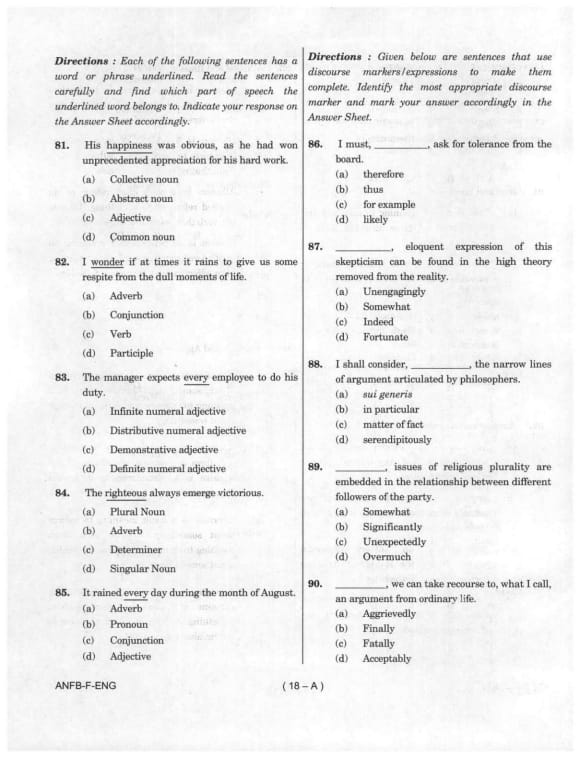
Directions: Each of the following sentences has a word or phrase underlined. Read the sentences carefully and find which part of speech the underlined word belongs to. Indicate your response on the Answer Sheet accordingly.
Ques. 81 His happiness was obvious, as he had won unprecedented appreciation for his hard work.
(a) Collective noun
(b) Abstract noun
(c) Adjective
(d) Common noun
Ans. (b)
Ques. 82 I wonder if at times it rains to give us some respite from the dull moments of life.
(a) Adverb
(b) Conjunction
(c) Verb
(d) Participle
Ans. (b)
Ques. 83 The manager expects every employee to do his duty.
(a) Infinite numeral adjective
(b) Distributive numeral adjective
(c) Demonstrative adjective
(d) Definite numeral adjective
Ans. (b)
Ques. 84 The righteous always emerge victorious.
(a) Plural Noun
(b) Adverb
(c) Determiner
(d) Singular Noun
Ans. (a)
Ques. 85 It rained every day during the month of August.
(a) Adverb
(b) Pronoun
(c) Conjunction
(d) Adjective
Ans. (a)
Directions: Given below are sentences that use discourse markers/expressions to make them complete. Identify the most appropriate discourse marker and mark your answer accordingly in the Answer Sheet.
Ques. 86 I must, __________ ask for tolerance from the board.
(a) therefore
(b) thus
(c) for example
(d) likely
Ans. (a)
Ques. 87 __________ eloquent expression of this skepticism can be found in the high theory removed from the reality.
(a) Unengagingly
(b) Somewhat
(c) Indeed
(d) Fortunate
Ans. (c)
Ques. 88 I shall consider, __________ the narrow lines of argument articulated by philosophers.
(a) sui generis
(b) in particular
(c) matter of fact
(d) serendipitously
Ans. (b)
Ques. 89 __________ issues of religious plurality are embedded in the relationship between different followers of the party.
(a) Somewhat
(b) Significantly
(c) Unexpectedly
(d) Overmuch
Ans. (b)
Ques. 90 __________ we can take recourse to, what I call, an argument from ordinary life.
(a) Aggrievedly
(b) Finally
(c) Fatally
(d) Acceptably
Ans. (b)
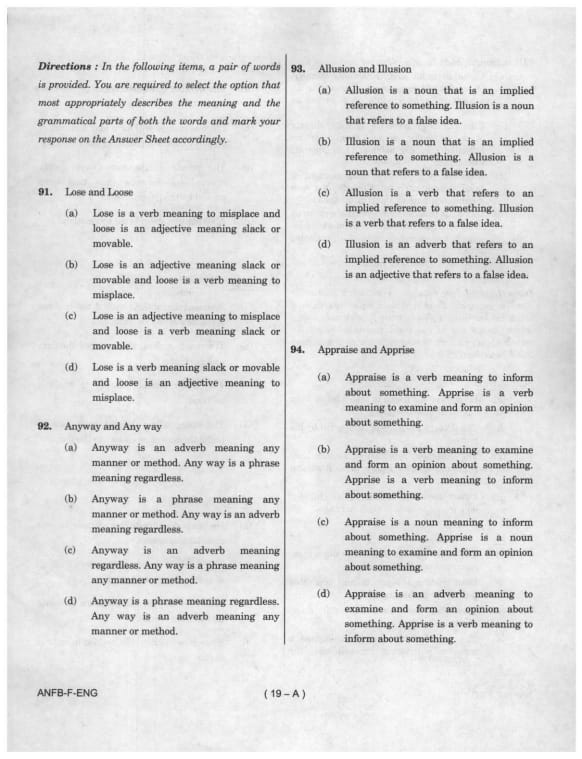
Directions: In the following items, a pair of words is provided. You are required to select the option that most appropriately describes the meaning and the grammatical parts of both the words and mark your response on the Answer Sheet accordingly.
Ques. 91 Lose and Loose
(a) Lose is a verb meaning to misplace and loose is an adjective meaning slack or movable.
(b) Lose is an adjective meaning slack or movable and loose is a verb meaning to misplace.
(c) Lose is an adjective meaning to misplace and loose is a verb meaning slack or movable.
(d) Lose is a verb meaning slack or movable and loose is an adjective meaning to misplace.
Ans. (a)
Ques. 92 Anyway and Any way
(a) Anyway is an adverb meaning any manner or method. Any way is a phrase meaning regardless.
(b) Anyway is a phrase meaning any manner or method. Any way is an adverb meaning regardless.
(c) Anyway is an adverb meaning regardless. Any way is a phrase meaning any manner or method.
(d) Anyway is a phrase meaning regardless. Any way is an adverb meaning any manner or method.
Ans. (c)
Ques. 93 Allusion and Illusion
(a) Allusion is a noun that is an implied reference to something. Illusion is a noun that refers to a false idea.
(b) Illusion is a noun that is an implied reference to something. Allusion is a noun that refers to a false idea.
(c) Allusion is a verb that refers to an implied reference to something. Illusion is a verb that refers to a false idea.
(d) Illusion is an adverb that refers to an implied reference to something. Allusion is an adjective that refers to a false idea.
Ans. (a)
Ques. 94 Appraise and Apprise
(a) Appraise is a verb meaning to inform about something. Apprise is a verb meaning to examine and form an opinion about something.
(b) Appraise is a verb meaning to examine and form an opinion about something. Apprise is a verb meaning to inform about something.
(c) Appraise is a noun meaning to inform about something. Apprise is a noun meaning to examine and form an opinion about something.
(d) Appraise is an adverb meaning to examine and form an opinion about something. Apprise is a verb meaning to inform about something.
Ans. (b)
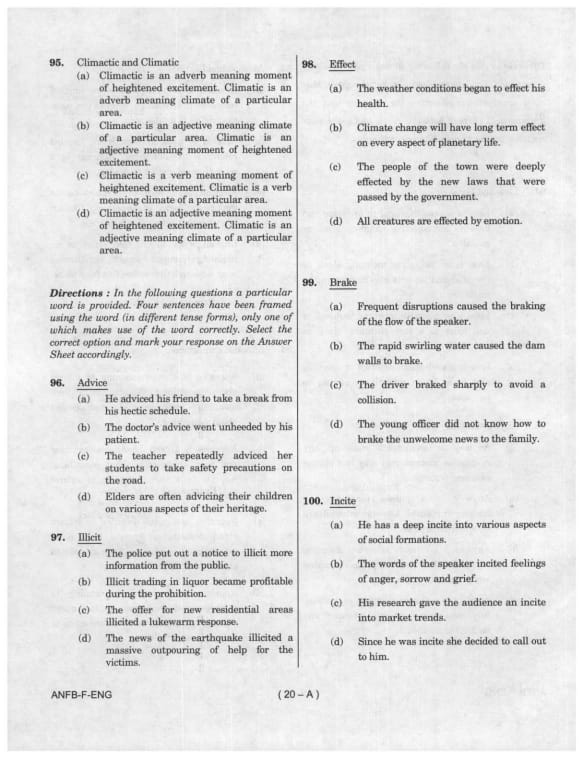
Ques. 95 Climactic and Climatic
(a) Climactic is an adverb meaning moment of heightened excitement. Climatic is an adverb meaning climate of a particular area.
(b) Climactic is an adjective meaning climate of a particular area. Climatic is an adjective meaning moment of heightened excitement.
(c) Climactic is a verb meaning moment of heightened excitement. Climatic is a verb meaning climate of a particular area.
(d) Climactic is an adjective meaning moment of heightened excitement. Climatic is an adjective meaning climate of a particular area.
Ans. (d)
Directions: In the following questions a particular word is provided. Four sentences have been framed using the word (in different tense forms), only one of which makes use of the word correctly. Select the correct option and mark your response on the Answer Sheet accordingly.
Ques. 96 Advice (Noun)
(a) He adviced his friend to take a break from his hectic schedule.
(b) The doctor's advice went unheeded by his patient.
(c) The teacher repeatedly adviced her students to take safety precautions on the road.
(d) Elders are often advicing their children on various aspects of their heritage.
Ans. (b)
Ques. 97 Illicit
(a) The police put out a notice to illicit more information from the public.
(b) Illicit trading in liquor became profitable during the prohibition.
(c) The offer for new residential areas illicited a lukewarm response.
(d) The news of the earthquake illicited a massive outpouring of help for the victims.
Ans. (b)
Ques. 98 Effect
(a) The weather conditions began to effect his health.
(b) Climate change will have long term effect on every aspect of planetary life.
(c) The people of the town were deeply effected by the new laws that were passed by the government.
(d) All creatures are effected by emotion.
Ans. (b)
Ques. 99 Brake
(a) Frequent disruptions caused the braking of the flow of the speaker.
(b) The rapid swirling water caused the dam walls to brake.
(c) The driver braked sharply to avoid a collision.
(d) The young officer did not know how to brake the unwelcome news to the family.
Ans. (c)
Ques. 100 Incite
(a) He has a deep incite into various aspects of social formations.
(b) The words of the speaker incited feelings of anger, sorrow and grief.
(c) His research gave the audience an incite into market trends.
(d) Since he was incite she decided to call out to him.
Ans. (b)
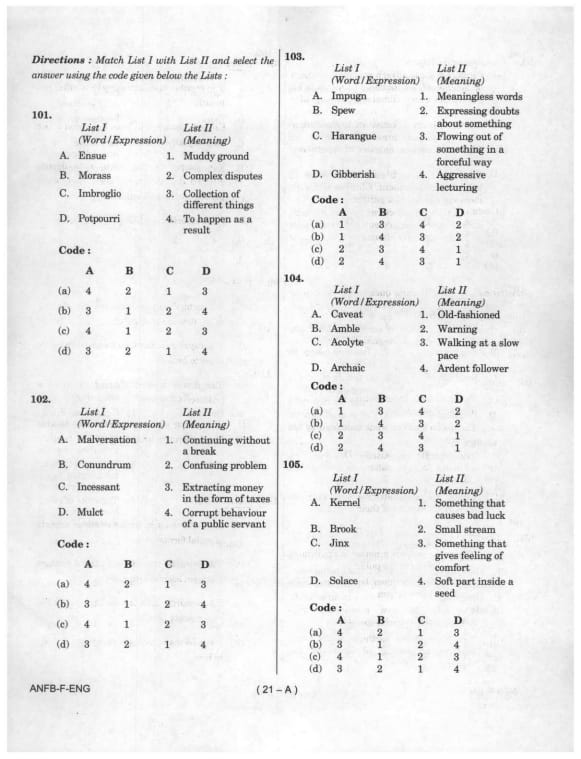
Directions: Match List I with List II and select the answer using the code given below the Lists:
Ques. 101
| List I (Word/Expression) |
List II (Meaning) |
| A. Ensue | 1. Muddy ground |
| B. Morass | 2. Complex disputes |
| C. Imbroglio | 3. Collection of different things |
| D. Potpourri | 4. To happen as a result |
Code:
A B C D
(a) 4 2 1 3
(b) 3 1 2 4
(c) 4 1 2 3
(d) 3 2 1 4
Ans. (c)
Ques. 102
| List I (Word/Expression) |
List II (Meaning) |
| A. Malversation | 1. Continuing without a break |
| B. Conundrum | 2. Confusing problem |
| C. Incessant | 3. Extracting money in the form of taxes |
| D. Mulct | 4. Corrupt behaviour of a public servant |
Code:
A B C D
(a) 4 2 1 3
(b) 3 1 2 4
(c) 4 1 2 3
(d) 3 2 1 4
Ans. (a)
Ques. 103
| List I (Word/Expression) |
List II (Meaning) |
| A. Impugn | 1. Meaningless words |
| B. Spew | 2. Expressing doubts about something |
| C. Harangue | 3. Flowing out of something in a forceful way |
| D. Gibberish | 4. Aggressive lecturing |
Code:
A B C D
(a) 1 3 4 2
(b) 1 4 3 2
(c) 2 3 4 1
(d) 2 4 3 1
Ans. (c)
Ques. 104
| List I (Word/Expression) |
List II (Meaning) |
| A. Caveat | 1. Old-fashioned |
| B. Amble | 2. Warning |
| C. Acolyte | 3. Walking at a slow pace |
| D. Archaic | 4. Ardent follower |
Code:
A B C D
(a) 1 3 4 2
(b) 1 4 3 2
(c) 2 3 4 1
(d) 2 4 3 1
Ans. (c)
Ques. 105
| List I (Word/Expression) |
List II (Meaning) |
| A. Kernel | 1. Something that causes bad luck |
| B. Brook | 2. Small stream |
| C. Jinx | 3. Something that gives feeling of comfort |
| D. Solace | 4. Soft part inside a seed |
Code:
A B C D
(a) 4 2 1 3
(b) 3 1 2 4
(c) 4 1 2 3
(d) 3 2 1 4
Ans. (a)
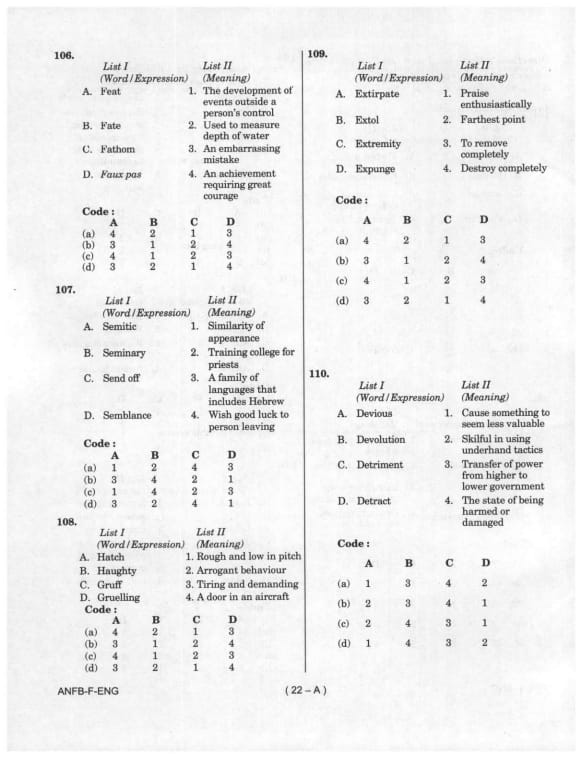
Ques. 106
| List I (Word/Expression) |
List II (Meaning) |
| A. Feat | 1. The development of events outside a person's control |
| B. Fate | 2. Used to measure depth of water |
| C. Fathom | 3. An embarrassing mistake |
| D. Faux pas | 4. An achievement requiring great courage |
Code:
A B C D
(a) 4 2 1 3
(b) 3 1 2 4
(c) 4 1 2 3
(d) 3 2 1 4
Ans. (c)
Ques. 107
| List I (Word/Expression) |
List II (Meaning) |
| A. Semitic | 1. Similarity of appearance |
| B. Seminary | 2. Training college for priests |
| C. Send off | 3. A family of languages that includes Hebrew |
| D. Semblance | 4. Wish good luck to person leaving |
Code:
A B C D
(a) 1 2 4 3
(b) 3 4 2 1
(c) 1 4 2 3
(d) 3 2 4 1
Ans. (d)
Ques. 108
| List I (Word/Expression) |
List II (Meaning) |
| A. Hatch | 1. Rough and low in pitch |
| B. Haughty | 2. Arrogant behaviour |
| C. Gruff | 3. Tiring and demanding |
| D. Gruelling | 4. A door in an aircraft |
Code:
A B C D
(a) 4 2 1 3
(b) 3 1 2 4
(c) 4 1 2 3
(d) 3 2 1 4
Ans. (a)
Ques. 109
| List I (Word/Expression) |
List II (Meaning) |
| A. Extirpate | 1. Praise enthusiastically |
| B. Extol | 2. Farthest point |
| C. Extremity | 3. To remove completely |
| D. Expunge | 4. Destroy completely |
Code:
A B C D
(a) 4 2 3 1
(b) 1 2 3 4
(c) 1 3 2 4
(d) 4 3 2 1
Ans. (a)
Ques. 110
| List I (Word/Expression) |
List II (Meaning) |
| A. Devious | 1. Cause something to seem less valuable |
| B. Devolution | 2. Skilful in using underhand tactics |
| C. Detriment | 3. Transfer of power from higher to lower government |
| D. Detract | 4. The state of being harmed or damaged |
Code:
A B C D
(a) 1 3 4 2
(b) 2 3 4 1
(c) 2 4 3 1
(d) 1 4 3 2
Ans. (b)
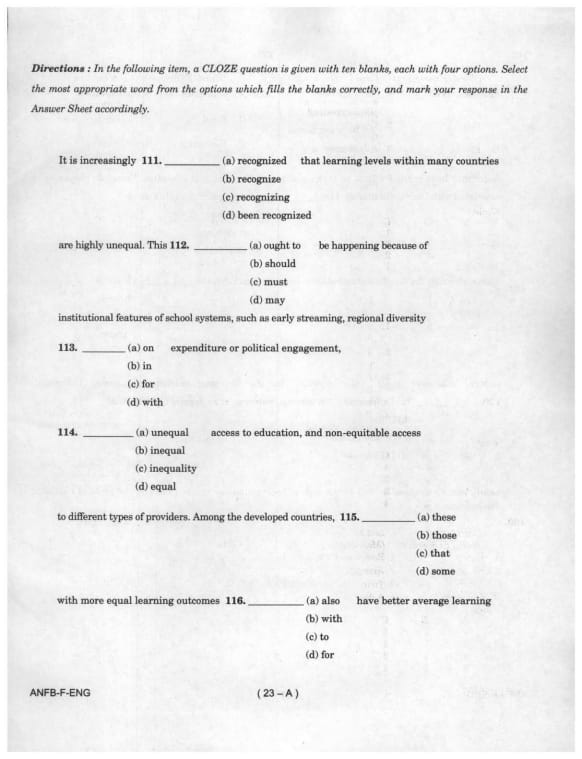
Directions: In the following item, a CLOZE question is given with ten blanks, each with four options. Select the most appropriate word from the options which fills the blanks correctly, and mark your response in the Answer Sheet accordingly.
Ques. 111 It is increasingly __________ that learning levels within many countries are highly unequal.
(a) recognized
(b) recognize
(c) recognizing
(d) been recognized
Ans. (a)
Ques. 112 This __________ be happening because of institutional features of school systems, such as early streaming, regional diversity
(a) ought to
(b) should
(c) must
(d) may
Ans. (d)
Ques. 113 regional diversity __________ expenditure or political engagement,
(a) on
(b) in
(c) for
(d) with
Ans. (b)
Ques. 114 __________ access to education, and non-equitable access
(a) unequal
(b) inequal
(c) inequality
(d) equal
Ans. (a)
Ques. 115 Among the developed countries, __________ with more equal learning outcomes
(a) these
(b) those
(c) that
(d) some
Ans. (b)
Ques. 116 with more equal learning outcomes __________ have better average learning
(a) also
(b) with
(c) to
(d) for
Ans. (a)
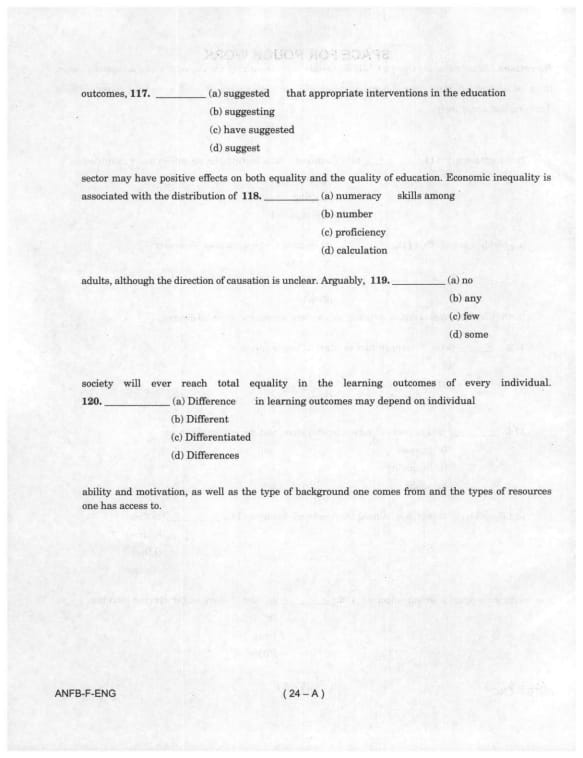
Ques. 117 outcomes, __________ that appropriate interventions in the education
(a) suggested
(b) suggesting
(c) have suggested
(d) suggest
Ans. (b)
Ques. 118 Economic inequality is associated with the distribution of __________ skills among adults
(a) numeracy
(b) number
(c) proficiency
(d) calculation
Ans. (a)
Ques. 119 Arguably, __________ society will ever reach total equality in the learning outcomes of every individual.
(a) no
(b) any
(c) few
(d) some
Ans. (a)
Ques. 120 __________ in learning outcomes may depend on individual ability and motivation
(a) Difference
(b) Different
(c) Differentiated
(d) Differences
Ans. (d)




CDS 2025 exam pattern consists of three papers for the Indian Military Academy, Indian Naval Academy, and Air Force Academy (English, General Knowledge, and Elementary Mathematics) – each of 100 marks, total 300 marks. For OTA (Officers’ Training Academy), only two papers (English and General Knowledge) are conducted, with a total of 200 marks.
CDS Year Wise Question Paper
Download the PREPP App and attempt FREE CDS Mock Tests and get complete study material!
Full Test - 01 : UPSC CDS (Elementary Mathematics)

Full Test - 02 : UPSC CDS (General Knowledge)
CDS 1 2026 GK Question Paper (12-Apr-2026)
CDS 1 2026 English Question Paper (12-Apr-2026)

17 February 2025 | The Hindu Must Read Articles | Current Affairs

16 February 2026 | The Hindu Must Read Articles | Current Affairs

13 February 2026 | The Hindu Must Read Articles | Current Affairs









Comments