Agriculture Optional Paper 1 Question Paper 2025 with Detailed Solution; Download PDF
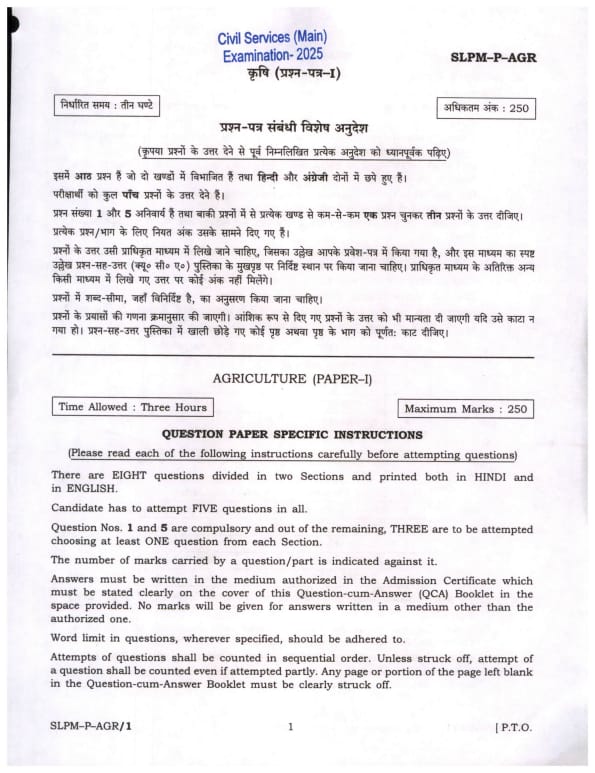
UPSC Mains 2025 Question Paper for Agriculture Optional Paper 1 is available here to download in PDF Format. The exam has been conducted on August 31, 2025, in Afternoon Session (09:00 PM to 12:00 Noon). This Paper comprises 8 questions which are of 250 marks. The duration of the exam is 3 hours.
UPSC Mains Agriculture Optional Paper 1 Question Paper 2025 with Detailed Solution; Download PDF (August 31, 2025)
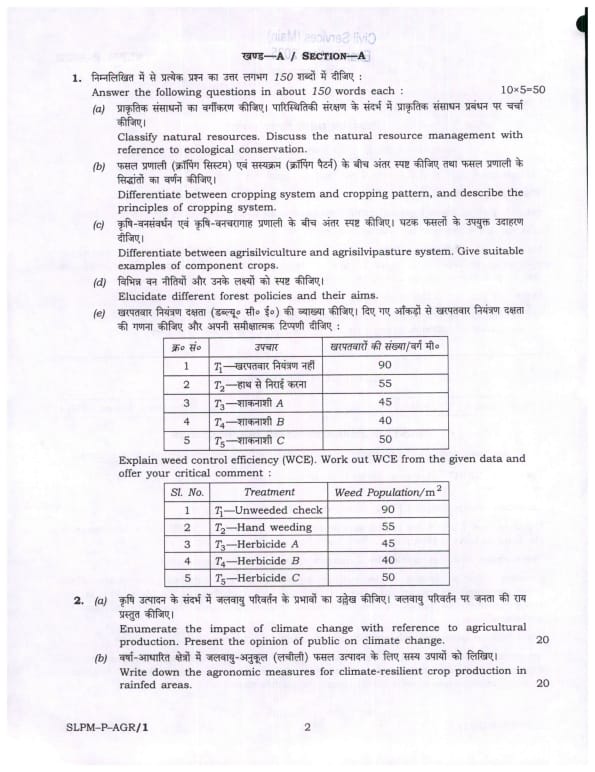
Q1 (A) Classify natural resources. Discuss the natural resource management with reference to ecological conservation.
Q1 (B) Differentiate between cropping system and cropping pattern, and describe the principles of cropping system.
Q1 (C) Differentiate between agrisilviculture and agrisilvipasture system. Give suitable examples of component crops.
Q1 (D) Elucidate different forest policies and their aims.
Q1 (E) Explain weed control efficiency (WCE). Work out WCE from the given data and offer your critical comment :
Q2 (A) Enumerate the impact of climate change with reference to agricultural production. Present the opinion of public on climate change.
Q2 (B) Write down the agronomic measures for climate-resilient crop production in rainfed areas.
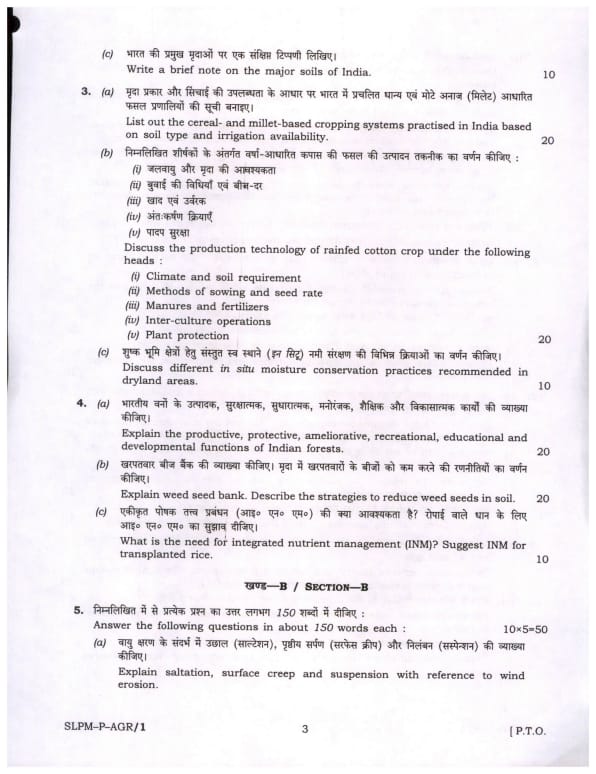
Q2 (C) Write a brief note on the major soils of India.
Q3 (A) List out the cereal- and millet-based cropping systems practised in India based on soil type and irrigation availability.
Q3 (B)
Discuss the production technology of rainfed cotton crop under the following heads :
(i) Climate and soil requirement
(ii) Methods of sowing and seed rate
(iii) Manures and fertilizers
(iv) Inter-culture operations
(v) Plant protection
Q3 (C) Discuss different in situ moisture conservation practices recommended in dryland areas.
Q4 (A) Explain the productive, protective, ameliorative, recreational, educational and developmental functions of Indian forests.
Q4 (B) Explain weed seed bank. Describe the strategies to reduce weed seeds in soil.
Q4 (C) What is the need for integrated nutrient management (INM)? Suggest INM for transplanted rice.
Q5 (A) Explain saltation, surface creep and suspension with reference to wind erosion.
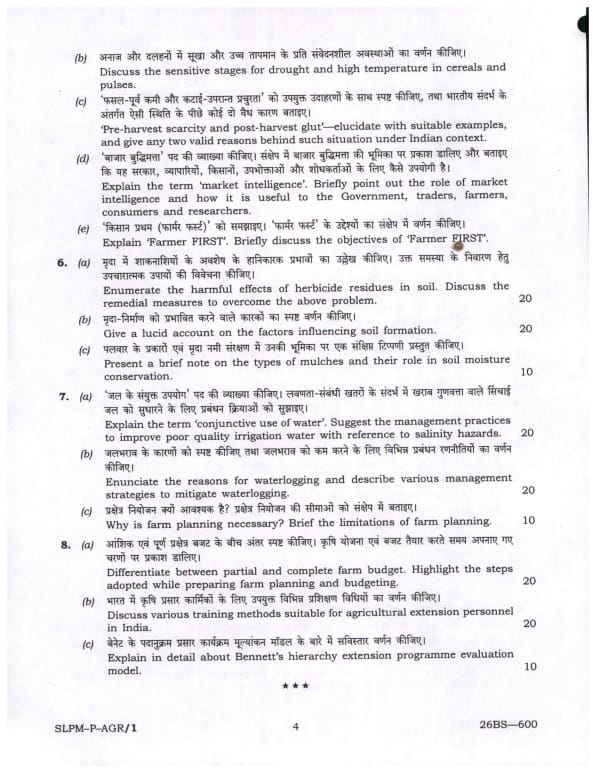
Q5 (B) Discuss the sensitive stages for drought and high temperature in cereals and pulses.
Q5 (C) Pre-harvest scarcity and post-harvest glut'-elucidate with suitable examples,and give any two valid reasons behind such situation under Indian context.
Q5 (D) Explain the term 'market intelligence'. Briefly point out the role of market intelligence and how it is useful to the Government, traders, farmers, consumers and researchers.
Q5 (E) Explain 'Farmer FIRST'. Briefly discuss the objectives of 'Farmer FIRST'.
Q6 (A) Enumerate the harmful effects of herbicide residues in soil. Discuss the remedial measures to overcome the above problem.
Q6 (B) Give a lucid account on the factors influencing soil formation.
Q6 (C) Present a brief note on the types of mulches and their role in soil moisture conservation.
Q7 (A) Explain the term 'conjunctive use of water'. Suggest the management practices to improve poor quality irrigation water with reference to salinity hazards.
Q7 (B) Enunciate the reasons for waterlogging and describe various management strategies to mitigate waterlogging.
Q7 (C) Why is farm planning necessary? Brief the limitations of farm planning.
Q8 (A) Differentiate between partial and complete farm budget. Highlight the steps adopted while preparing farm planning and budgeting.
Q8 (B) Discuss various training methods suitable for agricultural extension personnel in India.
Q8 (C) Explain in detail about Bennett's hierarchy extension programme evaluation model.
UPSC Previous Year Question Papers
Other Relevant Articles
| UPSC IAS Exam Syllabus | UPSC IAS Exam Pattern | UPSC IAS Exam Current Affairs |
| UPSC IAS Exam Study Materials | UPSC IAS Mock Test Series | UPSC IAS Salary |
Check the latest Government Recruitment News here.
Join Prepp Telegram Channel today for further updates.
Download the PREPP App and attempt FREE IAS Exam Mock Tests and get complete study material!

UPSC Civil Services Prelims General Studies Mini Mock Test 2
UPSC Civil Services Prelims General Studies Mini Mock Test 1

Industries Class 8 NCERT | Geography for UPSC CSE 2026 | Complete Chapter Analysis
Agriculture Explained | NCERT Class 8 Geography Ch-4 | UPSC CSE Prelims & Mains 2026

Why Private Sector Investment is Falling? | Economic Crisis Explained for UPSC







Comments