Botany Optional Paper 1 Question Paper 2025 with Detailed Solution; Download PDF
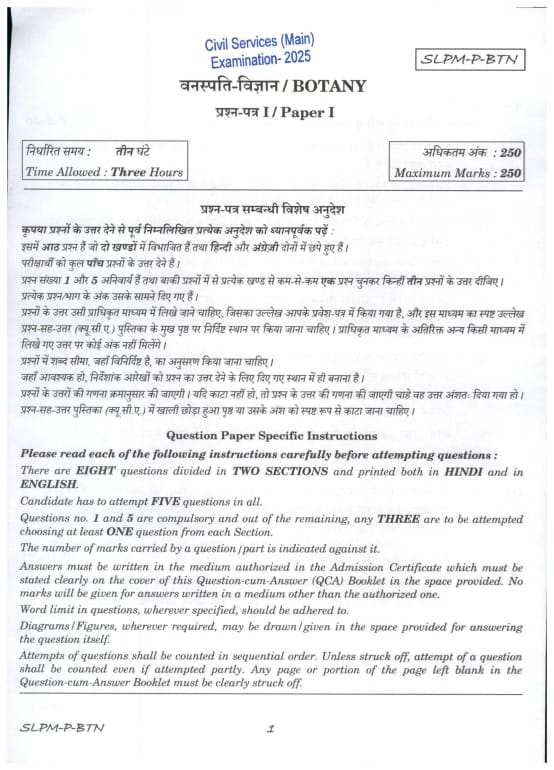
UPSC Mains 2025 Question Paper for Botany Optional Paper 1 is available here to download in PDF Format. The exam has been conducted on August 31, 2025, in Afternoon Session (09:00 PM to 12:00 Noon). This Paper comprises 8 questions which are of 250 marks. The duration of the exam is 3 hours.
UPSC Mains Botany Optional Paper 1 Question Paper 2025 with Detailed Solution; Download PDF (August 31, 2025)
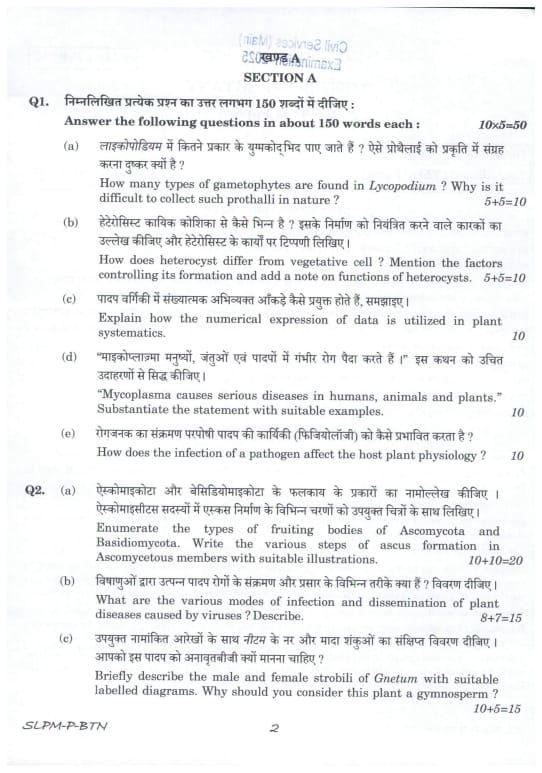
Q1 (A) How many types of gametophytes are found in Lycopodium? Why is it difficult to collect such prothalli in nature?
Q1 (B) How does heterocyst differ from vegetative cell ? Mention the factors controlling its formation and add a note on functions of heterocysts.
Q1 (C) Explain how the numerical expression of data is utilized in plant systematics.
Q1 (D) "Mycoplasma causes serious diseases in humans, animals and plants." Substantiate the statement with suitable examples.
Q1 (E) How does the infection of a pathogen affect the host plant physiology?
Q2 (A) Enumerate the types of fruiting bodies of Ascomycota and Basidiomycota. Write the various steps of ascus formation in Ascomycetous members with suitable illustrations.
Q2 (B) What are the various modes of infection and dissemination of plant diseases caused by viruses ? Describe.
Q2 (C) Briefly describe the male and female strobili of Gnetum with suitable labelled diagrams. Why should you consider this plant a gymnosperm?
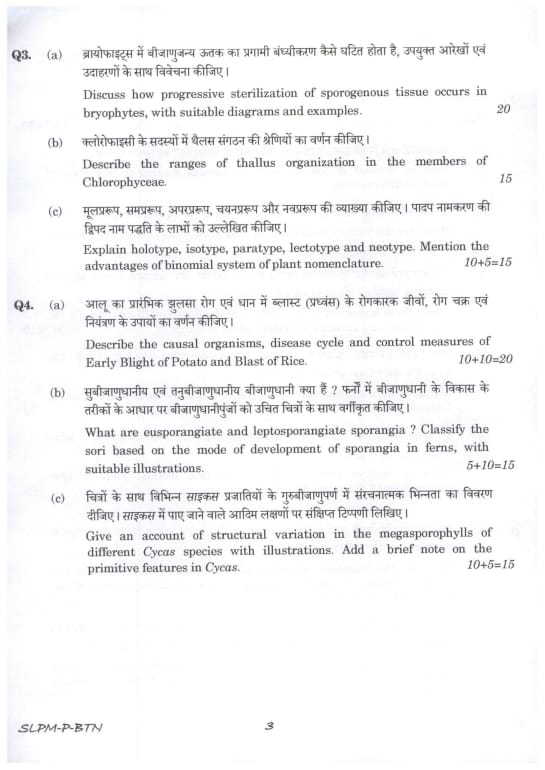
Q3 (A) Discuss how progressive sterilization of sporogenous tissue occurs in bryophytes, with suitable diagrams and examples.
Q3 (B) Describe the ranges of thallus organization in the members of Chlorophyceae.
Q3 (C) Explain holotype, isotype, paratype, lectotype and neotype. Mention the advantages of binomial system of plant nomenclature.
Q4 (A) Describe the causal organisms, disease cycle and control measures of Early Blight of Potato and Blast of Rice.
Q4 (B) What are eusporangiate and leptosporangiate sporangia? Classify the sori based on the mode of development of sporangia in ferns, with suitable illustrations.
Q4 (C) Give an account of structural variation in the megasporophylls of different Cycas species with illustrations. Add a brief note on the primitive features in Cycas.
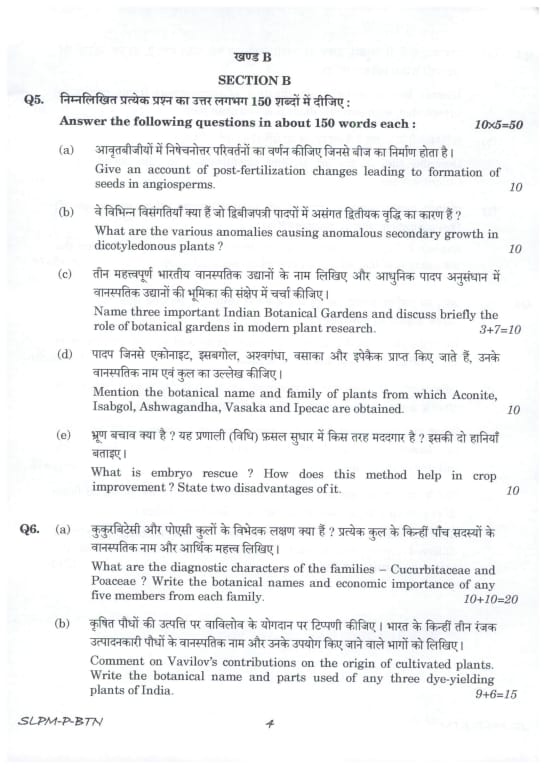
Q5 (A) Give an account of post-fertilization changes leading to formation of seeds in angiosperms.
Q5 (B) What are the various anomalies causing anomalous secondary growth in dicotyledonous plants?
Q5 (C) Name three important Indian Botanical Gardens and discuss briefly the role of botanical gardens in modern plant research.
Q5 (D) Mention the botanical name and family of plants from which Aconite, Isabgol, Ashwagandha, Vasaka and Ipecac arere obtained.
Q5 (E) What is embryo rescue? How does this method help in crop improvement? State two disadvantages of it.
Q6 (A) What are the diagnostic characters of the families - Cucurbitaceae and Poaceae ? Write the botanical names and economic importance of any five members from each family.
Q6 (B) Comment on Vavilov's contributions on the origin of cultivated plants. Write the botanical name and parts used of any three dye-yielding plants of India.
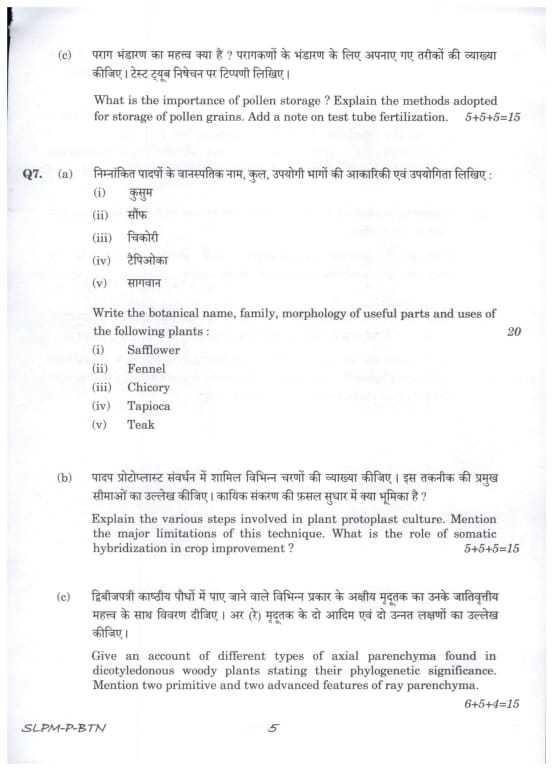
Q6 (C) What is the importance of pollen storage ? Explain the methods adopted for storage of pollen grains. Add a note on test tube fertilization.
Q7 (A)
Write the botanical name, family, morphology of useful parts and uses of
the following plants:
(i) Safflower
(ii) Fennel
(iii) Chicory
(iv) Tapioca
(v) Teak
Q7 (B) Explain the various steps involved in plant protoplast culture. Mention the major limitations of this technique. What is the role of somatic hybridization in crop improvement?
Q7 (C) Give an account of different types of axial parenchyma found in dicotyledonous woody plants stating their phylogenetic significance. Mention two primitive and two advanced features of ray parenchyma.
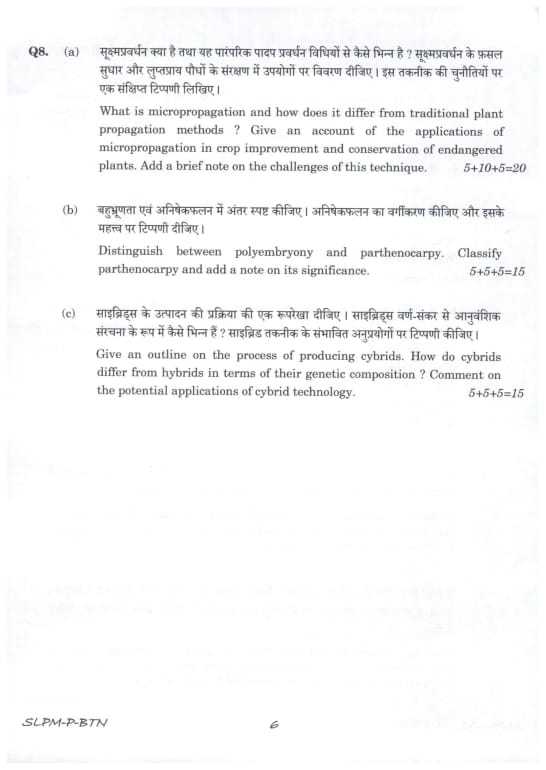
Q8 (A) What is micropropagation and how does it differ from traditional plant propagation methods ? Give an account of the applications of micropropagation in crop improvement and conservation of endangered plants. Add a brief note on the challenges of this technique.
Q8 (B) Distinguish between polyembryony and parthenocarpy. Classify parthenocarpy and add a note on its significance.
Q8 (C) Give an outline on the process of producing cybrids. How do cybrids differ from hybrids in terms of their genetic composition? Comment on the potential applications of cybrid technology.
UPSC Previous Year Question Papers
Other Relevant Articles
| UPSC IAS Exam Syllabus | UPSC IAS Exam Pattern | UPSC IAS Exam Current Affairs |
| UPSC IAS Exam Study Materials | UPSC IAS Mock Test Series | UPSC IAS Salary |
Check the latest Government Recruitment News here.
Join Prepp Telegram Channel today for further updates.
Download the PREPP App and attempt FREE IAS Exam Mock Tests and get complete study material!
Full Test - 01: UPSC CSE Prelims 2027

testing
UPSC CSE Prelims 2026 GS Paper 1 Question Paper (24-May-2026)
UPSC CSE Prelims 2026 CSAT Paper 2 Question Paper (24-May-2026)

17 February 2025 | The Hindu Must Read Articles | Current Affairs

16 February 2026 | The Hindu Must Read Articles | Current Affairs

13 February 2026 | The Hindu Must Read Articles | Current Affairs









Comments