Economics Optional Paper 2 Question Paper 2025 with Detailed Solution; Download PDF
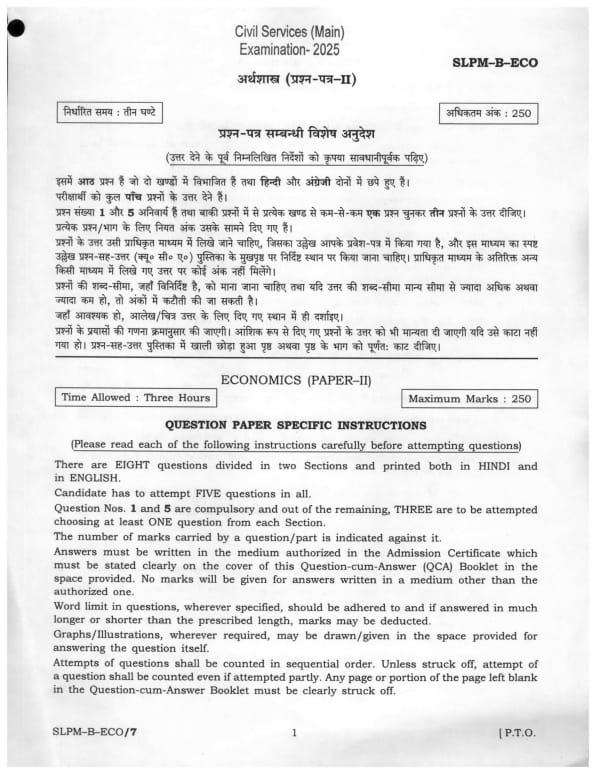
UPSC Mains 2025 Question Paper for Economics Optional Paper 2 is available here to download in PDF Format. The exam has been conducted on August 31, 2025, in Afternoon Session (02:30 PM to 05:30 PM). This Paper comprises 8 questions which are of 250 marks. The duration of the exam is 3 hours.
UPSC Mains Economics Optional Paper 2 Question Paper 2025 with Detailed Solution; Download PDF (August 31, 2025)
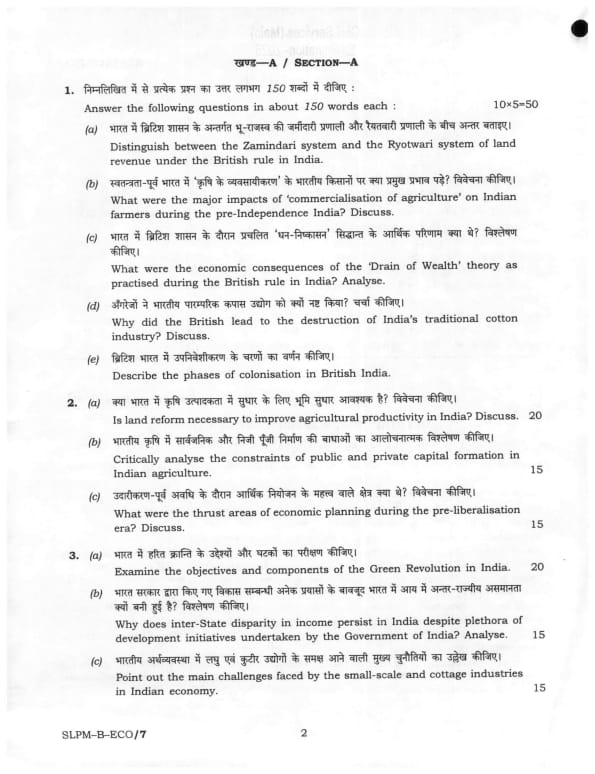
Q1 (A) Distinguish between the Zamindari system and the Ryotwari system of land revenue under the British rule in India.
Q1 (B) What were the major impacts of 'commercialisation of agriculture' on Indian farmers during the pre-Independence India? Discuss.
Q1 (C) What were the economic consequences of the Drain of Wealth' theory as practised during the British rule in India? Analyse.
Q1 (D) Why did the British lead to the destruction of India's traditional cotton industry? Discuss.
Q1 (E) Describe the phases of colonisation in British India.
Q2 (A) Is land reform necessary to improve agricultural productivity in India? Discuss.
Q2 (B) Critically analyse the constraints of public and private capital formation in Indian agriculture.
Q2 (C) What were the thrust areas of economic planning during the pre-liberalisation era? Discuss.
Q3 (A) Examine the objectives and components of the Green Revolution in India.
Q3 (B) Why does inter-State disparity in income persist in India despite plethora of development initiatives undertaken by the Government of India? Analyse.
Q3 (C) Point out the main challenges faced by the small-scale and cottage industries in Indian economy.
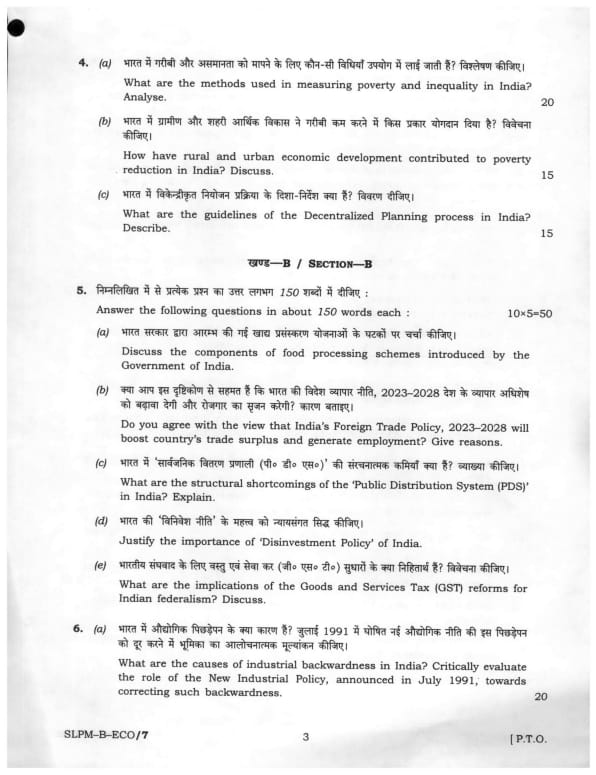
Q4 (A) What are the methods used in measuring poverty and inequality in India? Analyse.
Q4 (B) How have rural and urban economic development contributed to poverty reduction in India? Discuss.
Q4 (C) What are the guidelines of the Decentralized Planning process in India? Describe.
Q5 (A) Discuss the components of food processing schemes introduced by the Government of India.
Q5 (B) Do you agree with the view that India's Foreign Trade Policу, 2023–2028 will boost country's trade surplus and generate employment? Give reasons.
Q5 (C) What are the structural shortcomings of the 'Public Distribution System (PDS)' in India? Explain.
Q5 (D) Justify the importance of 'Disinvestment Policy' of India.
Q5 (E) What are the implications of the Goods and Services Tax (GST) reforms for Indian federalism? Discuss.
Q6 (A) What are the causes of industrial backwardness in India? Critically evaluate the role of the New Industrial Policy, announced in July 1991, towards correcting such backwardness.
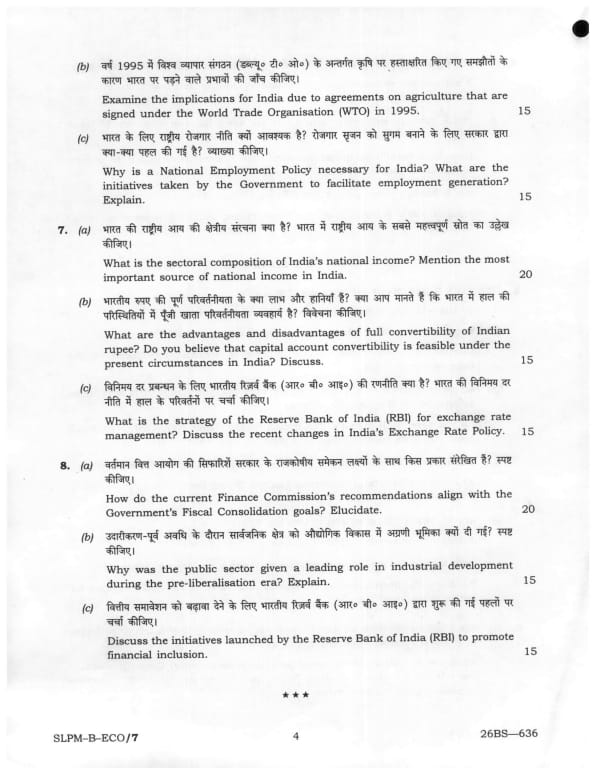
Q6 (B) Examine the implications for India due to agreements on agriculture that are signed under the World Trade Organisation (WTO) in 1995.
Q6 (C) Why is a National Employment Policy necessary for India? What are the initiatives taken by the Government to facilitate employment generation? Explain.
Q7 (A) What is the sectoral composition of India's national income? Mention the most important source of national income in India.
Q7 (B) What are the advantages and disadvantages of full convertibility of Indian rupee? Do you believe that capital account convertibility is feasible under the present circumstances in India? Discuss.
Q7 (C) What is the strategy of the Reserve Bank of India (RBI) for exchange rate management? Discuss the recent changes in India's Exchange Rate Policy
Q8 (A) How do the current Finance Commission's recommendations align with the Government's Fiscal Consolidation goals? Elucidate.
Q8 (B) Why was the public sector given a leading role in industrial development during the pre-liberalisation era? Explain.
Q8 (C) Discuss the initiatives launched by the Reserve Bank of India (RBI) to promote financial inclusion.
UPSC Previous Year Question Papers
Other Relevant Articles
| UPSC IAS Exam Syllabus | UPSC IAS Exam Pattern | UPSC IAS Exam Current Affairs |
| UPSC IAS Exam Study Materials | UPSC IAS Mock Test Series | UPSC IAS Salary |
Check the latest Government Recruitment News here.
Join Prepp Telegram Channel today for further updates.
Download the PREPP App and attempt FREE IAS Exam Mock Tests and get complete study material!
Full Test - 01: UPSC CSE Prelims 2027

testing
UPSC CSE Prelims 2026 GS Paper 1 Question Paper (24-May-2026)
UPSC CSE Prelims 2026 CSAT Paper 2 Question Paper (24-May-2026)

17 February 2025 | The Hindu Must Read Articles | Current Affairs

16 February 2026 | The Hindu Must Read Articles | Current Affairs

13 February 2026 | The Hindu Must Read Articles | Current Affairs









Comments