Philosophy Optional Paper 1 Question Paper 2025 with Detailed Solution; Download PDF
UPSC Mains 2025 Question Paper for Philosophy Optional Paper 1 is available here to download in PDF Format. The exam has been conducted on August 31, 2025, in Afternoon Session (09:00 PM to 12:00 Noon). This Paper comprises 8 questions which are of 250 marks. The duration of the exam is 3 hours.
UPSC Mains Philosophy Optional Paper 1 Question Paper 2025 with Detailed Solution; Download PDF (August 31, 2025)
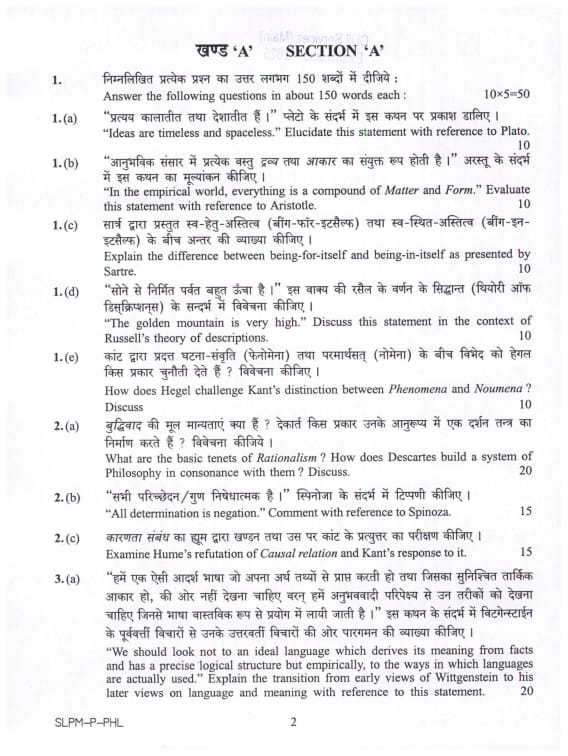
Q1 (A) "Ideas are timeless and spaceless." Elucidate this statement with reference to Plato.
Q1 (B) "In the empirical world, everything is a compound of Matter and Form." Evaluate this statement with reference to Aristotle.
Q1 (C) Explain the difference between being-for-itself and being-in-itself as presented by Sartre.
Q1 (D) "The golden mountain is very high." Discuss this statement in the context of Russell's theory of descriptions.
Q1 (E) How does Hegel challenge Kant's distinction between Phenomena and Noumenа ? Discuss
Q2 (A) What are the basic tenets of Rationalism? How does Descartes build a system of Philosophy in consonance with them? Discuss.
Q2 (B) "All determination is negation." Comment with reference to Spinoza.
Q2 (C) Examine Hume's refutation of Causal relation and Kant's response to it.
Q3 (A) "We should look not to an ideal language which derives its meaning from facts and has a precise logical structure but empirically, to the ways in which languages are actually used." Explain the transition from early views of Wittgenstein to his later views on language and meaning with reference to this statement.
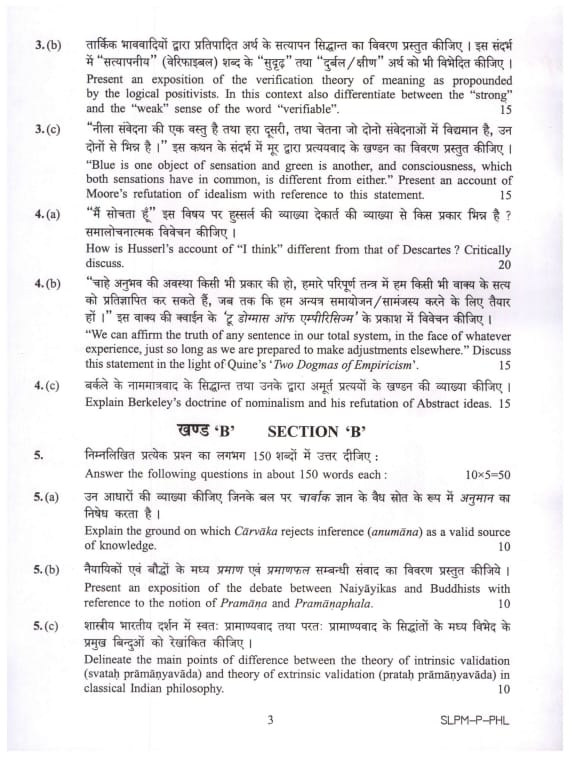
Q3 (B) Present an exposition of the verification theory of meaning as propounded by the logical positivists. In this context also differentiate between the "strong" and the "weak" sense of the word "verifiable".
Q3 (C) "Blue is one object of sensation and green is another, and consciousness, which both sensations have in common, is different from either." Present an account of Moore's refutation of idealism with reference to this statement.
Q4 (A) How is Husserl's account of "I think" different from that of Descartes? Critically discuss.
Q4 (B) "We can affirm the truth of any sentence in our total system, in the face of whatever experience, just so long as we are prepared to make adjustments elsewhere." Discuss this statement in the light of Quine's 'Two Dogmas of Empiricism'.
Q4 (C) Explain Berkeley's doctrine of nominalism and his refutation of Abstract ideas.
Q5 (A) Explain the ground on which Cārvāka rejects inference (anumāna) as a valid source of knowledge.
Q5 (B) Present an exposition of the debate between Naiyāyikas and Buddhists with reference to the notion of Pramāna and Pramāņaphala.
Q5 (C) Delineate the main points of difference between the theory of intrinsic validation (svatah prāmāņyavāda) and theory of extrinsic validation (pratah prāmāņyavāda) in classical Indian philosophy.
Q5 (D) Examine Rāmānuja's seven objections against Māyāvāda of Advaita.
Q5 (E) Present an exposition of Nyāya-Vaiśeșika's theory of causation.
Q6 (A) Present a detailed account of Gautama's definition of Perception.
Q6 (B) How is Brahman conceptualised in Advaita philosophy as both Nimitta and Upādāna Kārana of the World? Discuss with suitable examples.
Q6 (C) Discuss the debate between the Bhatta and the Prabhākara mīmāmsakas with reference to the nature of Non-existence (Abhāva) and its knowledge.
Q7 (A) Why does Śarnkara consider Sämkhya Philosophy as his chief opponent (pradhāna malla)? Examine his arguments against Sāmkhya Philosophy.
Q7 (B) Explain the nature of God and its role in Kaivalya in yoga philosophy.
Q7 (C) Is Jaina philosophy pluralistic and realistic? Critically discuss.
Q8 (A) Discuss the idea of Bimba-pratibimbavāda as presented in Vedanta philosophy along with its soteriological significance.
Q8 (B) Both Ascetic and materialist are partial in their negation of each other'. Explain Sri Aurobindo's integral philosophy in the light of the above statement.
Q8 (C) Is Buddhist notion of Nirvāna in consonance with their conception of Kşanikavāda (momentariness) and Nairātmyavāda (no-soul theory)? Critically discuss.


UPSC Previous Year Question Papers
Other Relevant Articles
| UPSC IAS Exam Syllabus | UPSC IAS Exam Pattern | UPSC IAS Exam Current Affairs |
| UPSC IAS Exam Study Materials | UPSC IAS Mock Test Series | UPSC IAS Salary |
Check the latest Government Recruitment News here.
Join Prepp Telegram Channel today for further updates.
Download the PREPP App and attempt FREE IAS Exam Mock Tests and get complete study material!
UPSC IAS : CSAT - Mini Live Test

Live Test : UPSC CSE Prelims CSAT (Paper-II) (Oct 20 - 23)
Full Test - 04: UPSC CSE Prelims CSAT (Paper-II)
Full Test - 03: UPSC CSE Prelims CSAT (Paper-II)
UPSC CSE Prelims 2026 GS Paper 1 Question Paper (24-May-2026)
UPSC CSE Prelims 2026 CSAT Paper 2 Question Paper (24-May-2026)

17 February 2025 | The Hindu Must Read Articles | Current Affairs

16 February 2026 | The Hindu Must Read Articles | Current Affairs

13 February 2026 | The Hindu Must Read Articles | Current Affairs









Comments