SSC CGL Tier 1 Question Paper Shift 1 (Sept 10, 2024); Download PDF with Answer Key and Solutions
SSC CGL 2024 Tier 1 September 10 Shift 1 Question Paper is available here for download. SSC CGL 2024 Tier 1 Shift has been conducted on September 10, 2024 from 09:00 AM to 10:00 AM. With 100 questions and a total weightage of 200 marks, the SSC CGL Tier 1 2024 Shift 1 challenges candidates to showcase their analytical reading skills and command over the language. The SSC CGL Tier 1 September 10, 2024 Shift 1 was Easy to Moderate.
Downloading and analyzing the CGL Tier 1 September 10, 2024 Shift 1 paper can help future candidates understand the question patterns, difficulty level, and ideal strategies for tackling this critical section effectively.
SSC CGL Tier 1 2024 Shift 1 Question Paper with Solutions PDF (September 10)
| SSC CGL Tier 1 2024 Question Paper with Answer Key |  Download Download |
Check Solutions |
SSC CGL Tier 1 2024 Shift 1 Questions with Solutions
| Question | Correct Answer | Solution |
|---|---|---|
| General Intelligence and Reasoning | ||
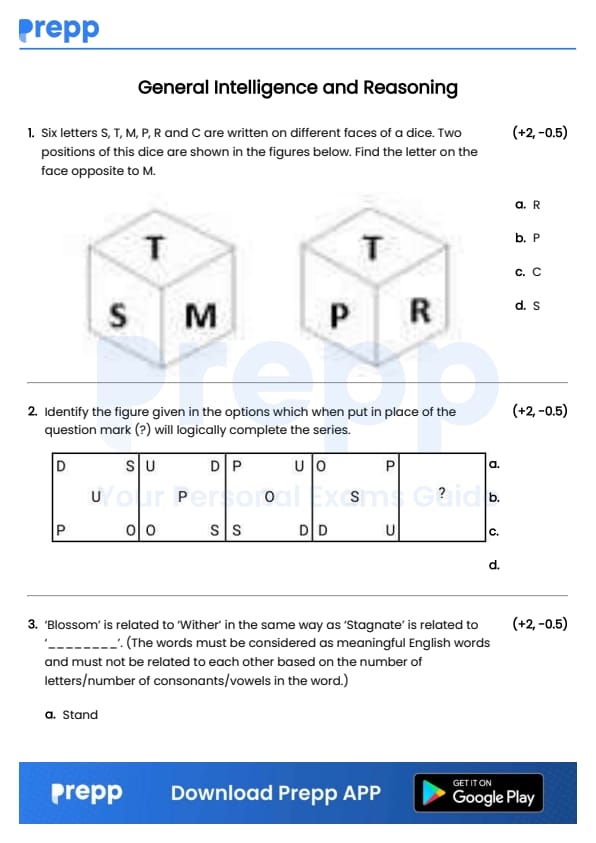
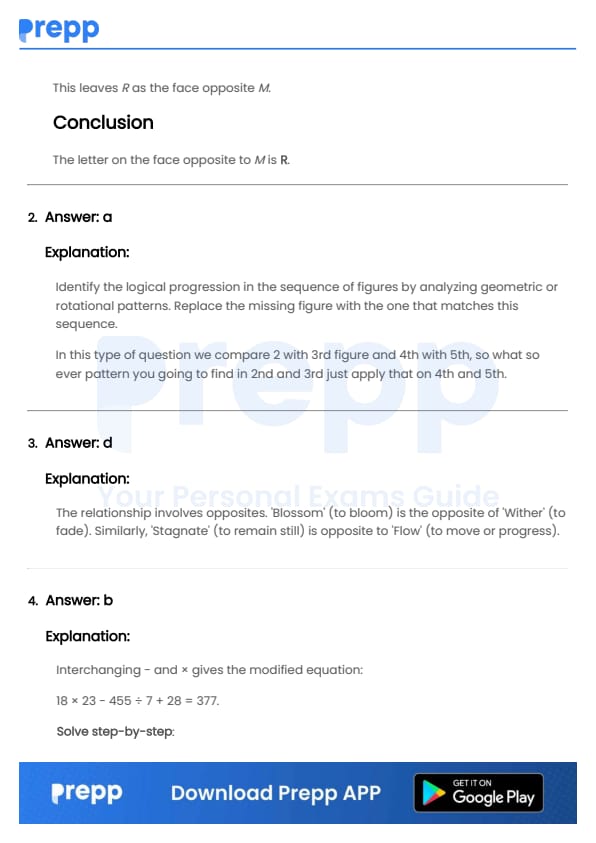
| Six letters S, T, M, P, R and C are written on different faces of a dice. Two positions of this dice are shown in the figures below. Find the letter on the face opposite to M. a. R b. P c. C d. S |
(A) R |
To determine the letter on the face opposite to M View SolutionStep 1: Observing the common letterIn the two positions, T is visible in both views. This tells us that T is not on the opposite faces of S, M, P, or R. Step 2: Determining adjacency In Position 1, S and M are adjacent to T. In Position 2, P and R are adjacent to T. Therefore, S, M, P, and R cannot be opposite T. Step 3: Matching opposites Each face of the dice has a unique opposite face. Since T is not opposite M, the remaining faces S, C, P, and R must include the face opposite M. Step 4: Identifying the opposite of M This leaves R as the face opposite M. Conclusion |
|
‘Blossom’ is related to ‘Wither’ in the same way as ‘Stagnate’ is related to a. Stand |
(D) Flow | The relationship involves opposites. 'Blossom' (to bloom) is the opposite of 'Wither' (to fade). Similarly, 'Stagnate' (to remain still) is opposite to 'Flow' (to move or progress). |
|
Which two signs should be interchanged to make the following equation correct? 18 − 23 × 455 ÷ 7 + 28 = 377 a. + and × |
(B) − and × |
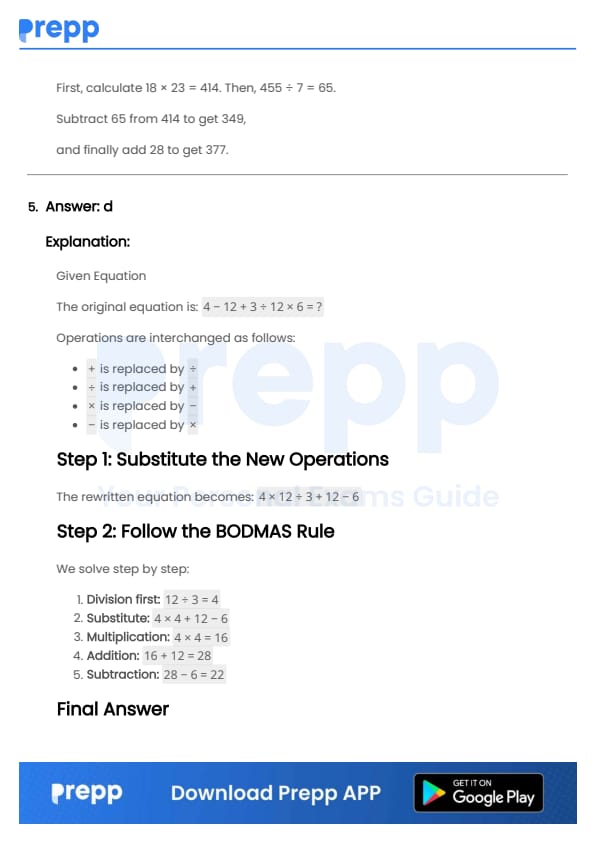
Interchanging − and × gives the modified equation: First, calculate 18 × 23 = 414. Then, 455 ÷ 7 = 65. |
|
What will come in place of the question mark (?) in the following equation if a. 13 |
(D) 22 |
Given Equation View SolutionStep 1: Substitute the New Operations The result of the equation is: 22. |
|
The position of how many letters will remain unchanged if each of the a. One |
(C) None |
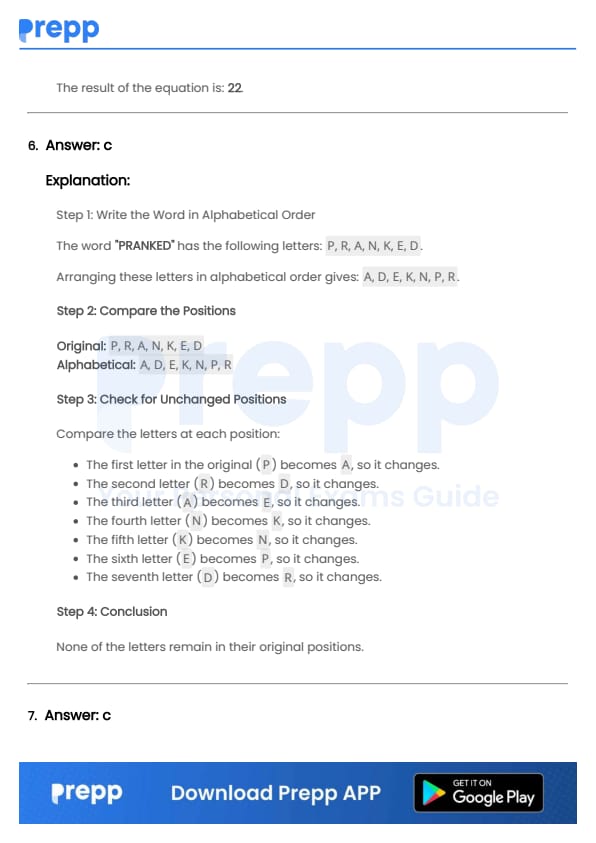
Step 1: Write the Word in Alphabetical Order View SolutionStep 2: Compare the PositionsOriginal: P, R, A, N, K, E, D Alphabetical: A, D, E, K, N, P, R Step 3: Check for Unchanged Positions Compare the letters at each position:
None of the letters remain in their original positions. |
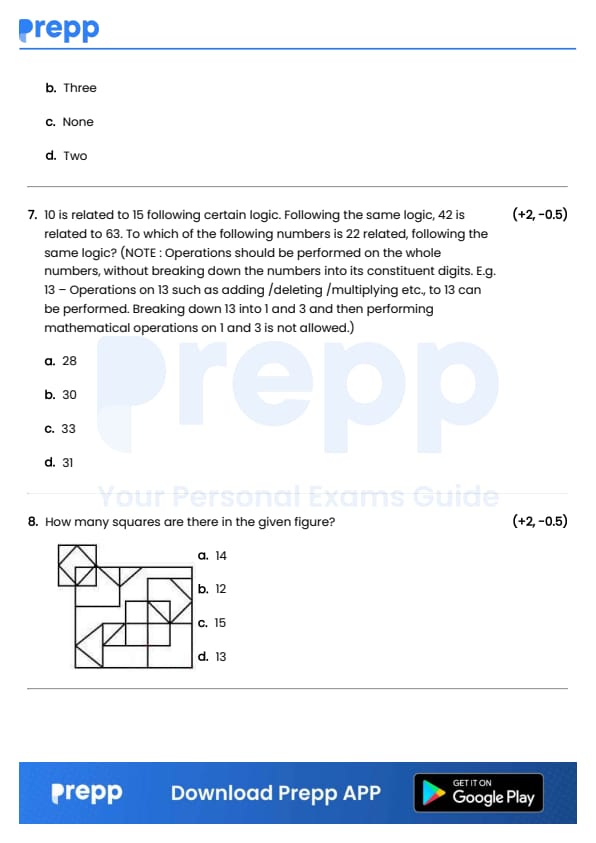
| 10 is related to 15 following certain logic. Following the same logic, 42 is related to 63. To which of the following numbers is 22 related, following the same logic? Read More(NOTE : Operations should be performed on the wholenumbers, without breaking down the numbers into its constituent digits. E.g. 13 – Operations on 13 such as adding /deleting /multiplying etc., to 13 can be performed. Breaking down 13 into 1 and 3 and then performing mathematical operations on 1 and 3 is not allowed.) b. 30 c. 33 d. 31 |
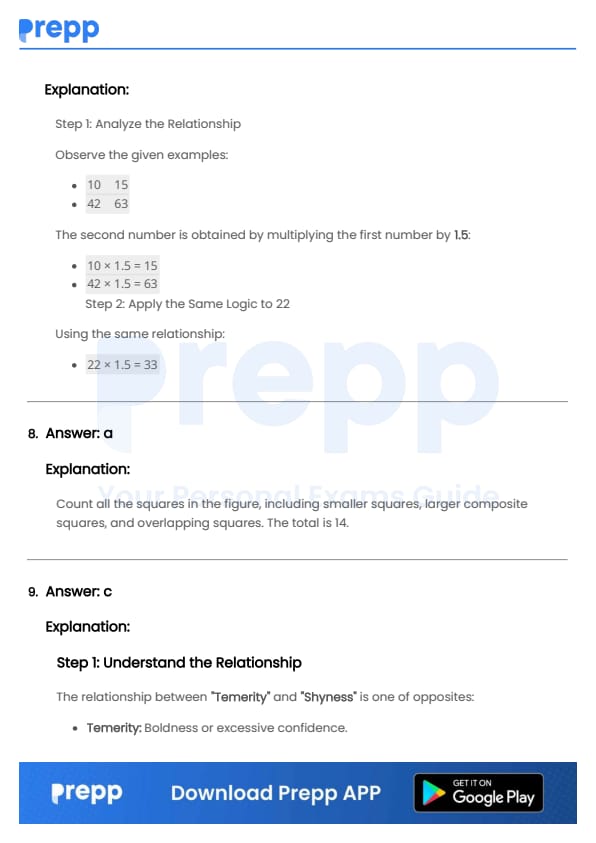
(C) 33 | Step 1: Analyze the Relationship Observe the given examples: 10 15 42 63 The second number is obtained by multiplying the first number by 1.5: 10 × 1.5 = 15 42 × 1.5 = 63 Step 2: Apply the Same Logic to 22 Using the same relationship: 22 × 1.5 = 33 |
|
How many squares are there in the given figure? a. 14 |
(A) 14 | Count all the squares in the figure, including smaller squares, larger composite squares, and overlapping squares. The total is 14. |
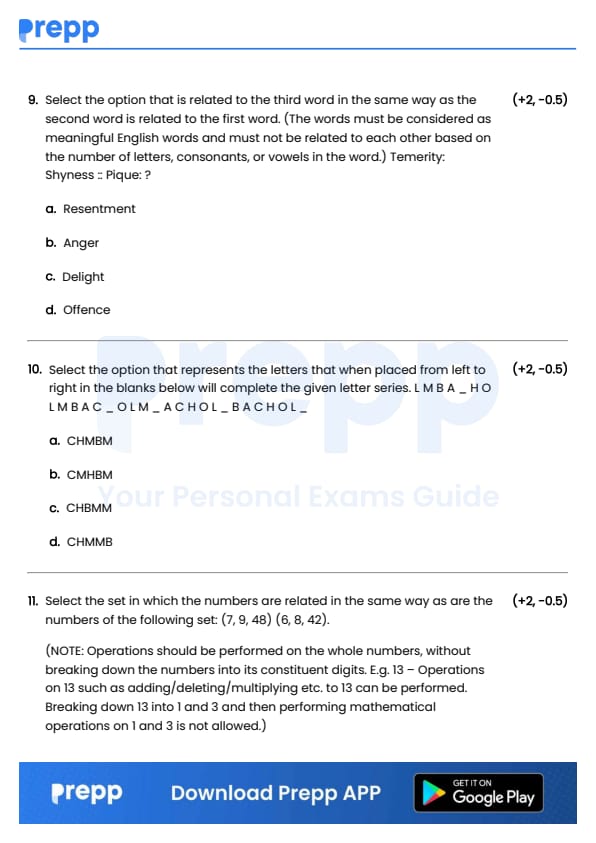
| Select the option that is related to the third word in the same way as the second word is related to the first word. (The words must be considered as meaningful English words and must not be related to each other based on the number of letters, consonants, or vowels in the word.) Temerity: Shyness :: Pique: ? a. Resentment b. Anger c. Delight d. Offence |
(C) Delight |
Step 1: Understand the Relationship
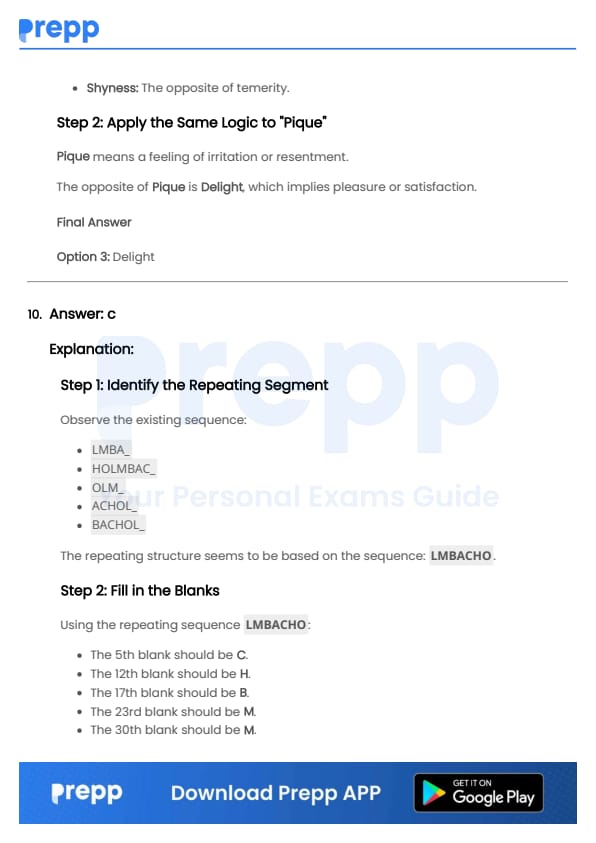
View SolutionStep 2: Apply the Same Logic to "Pique" |
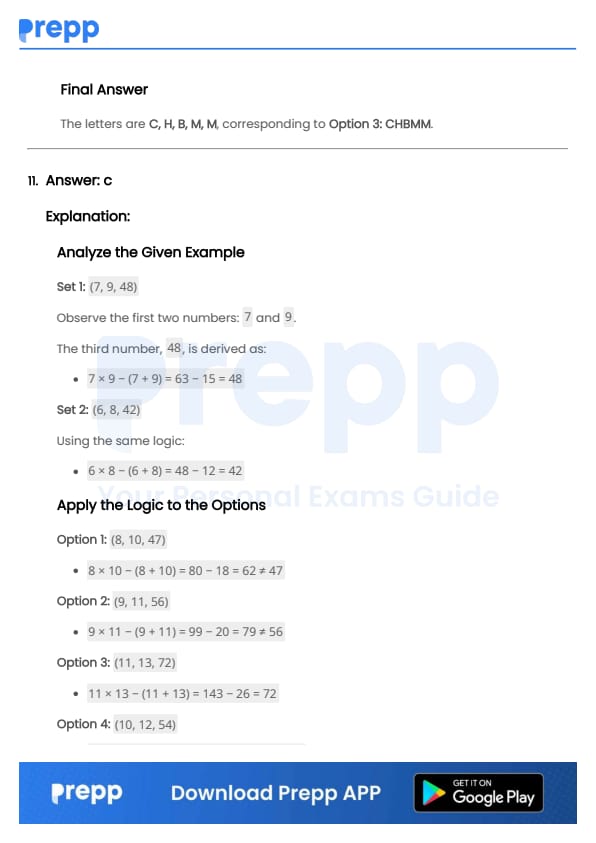
| Select the option that represents the letters that when placed from left to right in the blanks below will complete the given letter series. L M B A _ H O L M B A C _ O L M _ A C H O L _ B A C H O L _ a. CHMBM b. CMHBM c. CHBMM d. CHMMB |
(C) CHBMM |
Step 1: Identify the Repeating Segment View SolutionStep 2: Fill in the Blanks The letters are C, H, B, M, M, corresponding to Option 3: CHBMM. |
|
Select the set in which the numbers are related in the same way as are the Read More(NOTE: Operations should be performed on the whole numbers, withoutbreaking down the numbers into its constituent digits. E.g. 13 – Operations on 13 such as adding/deleting/multiplying etc. to 13 can be performed. Breaking down 13 into 1 and 3 and then performing mathematical operations on 1 and 3 is not allowed.) a. (8, 10, 47) |
(C) (11, 13, 72) |
Analyze the Given Example View SolutionApply the Logic to the OptionsOption 1: (8, 10, 47) 8 × 10 − (8 + 10) = 80 − 18 = 62 ≠ 47 Option 2: (9, 11, 56) 9 × 11 − (9 + 11) = 99 − 20 = 79 ≠ 56 Option 3: (11, 13, 72) 10 × 12 − (10 + 12) = 120 − 22 = 98 ≠ 54 Final Answer |
| Three of the following four options are alike in a certain way and thus form a group. Which is the option that does NOT belong to that group? Read More(NOTE : Operations should be performed on the whole numbers, withoutbreaking down the numbers into its constituent digits. E.g. 13 – Operations on 13 such as adding /deleting /multiplying etc., to 13 can be performed. Breaking down 13 into 1 and 3 and then performing mathematical operations on 1 and 3 is not allowed). b. 2 – 2 – 4 c. 3 – 2 – 5 d. 1 – 3 – 3 |
(C) 3 – 2 – 5 | The pattern among the options involves checking if the last number in each set is the product of the first two numbers: Option 1: 2 - 4 - 8 2 × 4 = 8 (Follows the pattern) Option 2: 2 - 2 - 4 2 × 2 = 4 (Follows the pattern) Option 3: 3 - 2 - 5 3 × 2 = 6 ≠ 5 (Does NOT follow the pattern) Option 4: 1 - 3 - 3 1 × 3 = 3 (Follows the pattern) Conclusion Option 3: 3 - 2 - 5 is the odd one out |
|
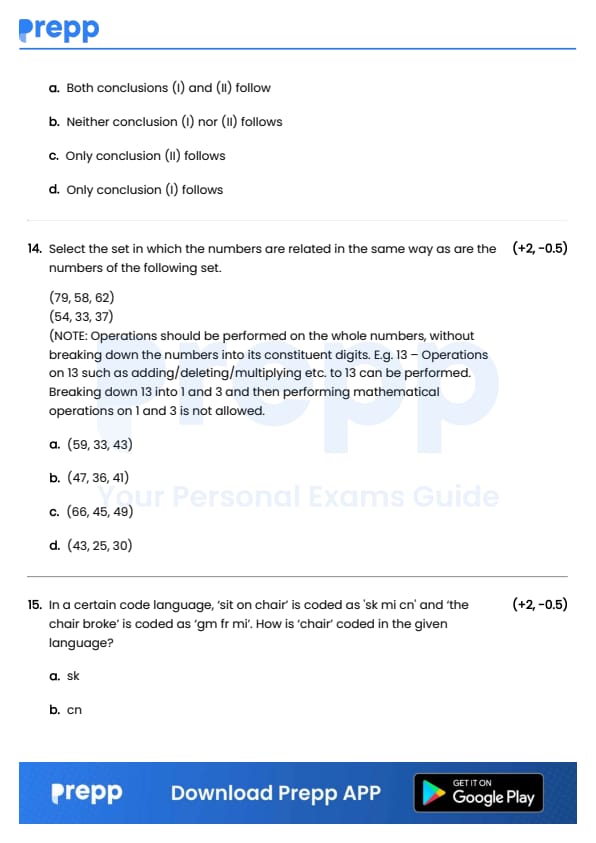
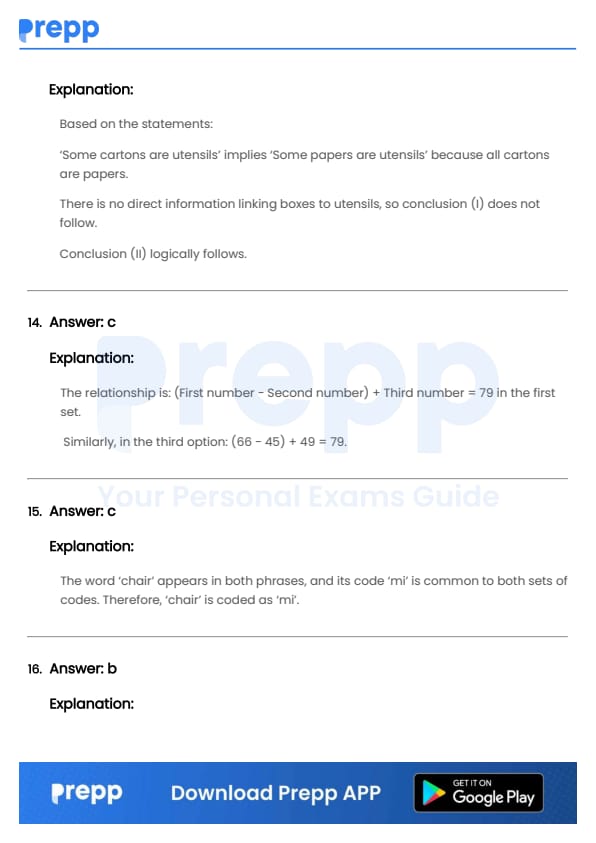
Read the given statements and conclusions carefully. Assuming that the Read MoreStatements: Some boxes are cartons. All cartons are papers. Some cartonsare utensils. Conclusion (I): No box is a utensil. Conclusion (II): Some papers are utensils. a. Both conclusions (I) and (II) follow |
(C) Only conclusion (II) follows | Based on the statements: ‘Some cartons are utensils’ implies ‘Some papers are utensils’ because all cartons are papers. There is no direct information linking boxes to utensils, so conclusion (I) does not follow. Conclusion (II) logically follows. |
|
Select the set in which the numbers are related in the same way as are the Read More(NOTE: Operations should be performed on the whole numbers, withoutbreaking down the numbers into its constituent digits. E.g. 13 – Operations on 13 such as adding/deleting/multiplying etc. to 13 can be performed. Breaking down 13 into 1 and 3 and then performing mathematical operations on 1 and 3 is not allowed. a. (59, 33, 43) |
(C) (66, 45, 49) | The relationship is: (First number − Second number) + Third number = 79 in the first set. Similarly, in the third option: (66 − 45) + 49 = 79. |
|
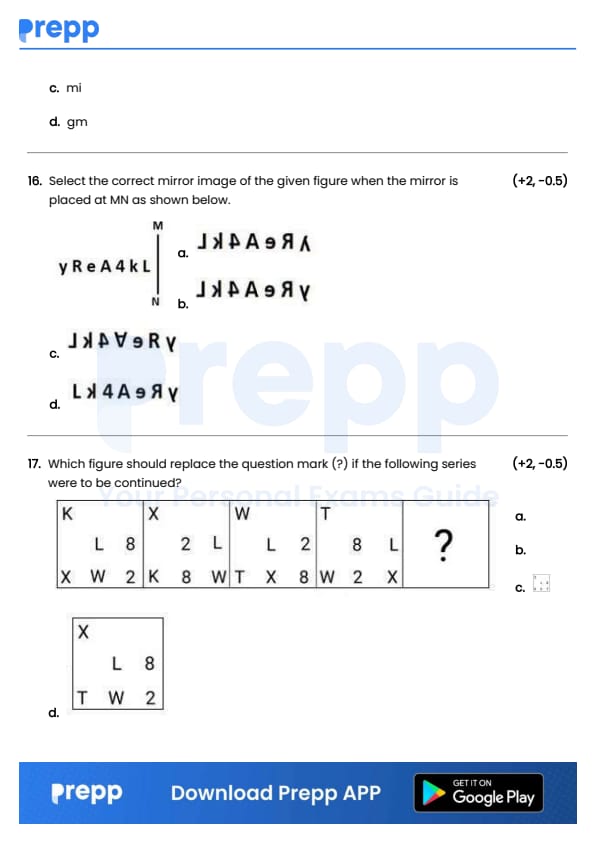
In a certain code language, ‘sit on chair’ is coded as 'sk mi cn' and ‘the a. sk |
(C) mi | The word ‘chair’ appears in both phrases, and its code ‘mi’ is common to both sets of codes. Therefore, ‘chair’ is coded as ‘mi’. |
|
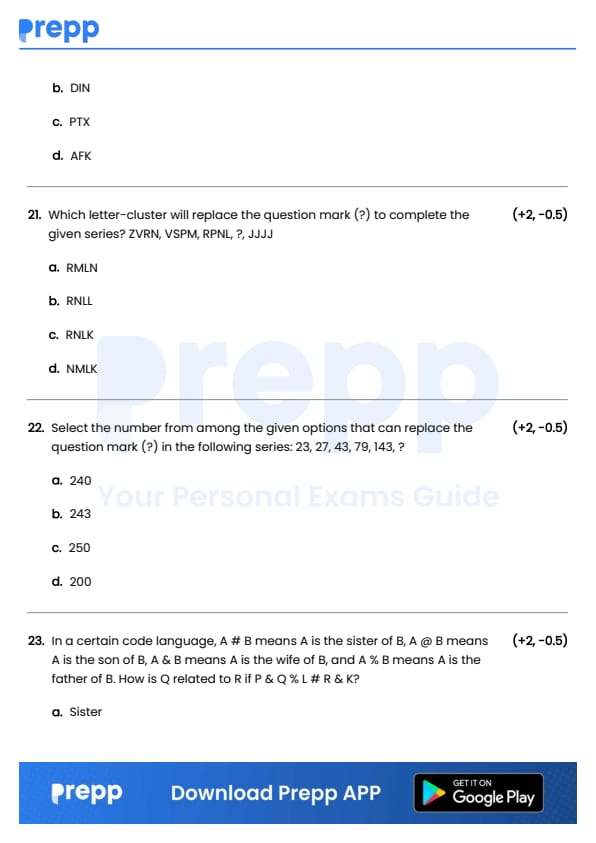
Four letter-clusters have been given, out of which three are alike in some a. LQV |
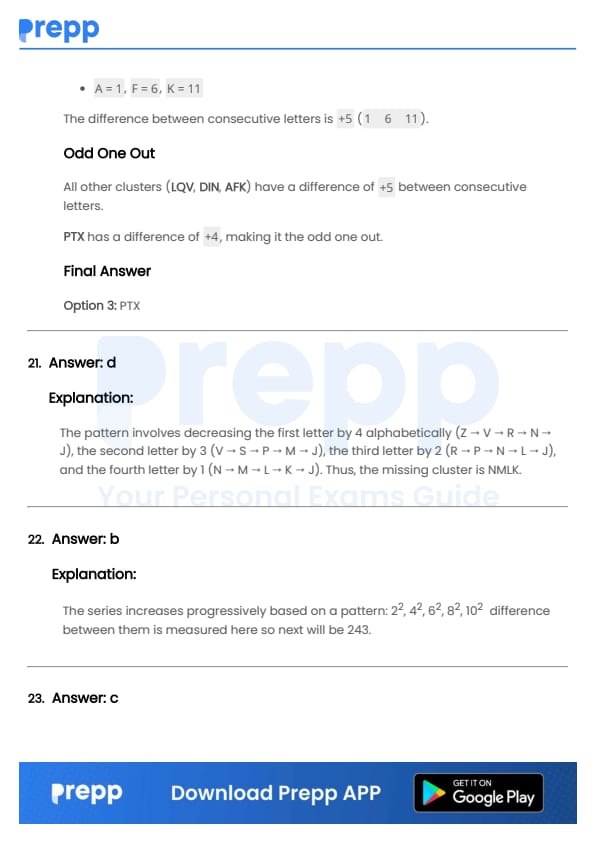
(C) PTX |
Examine the Patterns in the Given Letter Clusters View SolutionPTX: The positions of the letters are:P = 16 , T = 20 , X = 24 The difference between consecutive letters is +4 ( 16 20 24 ). AFK: The positions of the letters are: A = 1 , F = 6 , K = 11 Odd One Out |
| Which letter-cluster will replace the question mark (?) to complete the given series? ZVRN, VSPM, RPNL, ?, JJJJ a. RMLN b. RNLL c. RNLK d. NMLK |
(D) NMLK | The pattern involves decreasing the first letter by 4 alphabetically (Z → V → R → N → J), the second letter by 3 (V → S → P → M → J), the third letter by 2 (R → P → N → L → J), and the fourth letter by 1 (N → M → L → K → J). Thus, the missing cluster is NMLK. |
| Select the number from among the given options that can replace the question mark (?) in the following series: 23, 27, 43, 79, 143, ? a. 240 b. 243 c. 250 d. 200 |
(B) 243 | The series increases progressively based on a pattern: 22 , 42 , 62 , 82 , 102 difference between them is measured here so next will be 243. |
|
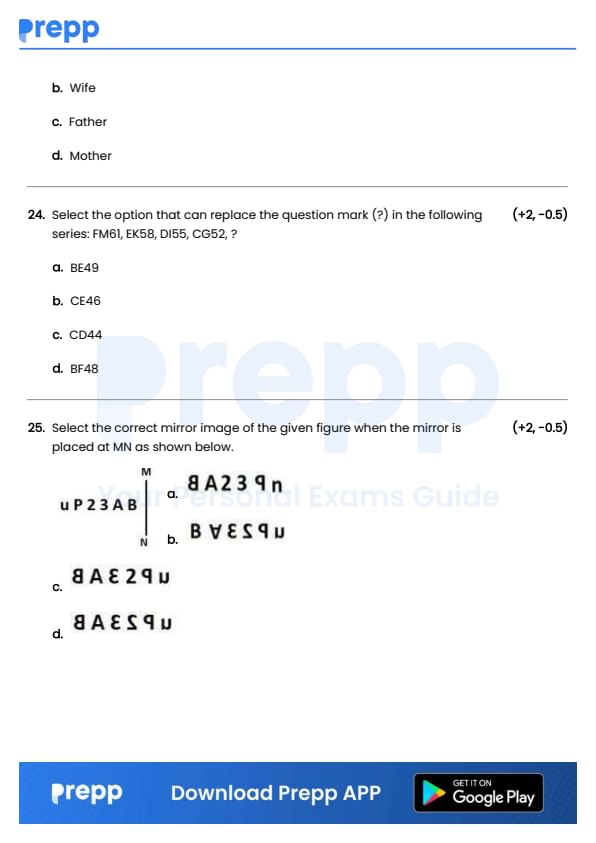
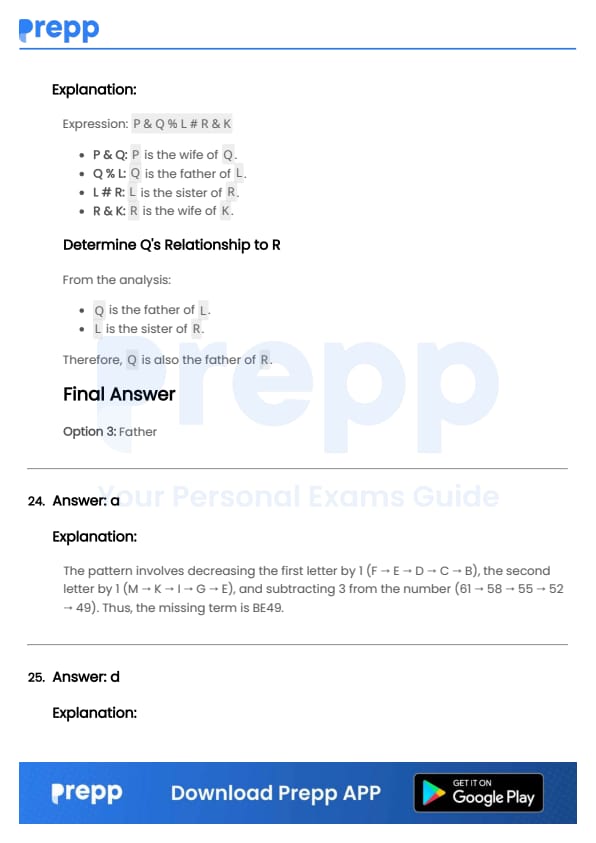
In a certain code language, A # B means A is the sister of B, A @ B means a. Sister |
(C) Father | Explanation: Expression: P & Q % L # R & K P & Q: P is the wife of Q. Q % L: Q is the father of L . L # R: L is the sister of R. R & K: R is the wife of K. Determine Q's Relationship to R From the analysis: Q is the father of L . L is the sister of R. Therefore, Q is also the father of R. Final Answer Option 3: Father |
| Select the option that can replace the question mark (?) in the following series: FM61, EK58, DI55, CG52, ? a. BE49 b. CE46 c. CD44 d. BF48 |
(A) BE49 | The pattern involves decreasing the first letter by 1 (F → E → D → C → B), the second letter by 1 (M → K → I → G → E), and subtracting 3 from the number (61 → 58 → 55 → 52 → 49). Thus, the missing term is BE49. |
| General Awareness | ||
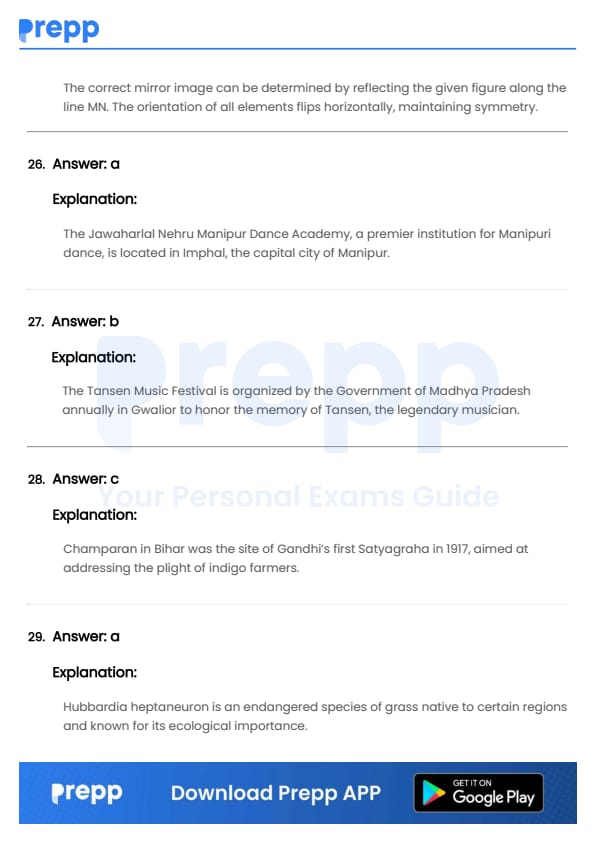
| In which of the following cities of Manipur is the Jawaharlal Nehru Manipur Dance Academy located? a. Imphal b. Ukhrul c. Chandel d. Thoubal |
(A) Imphal | The Jawaharlal Nehru Manipur Dance Academy, a premier institution for Manipuri dance, is located in Imphal, the capital city of Manipur. |
| By which of the following state governments is the Tansen Music Festival organised? a. Maharashtra Government b. Madhya Pradesh Government c. Rajasthan Government d. Uttar Pradesh Government |
(B) Madhya Pradesh Government | The Tansen Music Festival is organized by the Government of Madhya Pradesh annually in Gwalior to honor the memory of Tansen, the legendary musician. |
| Which of the following places is related to Gandhi’s Satyagraha of the year 1917? a. Kheda b. Ahmedabad c. Champaran d. Bardoli |
(C) Champaran | Champaran in Bihar was the site of Gandhi’s first Satyagraha in 1917, aimed at addressing the plight of indigo farmers |
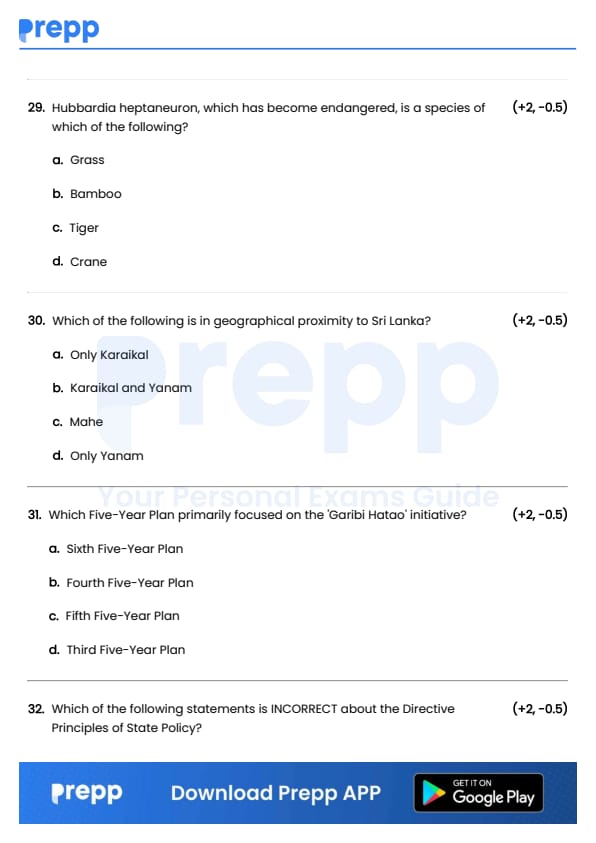
| Hubbardia heptaneuron, which has become endangered, is a species of which of the following? a. Grass b. Bamboo c. Tiger d. Crane |
(A) Grass | Hubbardia heptaneuron is an endangered species of grass native to certain regions and known for its ecological importance |
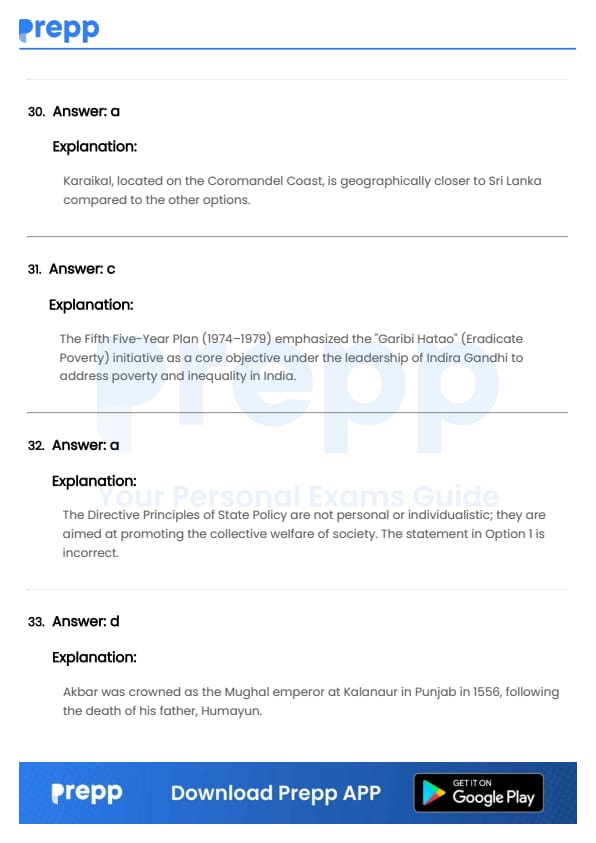
| Which of the following is in geographical proximity to Sri Lanka? a. Only Karaikal b. Karaikal and Yanam c. Mahe d. Only Yanam |
(A) Only Karaikal | Karaikal, located on the Coromandel Coast, is geographically closer to Sri Lanka compared to the other options. |
| Which Five-Year Plan primarily focused on the 'Garibi Hatao' initiative? a. Sixth Five-Year Plan b. Fourth Five-Year Plan c. Fifth Five-Year Plan d. Third Five-Year Plan |
(C) Fifth Five-Year Plan | The Fifth Five-Year Plan (1974–1979) emphasized the "Garibi Hatao" (Eradicate Poverty) initiative as a core objective under the leadership of Indira Gandhi to address poverty and inequality in India. |
|
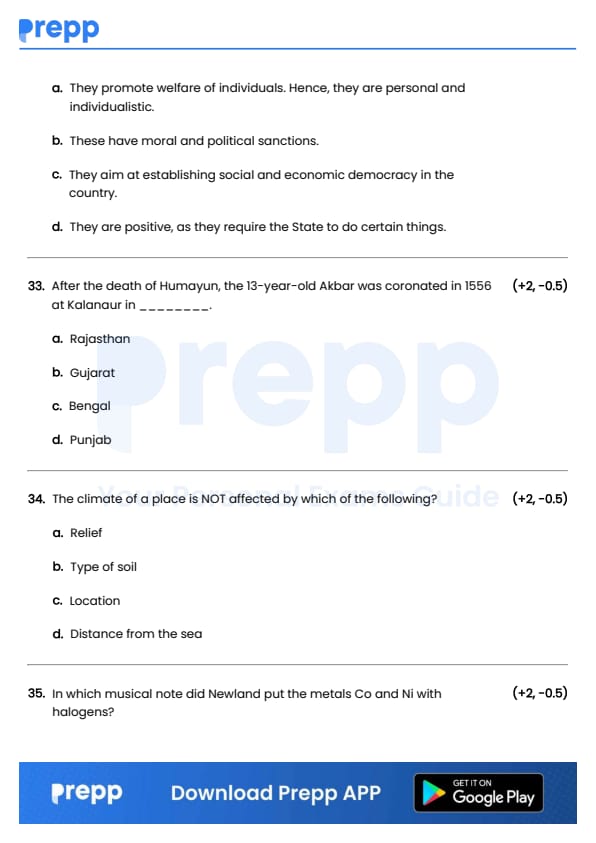
Which of the following statements is INCORRECT about the Directive Principles of State Policy? a. They promote welfare of individuals. Hence, they are personal and |
(A) They promote welfare of individuals. Hence, they are personal and individualistic. | The Directive Principles of State Policy are not personal or individualistic; they are aimed at promoting the collective welfare of society. The statement in Option 1 is incorrect |
| After the death of Humayun, the 13-year-old Akbar was coronated in 1556 at Kalanaur in ________. a. Rajasthan b. Gujarat c. Bengal d. Punjab |
(D) Punjab | Akbar was crowned as the Mughal emperor at Kalanaur in Punjab in 1556, following the death of his father, Humayun. |
| The climate of a place is NOT affected by which of the following? a. Relief b. Type of soil c. Location d. Distance from the sea |
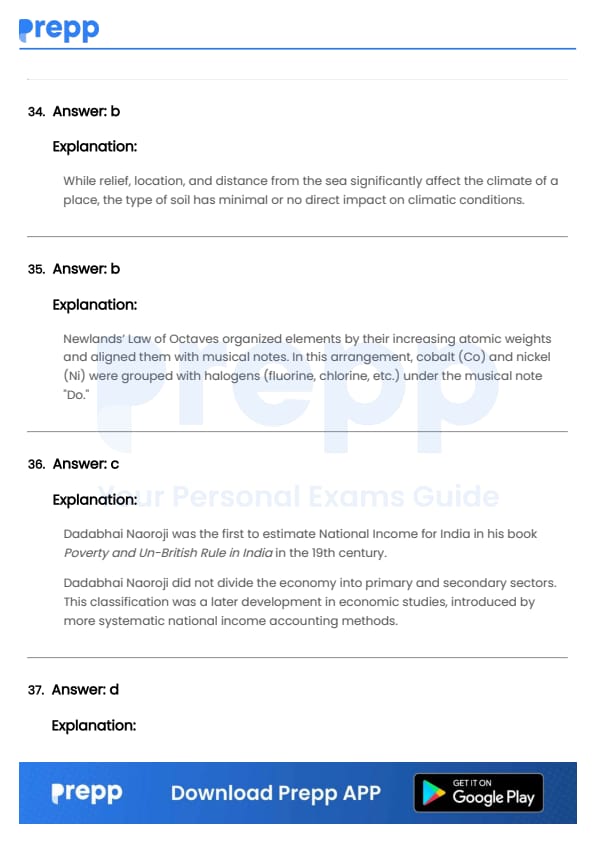
(B) Type of soil | While relief, location, and distance from the sea significantly affect the climate of a place, the type of soil has minimal or no direct impact on climatic conditions. |
|
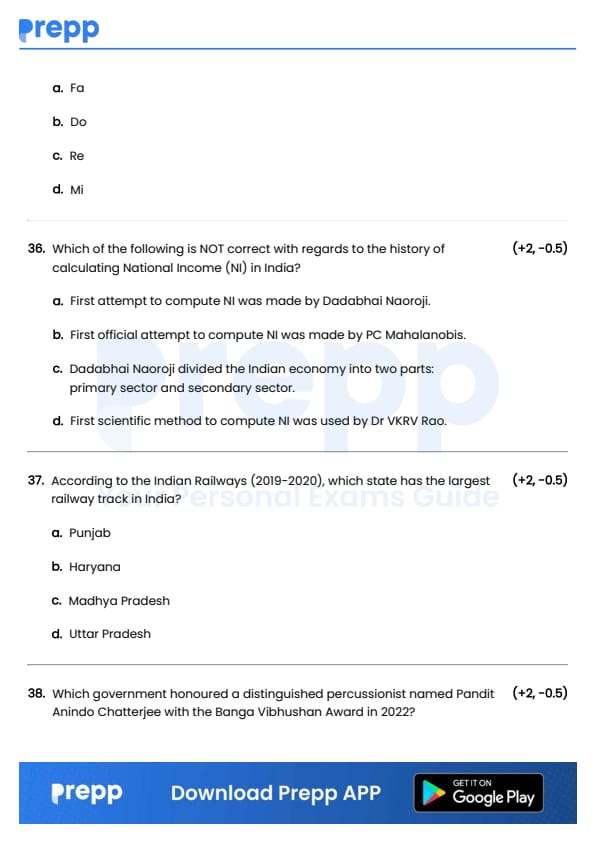
In which musical note did Newland put the metals Co and Ni with a. Fa |
(D) Do | Newlands’ Law of Octaves organized elements by their increasing atomic weights and aligned them with musical notes. In this arrangement, cobalt (Co) and nickel (Ni) were grouped with halogens (fluorine, chlorine, etc.) under the musical note "Do." |
|
Which of the following is NOT correct with regards to the history of |
(C) Dadabhai Naoroji divided the Indian economy into two parts: primary sector and secondary sector. |
Dadabhai Naoroji was the first to estimate National Income for India in his book Poverty and Un-British Rule in India in the 19th century. Dadabhai Naoroji did not divide the economy into primary and secondary sectors. This classification was a later development in economic studies, introduced by more systematic national income accounting methods. |
| According to the Indian Railways (2019-2020), which state has the largest railway track in India? a. Punjab b. Haryana c. Madhya Pradesh d. Uttar Pradesh |
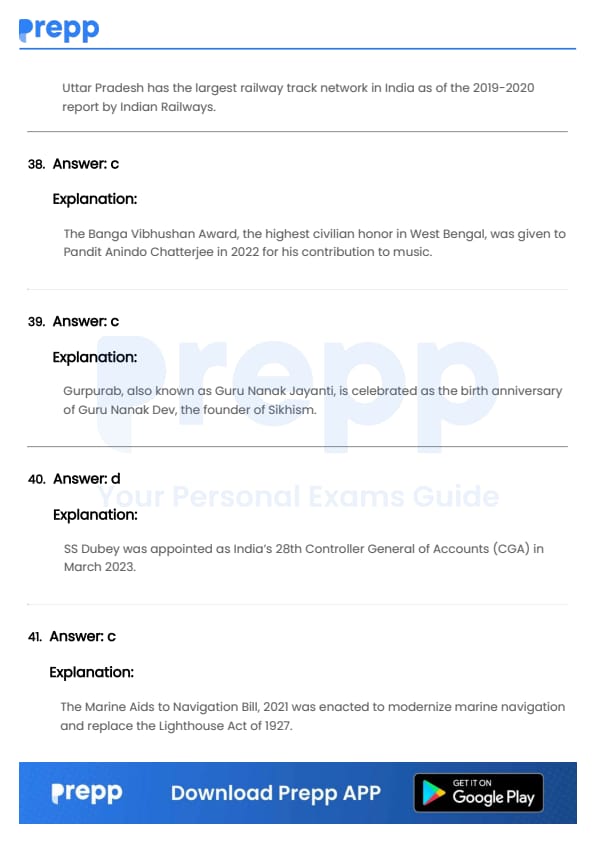
(D) Uttar Pradesh | Uttar Pradesh has the largest railway track network in India as of the 2019-2020 report by Indian Railways. |
|
Which government honoured a distinguished percussionist named Pandit a. Assam |
(C) West Bengal | The Banga Vibhushan Award, the highest civilian honor in West Bengal, was given to Pandit Anindo Chatterjee in 2022 for his contribution to music. |
| Which of the following festivals is celebrated as the birth anniversary of Guru Nanak Dev? a. Hola Mohalla b. Baisakhi c. Gurpurab d. Chappar Mela |
(C) Gurpurab | Gurpurab, also known as Guru Nanak Jayanti, is celebrated as the birth anniversary of Guru Nanak Dev, the founder of Sikhism. |
| Who was appointed as India’s 28th Controller General of Accounts (CGA) in March 2023? a. Arun Goel b. Praveen Sharma c. Vikram Devdutt d. SS Dubey |
(D) SS Dubey | SS Dubey was appointed as India’s 28th Controller General of Accounts (CGA) in March 2023. |
|
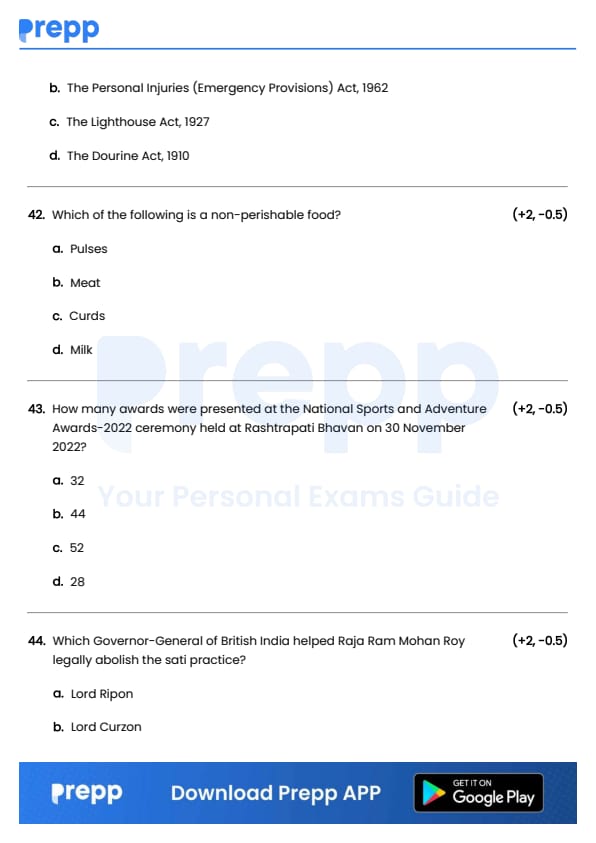
Which of the following is a non-perishable food? a. Pulses |
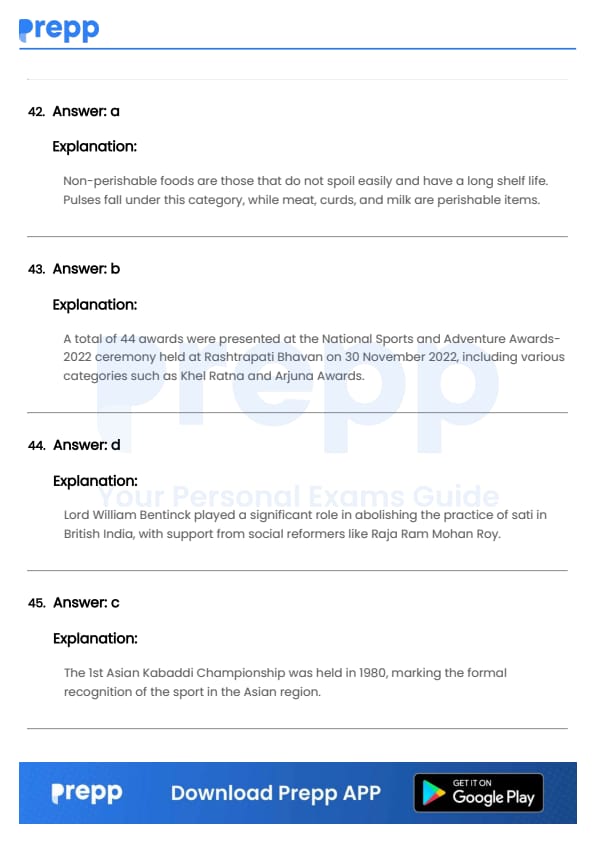
(A) Pulses | Non-perishable foods are those that do not spoil easily and have a long shelf life. Pulses fall under this category, while meat, curds, and milk are perishable items. |
|
How many awards were presented at the National Sports and Adventure a. 32 |
(B) 44 | A total of 44 awards were presented at the National Sports and Adventure Awards2022 ceremony held at Rashtrapati Bhavan on 30 November 2022, including various categories such as Khel Ratna and Arjuna Awards. |
|
Which Governor-General of British India helped Raja Ram Mohan Roy a. Lord Ripon |
(D) Lord William Bentinck | Lord William Bentinck played a significant role in abolishing the practice of sati in British India, with support from social reformers like Raja Ram Mohan Roy. |
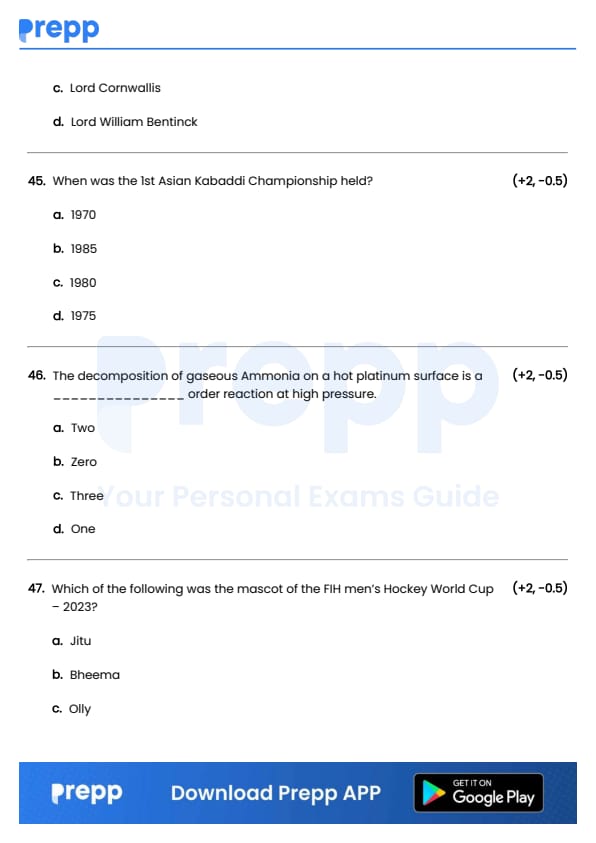
| When was the 1st Asian Kabaddi Championship held? a. 1970 b. 1985 c. 1980 d. 1975 |
(C) 1980 | The 1st Asian Kabaddi Championship was held in 1980, marking the formal recognition of the sport in the Asian region |
| The decomposition of gaseous Ammonia on a hot platinum surface is a _______________ order reaction at high pressure. a. Two b. Zero c. Three d. One |
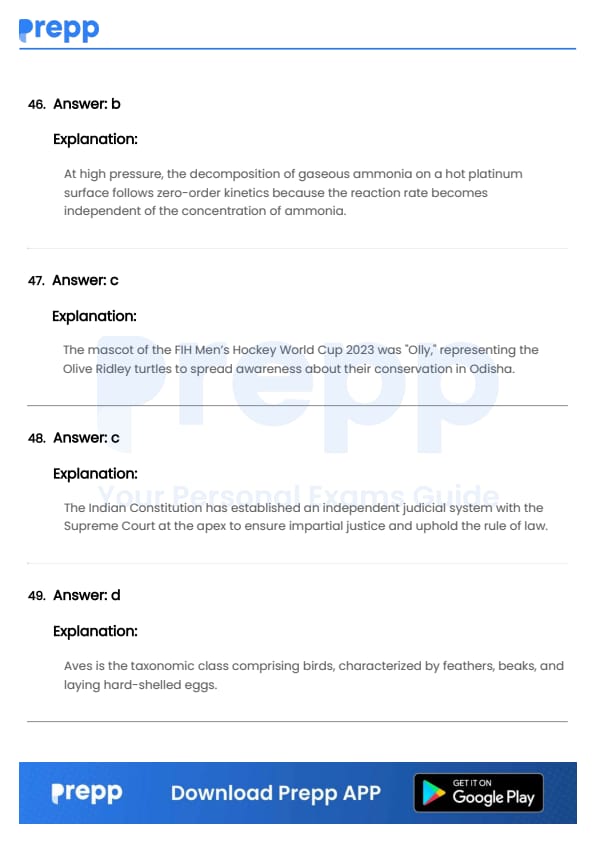
(B) Zero | At high pressure, the decomposition of gaseous ammonia on a hot platinum surface follows zero-order kinetics because the reaction rate becomes independent of the concentration of ammonia. |
|
Which of the following was the mascot of the FIH men’s Hockey World Cup |
(C) Olly | The mascot of the FIH Men’s Hockey World Cup 2023 was "Olly," representing the Olive Ridley turtles to spread awareness about their conservation in Odisha. |
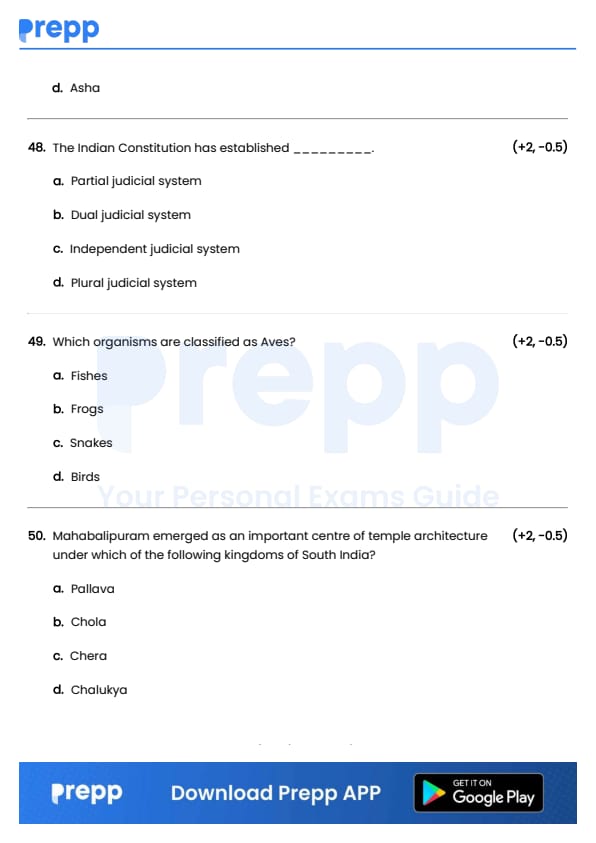
| The Indian Constitution has established _________. a. Partial judicial system b. Dual judicial system c. Independent judicial system d. Plural judicial system |
(C) Independent judicial system | The Indian Constitution has established an independent judicial system with the Supreme Court at the apex to ensure impartial justice and uphold the rule of law. |
| Which organisms are classified as Aves? a. Fishes b. Frogs c. Snakes d. Birds |
(D) Birds | Aves is the taxonomic class comprising birds, characterized by feathers, beaks, and laying hard-shelled eggs. |
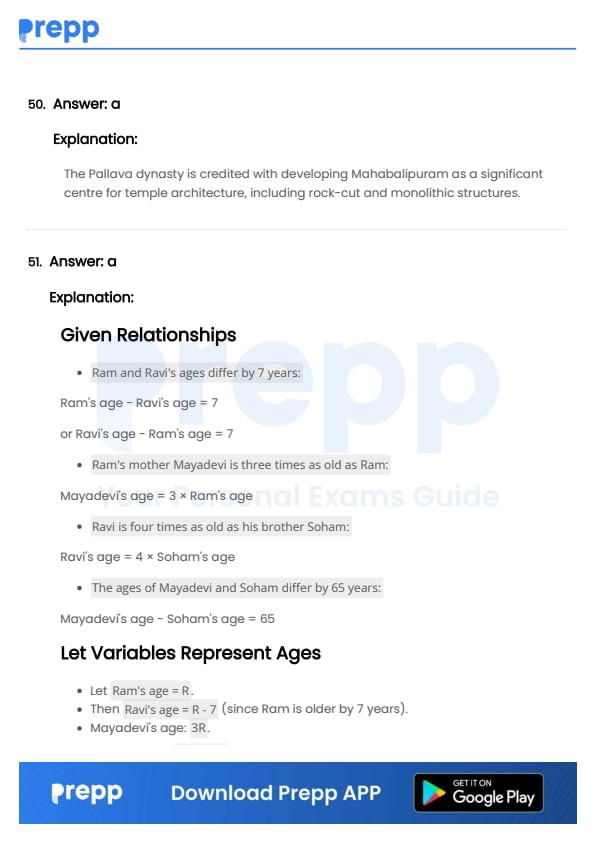
| Mahabalipuram emerged as an important centre of temple architecture under which of the following kingdoms of South India? a. Pallava b. Chola c. Chera d. Chalukya |
(A) Pallava | The Pallava dynasty is credited with developing Mahabalipuram as a significant centre for temple architecture, including rock-cut and monolithic structures. |
| Quantitative Aptitude | ||
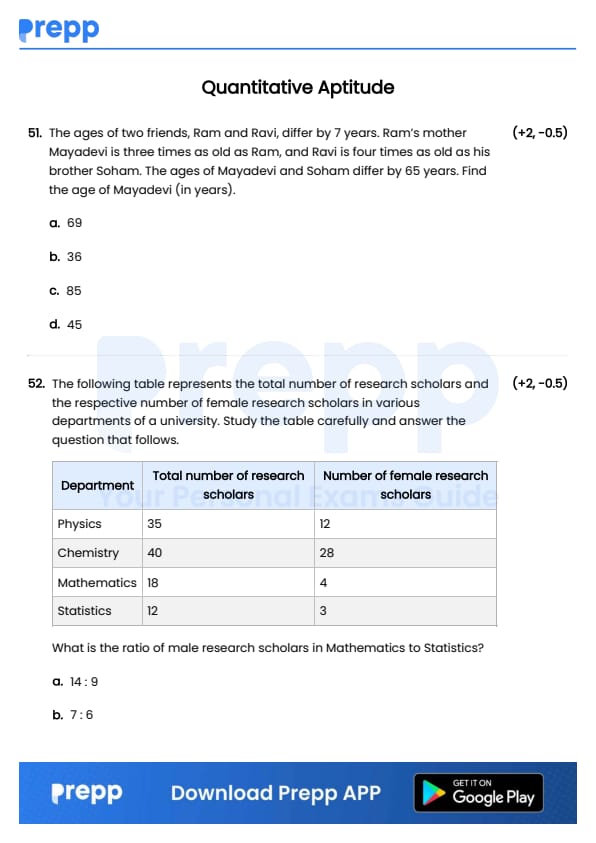
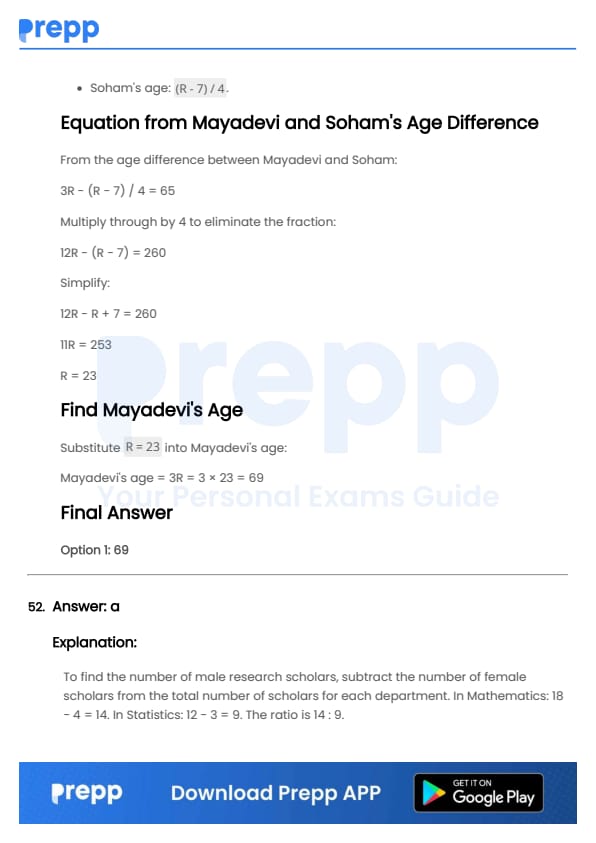
| The ages of two friends, Ram and Ravi, differ by 7 years. Ram’s mother Mayadevi is three times as old as Ram, and Ravi is four times as old as his brother Soham. The ages of Mayadevi and Soham differ by 65 years. Find the age of Mayadevi (in years). a. 69 b. 36 c. 85 d. 45 |
(A) 69 | Given Relationships Ram and Ravi's ages dier by 7 years: Ram's age - Ravi's age = 7 or Ravi's age - Ram's age = 7 Ram's mother Mayadevi is three times as old as Ram: Mayadevi's age = 3 × Ram's age Ravi is four times as old as his brother Soham: Ravi's age = 4 × Soham's age Read MoreThe ages of Mayadevi and Soham dier by 65 years:Mayadevi's age - Soham's age = 65 Let Variables Represent Ages Let Ram's age = R . Then Ravi's age = R - 7 (since Ram is older by 7 years). Mayadevi's age: 3R. Soham's age: (R - 7) / 4 . Equation from Mayadevi and Soham's Age Difference From the age difference between Mayadevi and Soham: 3R - (R - 7) / 4 = 65 Multiply through by 4 to eliminate the fraction: 12R - (R - 7) = 260 Simplify: 12R - R + 7 = 260 11R = 253 R = 23 Find Mayadevi's Age Substitute R = 23 into Mayadevi's age: Mayadevi's age = 3R = 3 × 23 = 69 Final Answer Option 1: 69 |
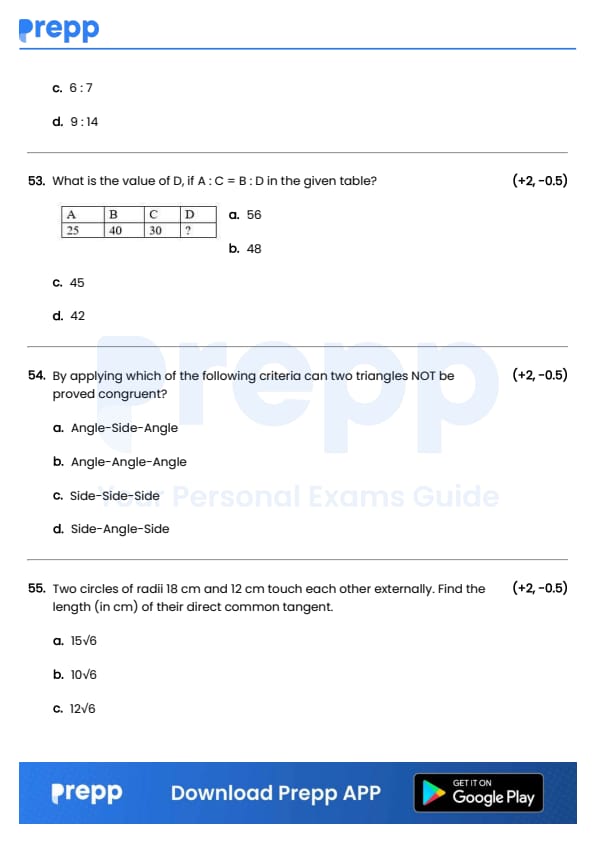
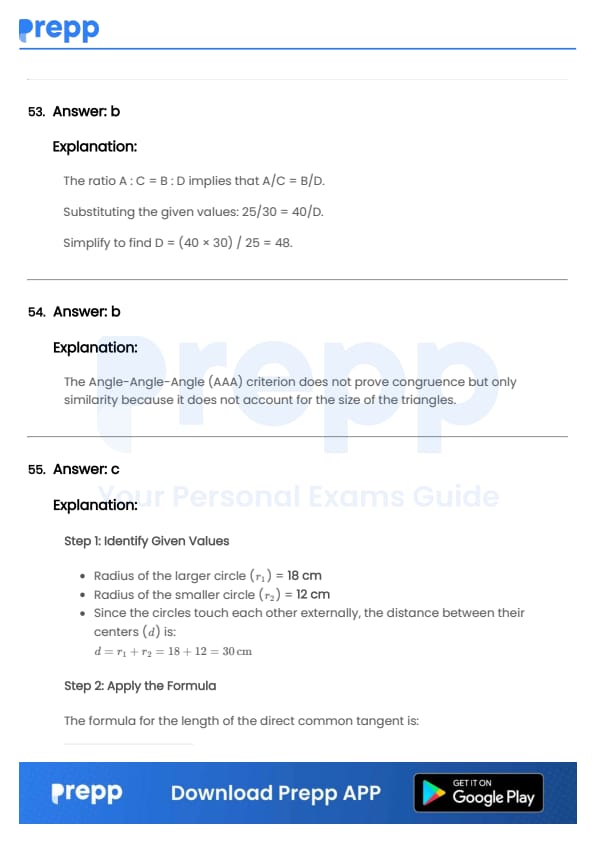
| By applying which of the following criteria can two triangles NOT be proved congruent? a. Angle-Side-Angle b. Angle-Angle-Angle c. Side-Side-Side d. Side-Angle-Side |
(B) Angle-Angle-Angle | The Angle-Angle-Angle (AAA) criterion does not prove congruence but only similarity because it does not account for the size of the triangles. |
|
Two circles of radii 18 cm and 12 cm touch each other externally. Find the |
(C) 12√6 | Step 1: Identify Given Values Radius of the larger circle (in cm ) = 18 cm Radius of the smaller circle ( in cm) = 12 cm Since the circles touch each other externally, the distance between their centers ( in cm) is: View SolutionStep 2: Apply the FormulaThe formula for the length of the direct common tangent is: Length = √(d² - (r₁ - r₂)²) Substitute the values: Length = √(30² - (18 - 12)²) Length = √(900 - 6²) Length = √(900 - 36) Length = √864 Step 3: Simplify Simplify the square root: √864 = √(144 × 6) = 12√6 |
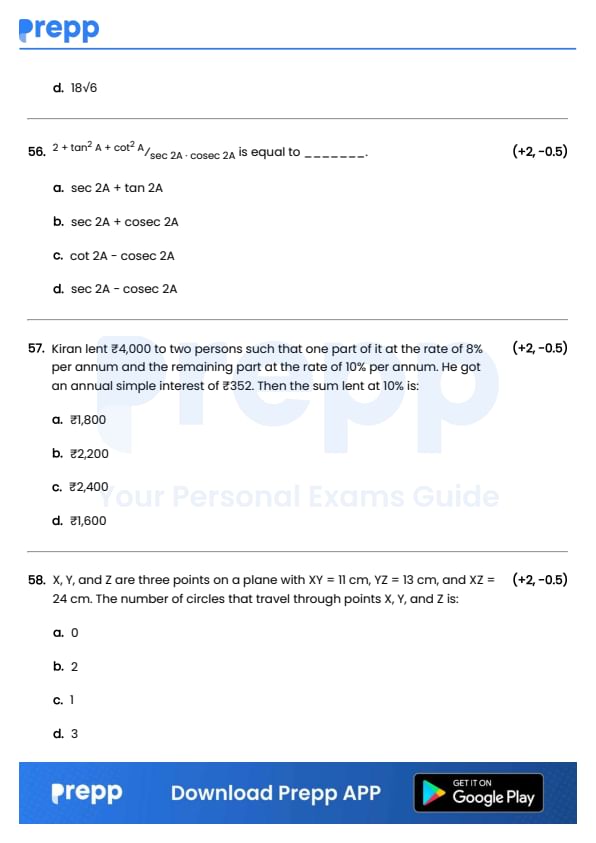
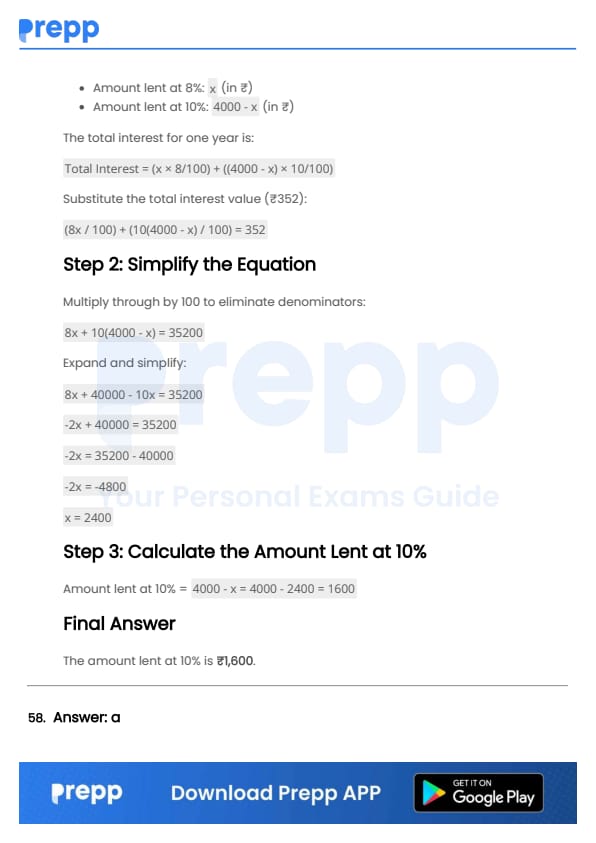
| Kiran lent ₹4,000 to two persons such that one part of it at the rate of 8% per annum and the remaining part at the rate of 10% per annum. He got an annual simple interest of ₹352. Then the sum lent at 10% is: a. ₹1,800 b. ₹2,200 c. ₹2,400 d. ₹1,600 |
(D) ₹1,600 | Step 1: Define Variables Amount lent at 8%: x (in ₹) Amount lent at 10%: 4000 - x (in ₹) The total interest for one year is: Total Interest = (x × 8/100) + ((4000 - x) × 10/100) Substitute the total interest value (₹352): (8x / 100) + (10(4000 - x) / 100) = 352 View SolutionStep 2: Simplify the EquationMultiply through by 100 to eliminate denominators: 8x + 10(4000 - x) = 35200 Expand and simplify: 8x + 40000 - 10x = 35200 -2x + 40000 = 35200 -2x = 35200 - 40000 -2x = -4800 x = 2400 Step 3: Calculate the Amount Lent at 10% Amount lent at 10% = 4000 - x = 4000 - 2400 = 1600 Final Answer The amount lent at 10% is ₹1,600. |
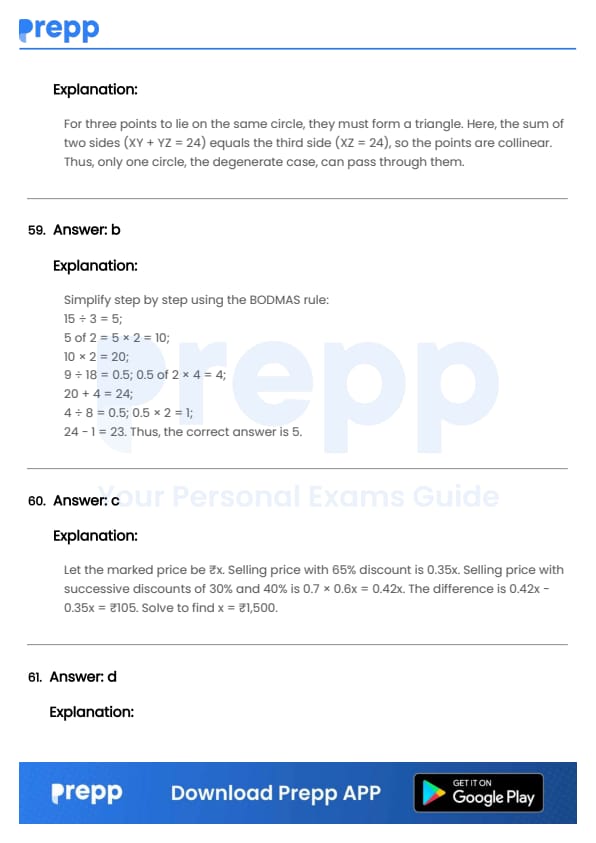
| X, Y, and Z are three points on a plane with XY = 11 cm, YZ = 13 cm, and XZ = 24 cm. The number of circles that travel through points X, Y, and Z is: a. 0 b. 2 c. 1 d. 3 |
(A) 0 | For three points to lie on the same circle, they must form a triangle. Here, the sum of two sides (XY + YZ = 24) equals the third side (XZ = 24), so the points are collinear. Thus, only one circle, the degenerate case, can pass through them. |
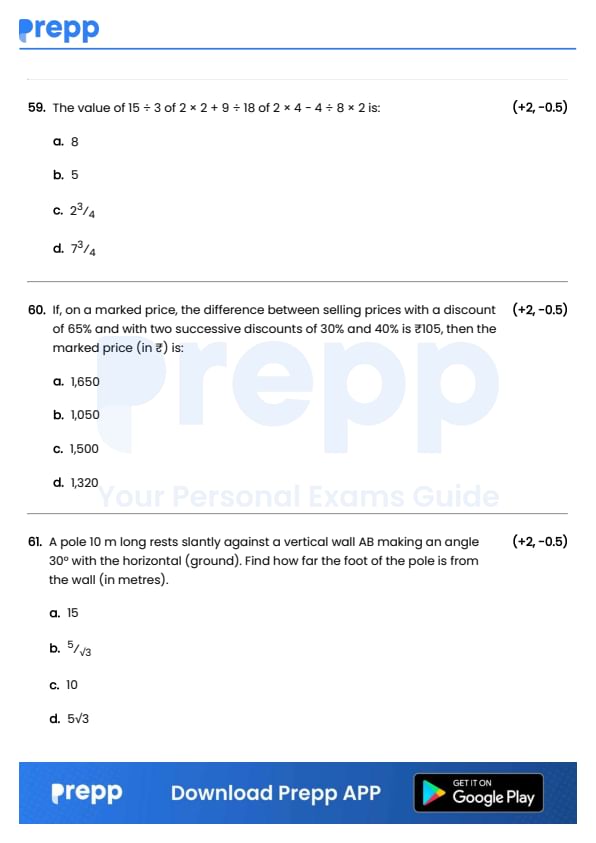
| The value of 15 ÷ 3 of 2 × 2 + 9 ÷ 18 of 2 × 4 − 4 ÷ 8 × 2 is: a. 8 b. 5 c. 2 3⁄4 d. 7 3⁄4 |
(B) 5 | Simplify step by step using the BODMAS rule: 15 ÷ 3 = 5; 5 of 2 = 5 × 2 = 10; 10 × 2 = 20; 9 ÷ 18 = 0.5; 0.5 of 2 × 4 = 4; 20 + 4 = 24; 4 ÷ 8 = 0.5; 0.5 × 2 = 1; 24 − 1 = 23. Thus, the correct answer is 5. |
| If, on a marked price, the difference between selling prices with a discount of 65% and with two successive discounts of 30% and 40% is ₹105, then the marked price (in ₹) is: a. 1,650 b. 1,050 c. 1,500 d. 1,320 |
(C) 1,500 | Let the marked price be ₹x. Selling price with 65% discount is 0.35x. Selling price with successive discounts of 30% and 40% is 0.7 × 0.6x = 0.42x. The difference is 0.42x − 0.35x = ₹105. Solve to find x = ₹1,500. |
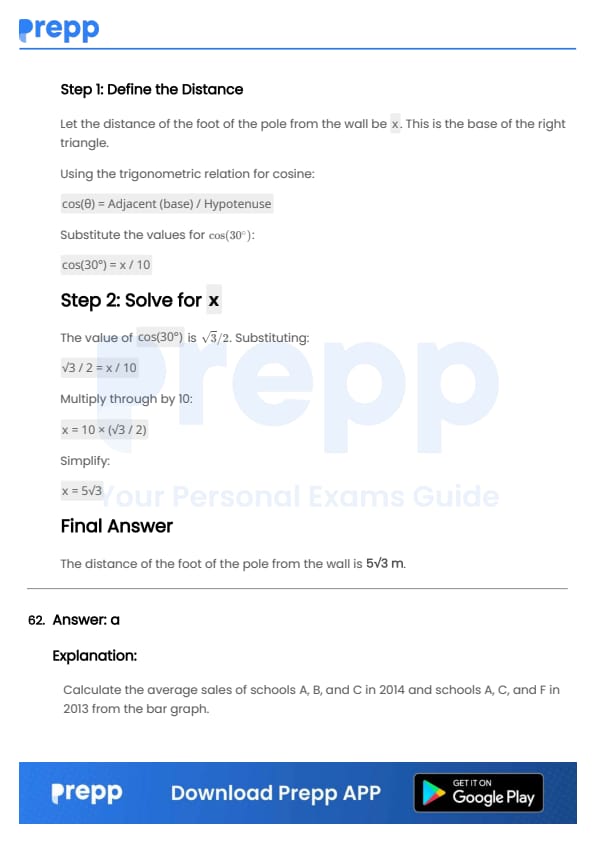
| A pole 10 m long rests slantly against a vertical wall AB making an angle 30° with the horizontal (ground). Find how far the foot of the pole is from the wall (in metres). a. 15 b. 5/√3 c. 10 d. 5√3 |
(D) 5√3 | Step 1: Define the Distance Let the distance of the foot of the pole from the wall be x . This is the base of the right triangle. Using the trigonometric relation for cosine: cos(θ) = Adjacent (base) / Hypotenuse Substitute the values for : View Solutioncos(30°) = x / 10Step 2: Solve for x The value of cos(30°) is . Substituting: √3 / 2 = x / 10 Multiply through by 10: x = 10 × (√3 / 2) Simplify: x = 5√3 Final Answer The distance of the foot of the pole from the wall is 5√3 m |
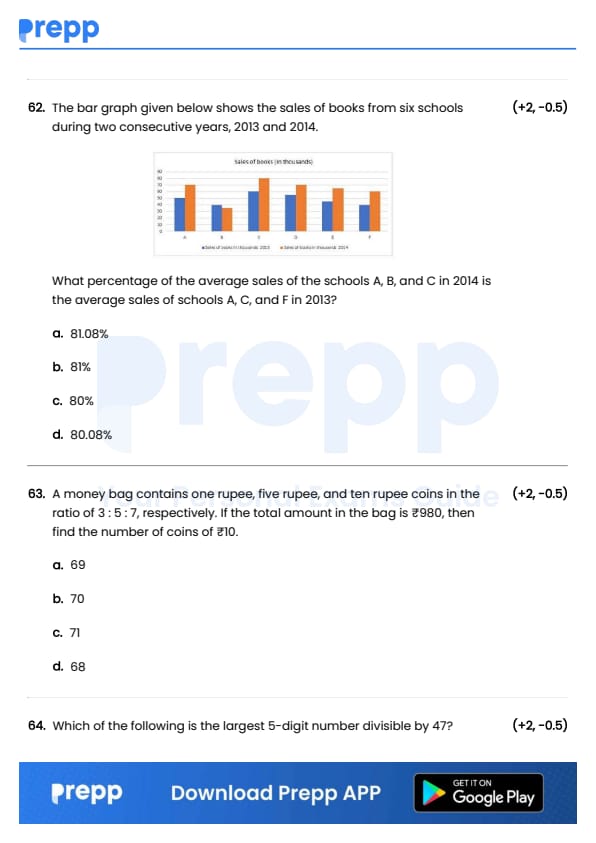
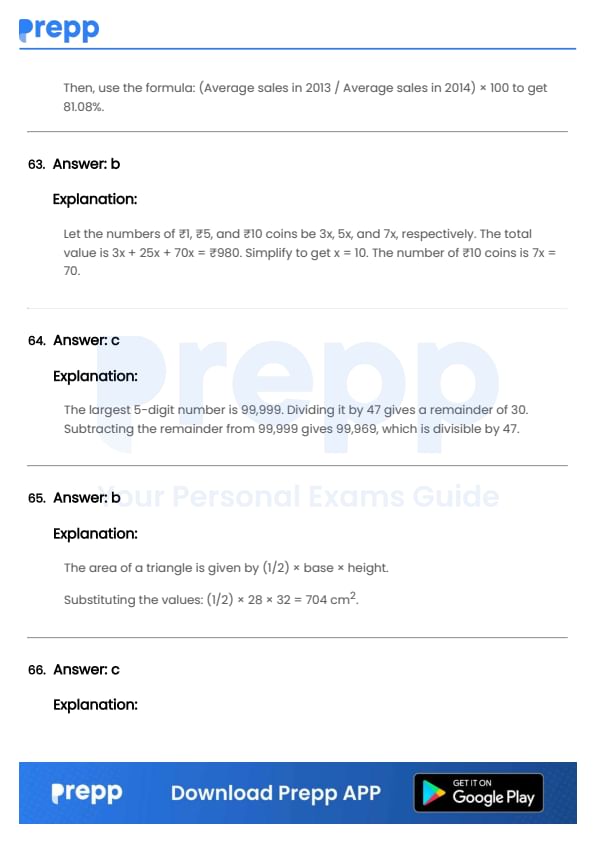
| A money bag contains one rupee, five rupee, and ten rupee coins in the ratio of 3 : 5 : 7, respectively. If the total amount in the bag is ₹980, then find the number of coins of ₹10. a. 69 b. 70 c. 71 d. 68 |
(B) 70 | Let the numbers of ₹1, ₹5, and ₹10 coins be 3x, 5x, and 7x, respectively. The total value is 3x + 25x + 70x = ₹980. Simplify to get x = 10. The number of ₹10 coins is 7x = 70. |
|
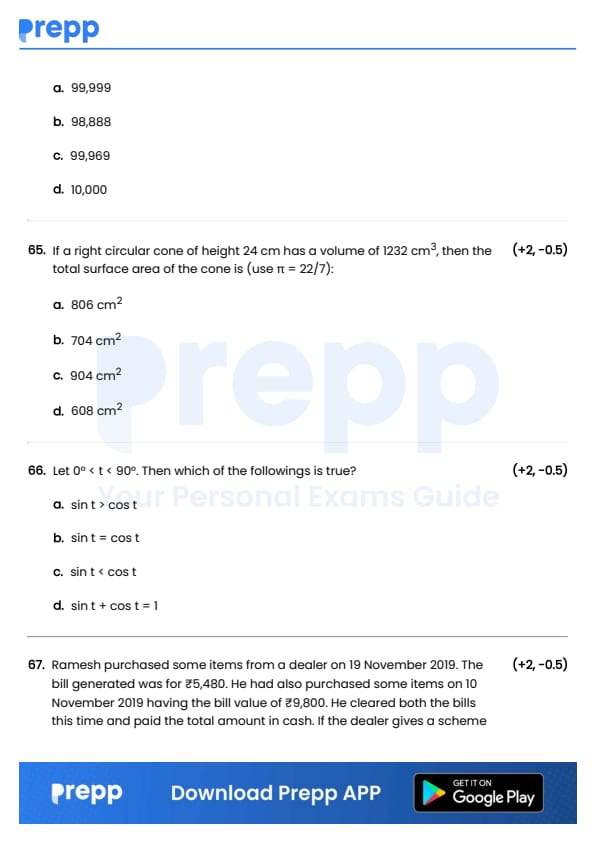
Which of the following is the largest 5-digit number divisible by 47? a. 99,999 |
(C) 99,969 | The largest 5-digit number is 99,999. Dividing it by 47 gives a remainder of 30. Subtracting the remainder from 99,999 gives 99,969, which is divisible by 47. |
| If a right circular cone of height 24 cm has a volume of 1232 cm3 , then the total surface area of the cone is (use π = 22/7): a. 806 cm2 b. 704 cm2 c. 904 cm2 d. 608 cm2 |
b. 704 cm2 | The area of a triangle is given by (1/2) × base × height. Substituting the values: (1/2) × 28 × 32 = 704 cm2 |
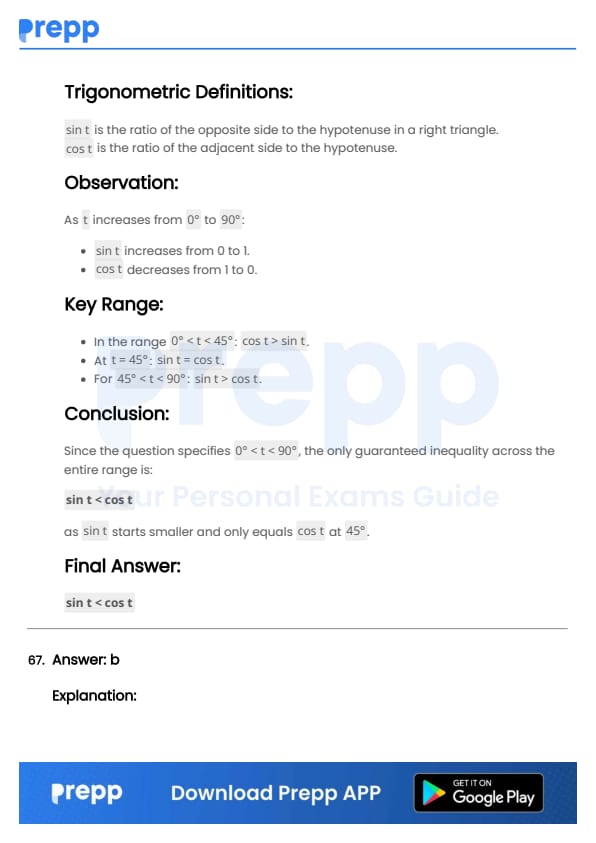
| Let 0° < t < 90°. Then which of the followings is true? a. sin t > cos t b. sin t = cos t c. sin t < cos t d. sin t + cos t = 1 |
(C) sin t < cos t | Trigonometric Definitions: sin t is the ratio of the opposite side to the hypotenuse in a right triangle. cos t is the ratio of the adjacent side to the hypotenuse. Observation: As t increases from 0° to 90° : sin t increases from 0 to 1. cos t decreases from 1 to 0. View SolutionKey Range:In the range 0° < t < 45° : cos t > sin t. At t = 45° : sin t = cos t. For 45° < t < 90° : sin t > cos t. Conclusion: Since the question specifies 0° < t < 90° , the only guaranteed inequality across the entire range is: sin t < cos t as sin t starts smaller and only equals cos t at 45° . Final Answer: sin t < cos t |
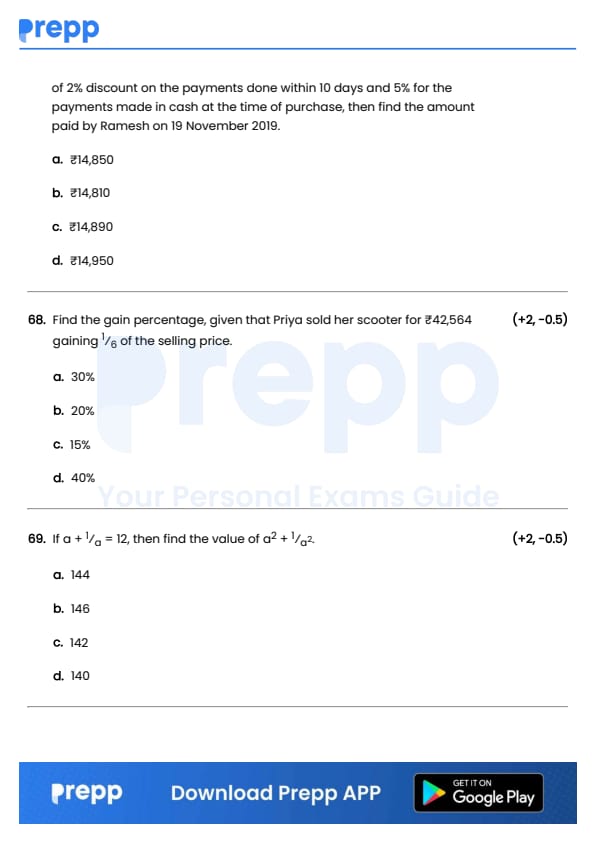
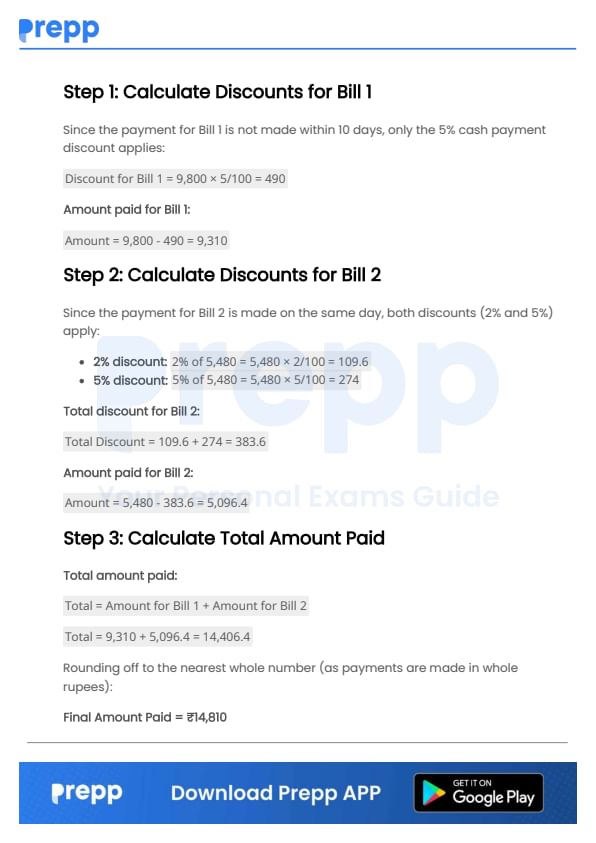
| Ramesh purchased some items from a dealer on 19 November 2019. The bill generated was for ₹5,480. He had also purchased some items on 10 November 2019 having the bill value of ₹9,800. He cleared both the bills this time and paid the total amount in cash. If the dealer gives a scheme of 2% discount on the payments done within 10 days and 5% for the payments made in cash at the time of purchase, then find the amount paid by Ramesh on 19 November 2019. a. ₹14,850 b. ₹14,810 c. ₹14,890 d. ₹14,950 |
(B) ₹14,810 | Step 1: Calculate Discounts for Bill 1 Since the payment for Bill 1 is not made within 10 days, only the 5% cash payment discount applies: Discount for Bill 1 = 9,800 × 5/100 = 490 Amount paid for Bill 1: Amount = 9,800 - 490 = 9,310 View SolutionStep 2: Calculate Discounts for Bill 2Since the payment for Bill 2 is made on the same day, both discounts (2% and 5%) apply: 2% discount: 2% of 5,480 = 5,480 × 2/100 = 109.6 5% discount: 5% of 5,480 = 5,480 × 5/100 = 274 Total discount for Bill 2: Total Discount = 109.6 + 274 = 383.6 Amount paid for Bill 2: Amount = 5,480 - 383.6 = 5,096.4 Step 3: Calculate Total Amount Paid Total amount paid: Total = Amount for Bill 1 + Amount for Bill 2 Total = 9,310 + 5,096.4 = 14,406.4 Rounding off to the nearest whole number (as payments are made in whole rupees): Final Amount Paid = ₹14,810 |
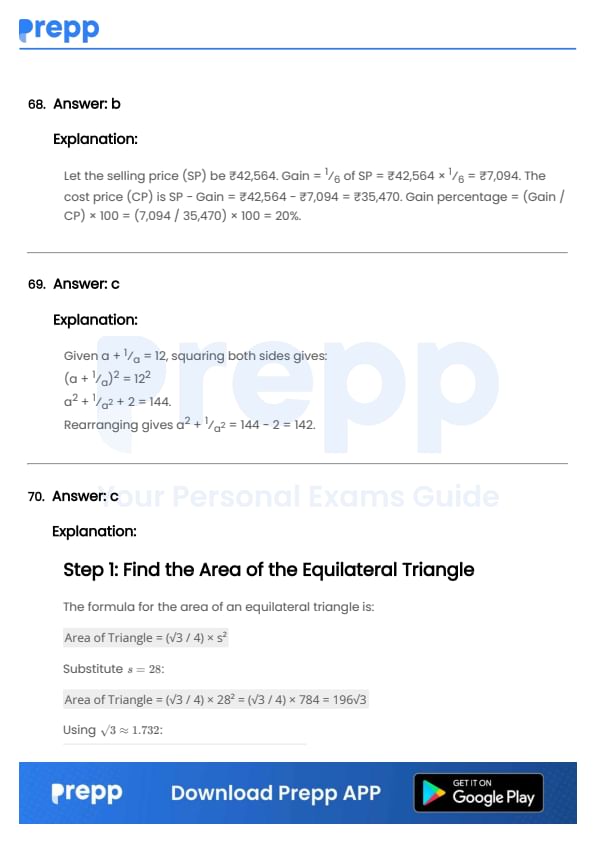
| Find the gain percentage, given that Priya sold her scooter for ₹42,564 gaining 1⁄6 of the selling price. a. 30% b. 20% c. 15% d. 40% |
(B) 20% | Let the selling price (SP) be ₹42,564. Gain = 1⁄6 of SP = ₹42,564 × 1⁄6 = ₹7,094. The cost price (CP) is SP − Gain = ₹42,564 − ₹7,094 = ₹35,470. Gain percentage = (Gain / CP) × 100 = (7,094 / 35,470) × 100 = 20%. |
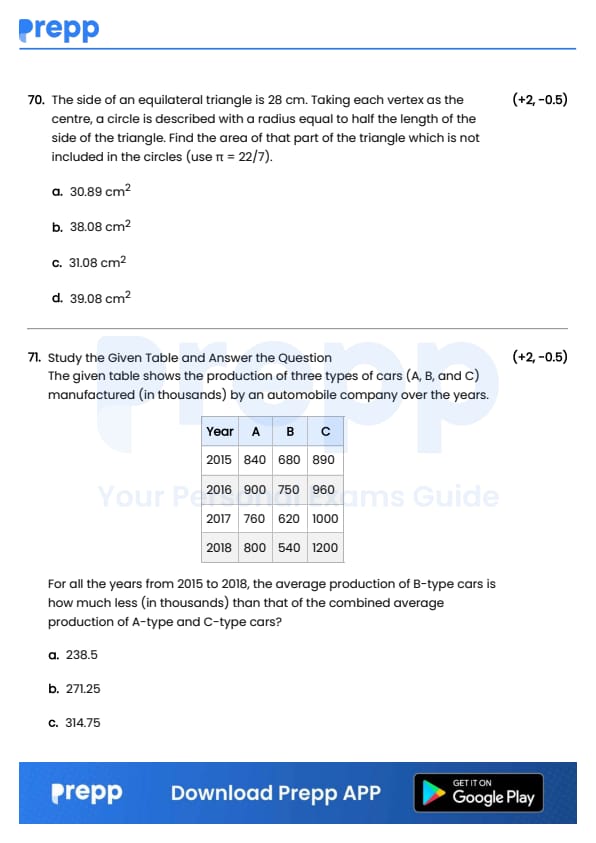
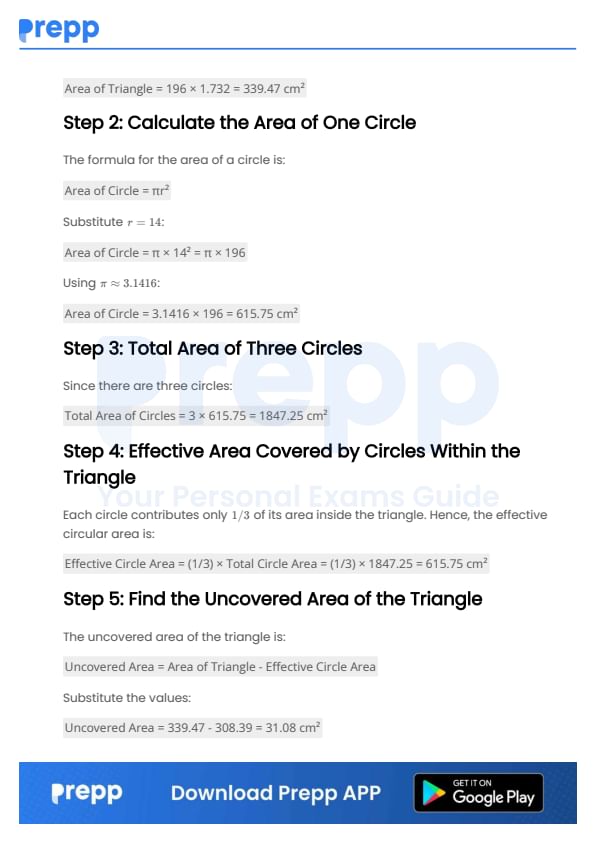
| The side of an equilateral triangle is 28 cm. Taking each vertex as the centre, a circle is described with a radius equal to half the length of the side of the triangle. Find the area of that part of the triangle which is not included in the circles (use π = 22/7). a. 30.89 cm2 b. 38.08 cm2 c. 31.08 cm2 d. 39.08 cm2 |
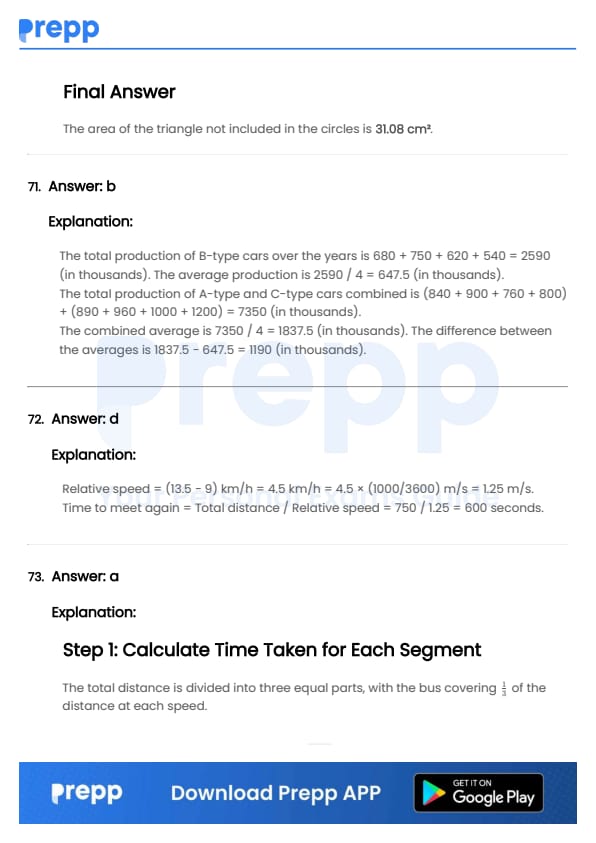
(C) 31.08 cm2 | Step 1: Find the Area of the Equilateral Triangle The formula for the area of an equilateral triangle is: Area of Triangle = (√3 / 4) × s² Substitute : Area of Triangle = (√3 / 4) × 28² = (√3 / 4) × 784 = 196√3 Using : s = 28 √3 ≈ 1.732 View SolutionArea of Triangle = 196 × 1.732 = 339.47 cm²Step 2: Calculate the Area of One Circle The formula for the area of a circle is: Area of Circle = πr² Substitute : Area of Circle = π × 14² = π × 196 Using : Area of Circle = 3.1416 × 196 = 615.75 cm² Step 3: Total Area of Three Circles Since there are three circles: Total Area of Circles = 3 × 615.75 = 1847.25 cm² Step 4: Effective Area Covered by Circles Within the Triangle Each circle contributes only of its area inside the triangle. Hence, the effective circular area is: Eective Circle Area = (1/3) × Total Circle Area = (1/3) × 1847.25 = 615.75 cm² Step 5: Find the Uncovered Area of the Triangle The uncovered area of the triangle is: Uncovered Area = Area of Triangle - Eective Circle Area Substitute the values: Uncovered Area = 339.47 - 308.39 = 31.08 cm² Final Answer The area of the triangle not included in the circles is 31.08 cm². |
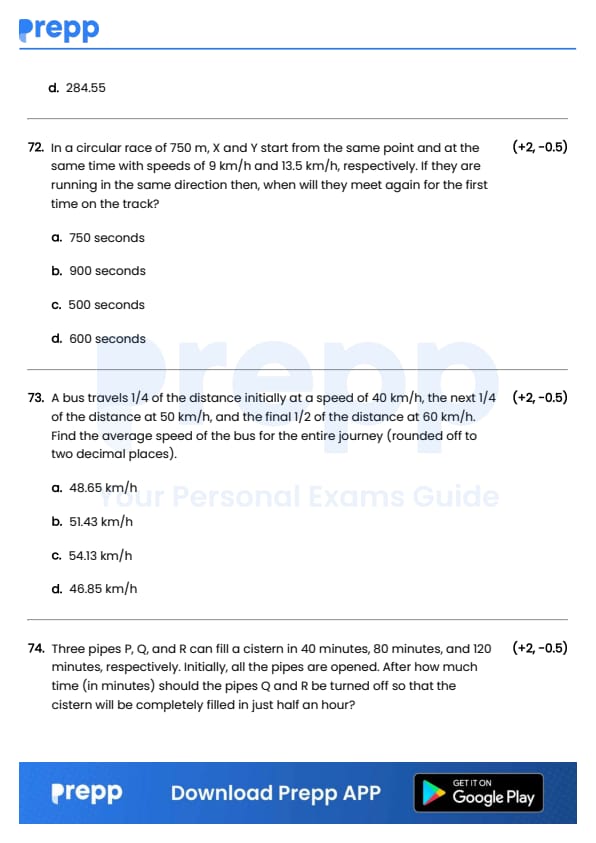
| In a circular race of 750 m, X and Y start from the same point and at the same time with speeds of 9 km/h and 13.5 km/h, respectively. If they are running in the same direction then, when will they meet again for the first time on the track? a. 750 seconds b. 900 seconds c. 500 seconds d. 600 seconds |
(D) 600 seconds | Relative speed = (13.5 − 9) km/h = 4.5 km/h = 4.5 × (1000/3600) m/s = 1.25 m/s. Time to meet again = Total distance / Relative speed = 750 / 1.25 = 600 seconds. |
| A bus travels 1/4 of the distance initially at a speed of 40 km/h, the next 1/4 of the distance at 50 km/h, and the final 1/2 of the distance at 60 km/h. Find the average speed of the bus for the entire journey (rounded off to two decimal places). a. 48.65 km/h b. 51.43 km/h c. 54.13 km/h d. 46.85 km/h |
(A) 48.65 km/h | Step 1: Calculate Time Taken for Each Segment The total distance is divided into three equal parts, with the bus covering of the distance at each speed. Distance covered in each segment: D/3 For speed 40 km/h: t₁ = (D/3) / 40 = D / 120 For speed 50 km/h: t₂ = (D/3) / 50 = D / 150 For speed 60 km/h: t₃ = (D/3) / 60 = D / 180 View SolutionStep 2: Total Time for the JourneyThe total time is the sum of the times for all three segments: tₜ ₜ ₗ = t₁ + t₂ + t₃ Substitute the values: tₜ ₜ ₗ = D/120 + D/150 + D/180 Find the LCM of 120, 150, and 180: 1800. Rewrite with common denominators: tₜ ₜ ₗ = (15D/1800) + (12D/1800) + (10D/1800) tₜ ₜ ₗ = 37D / 1800 Step 3: Calculate Average Speed The formula for average speed is: Average Speed = Total Distance / Total Time Substitute the values: Average Speed = D / (37D / 1800) Simplify: Average Speed = 1800 / 37 ≈ 48.65 km/h Final Answer The average speed of the bus is 48.65 km/h |
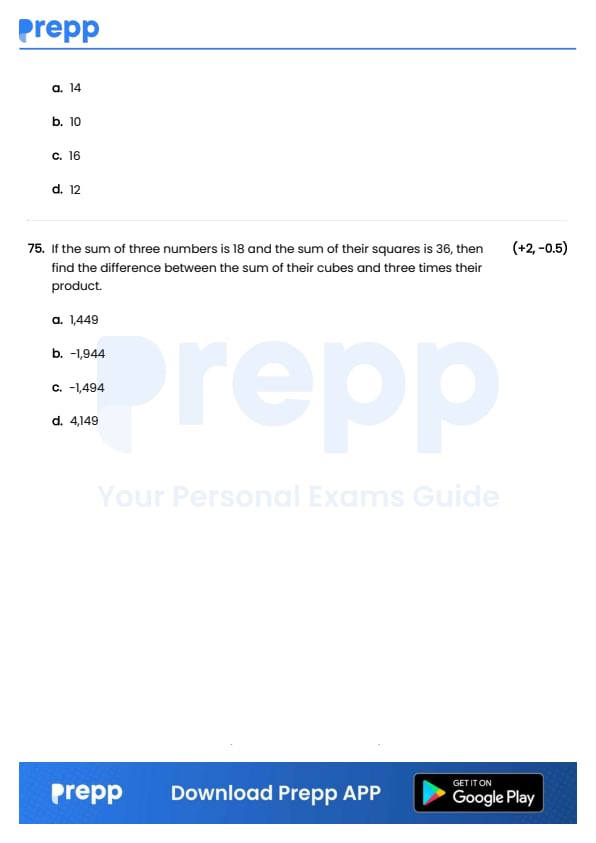
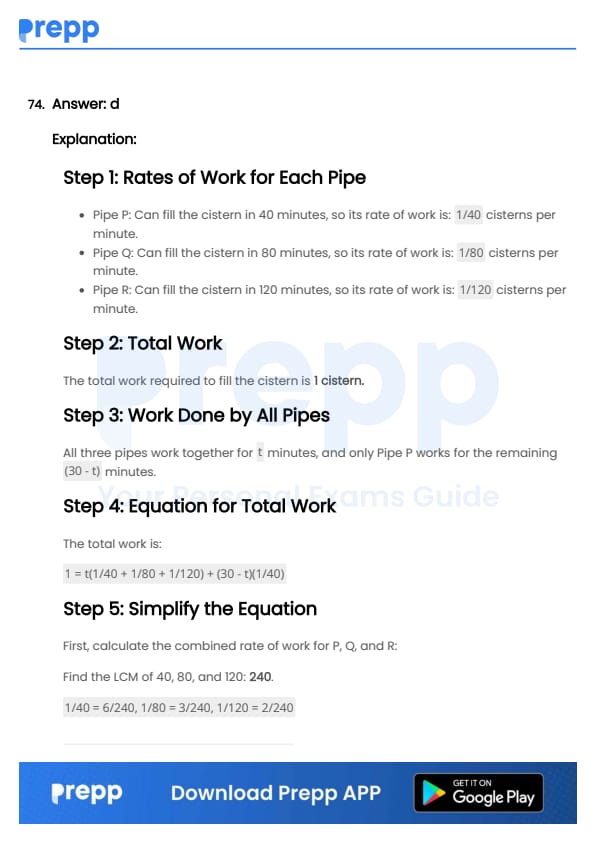
| Three pipes P, Q, and R can fill a cistern in 40 minutes, 80 minutes, and 120 minutes, respectively. Initially, all the pipes are opened. After how much time (in minutes) should the pipes Q and R be turned off so that the cistern will be completely filled in just half an hour? a. 14 b. 10 c. 16 d. 12 |
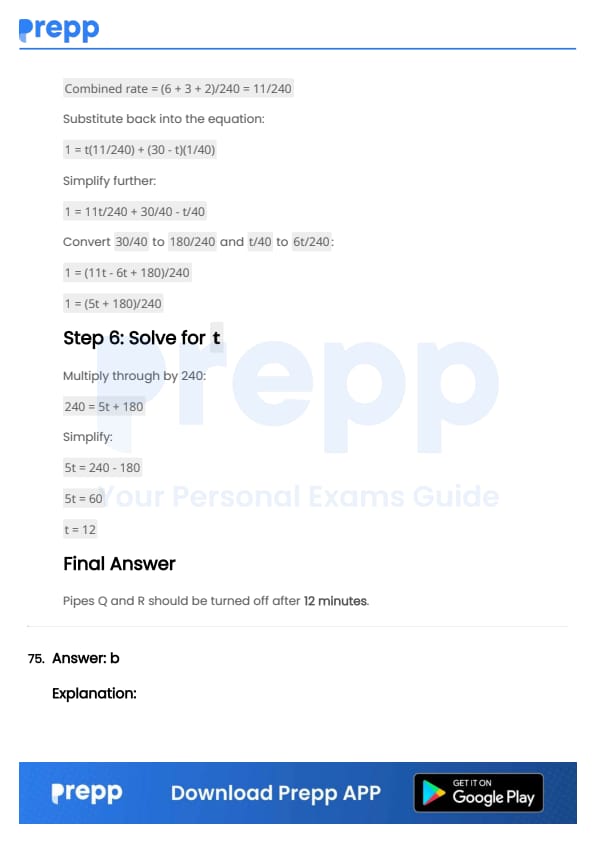
(D) 12 | Step 1: Rates of Work for Each Pipe Pipe P: Can fill the cistern in 40 minutes, so its rate of work is: 1/40 cisterns per minute. Pipe Q: Can fill the cistern in 80 minutes, so its rate of work is: 1/80 cisterns per minute. Pipe R: Can fill the cistern in 120 minutes, so its rate of work is: 1/120 cisterns per minute. View SolutionStep 2: Total WorkThe total work required to fill the cistern is 1 cistern. Step 3: Work Done by All Pipes All three pipes work together for t minutes, and only Pipe P works for the remaining (30 - t) minutes. Step 4: Equation for Total Work The total work is: 1 = t(1/40 + 1/80 + 1/120) + (30 - t)(1/40) Step 5: Simplify the Equation First, calculate the combined rate of work for P, Q, and R: Find the LCM of 40, 80, and 120: 240. 1/40 = 6/240, 1/80 = 3/240, 1/120 = 2/240 Combined rate = (6 + 3 + 2)/240 = 11/240 Substitute back into the equation: 1 = t(11/240) + (30 - t)(1/40) Simplify further: 1 = 11t/240 + 30/40 - t/40 Convert 30/40 to 180/240 and t/40 to 6t/240 : 1 = (11t - 6t + 180)/240 1 = (5t + 180)/240 Step 6: Solve for t Multiply through by 240: 240 = 5t + 180 Simplify: 5t = 240 - 180 5t = 60 t = 12 Final Answer Pipes Q and R should be turned off after 12 minutes. |
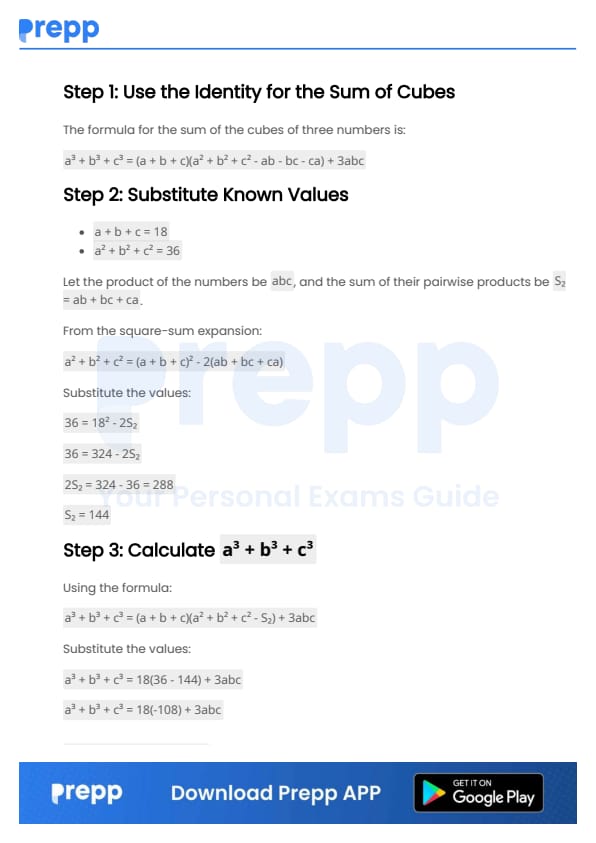
| If the sum of three numbers is 18 and the sum of their squares is 36, then find the difference between the sum of their cubes and three times their product. a. 1,449 b. −1,944 c. −1,494 d. 4,149 |
(B) −1,944 |
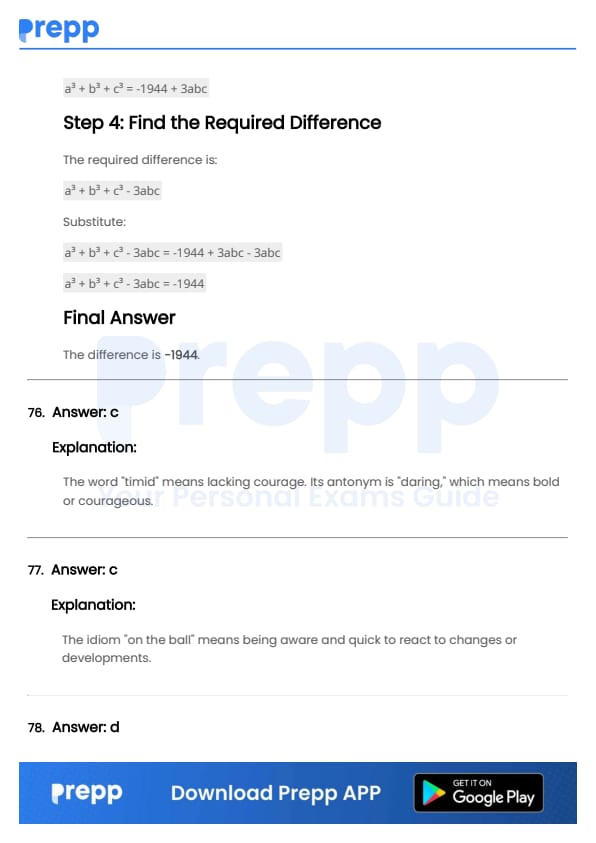
Step 1: Use the Identity for the Sum of Cubes View SolutionLet the product of the numbers be abc , and the sum of their pairwise products be S₂= ab + bc + ca . From the square-sum expansion: a² + b² + c² = (a + b + c)² - 2(ab + bc + ca) Substitute the values: 36 = 18² - 2S₂ 36 = 324 - 2S₂ 2S₂ = 324 - 36 = 288 S₂ = 144 Step 3: Calculate a³ + b³ + c³ Using the formula: a³ + b³ + c³ = (a + b + c)(a² + b² + c² - S₂) + 3abc Substitute the values: a³ + b³ + c³ = 18(36 - 144) + 3abc a³ + b³ + c³ = 18(-108) + 3abc a³ + b³ + c³ = -1944 + 3abc Step 4: Find the Required Difference The required difference is: a³ + b³ + c³ - 3abc Substitute: a³ + b³ + c³ - 3abc = -1944 + 3abc - 3abc a³ + b³ + c³ - 3abc = -1944 Final Answer The difference is -1944. |
| English Comprehension | ||
| Identify the most appropriate antonym of the given word. Timid a. Meek b. Anxious c. Daring d. Spooky |
(C) Daring | The word "timid" means lacking courage. Its antonym is "daring," which means bold or courageous. |
| Select the most appropriate meaning of the given idiom. On the ball a. Unaware of any changes or developments and lazy to react to them b. Aware of any changes or developments but slow to react to them c. Aware of any changes or developments and quick to react to them d. Aware of any changes or developments but doing nothing |
(C) Aware of any changes or developments and quick to react to them | The idiom "on the ball" means being aware and quick to react to changes or developments. |
| Select the most appropriate option to substitute the underlined segment in the given sentence. I have been living in Hyderabad since I am born. a. since I have born b. since I will be born c. since I born d. since I was born |
(D) since I was born | The correct phrase is "since I was born" as it refers to an event in the past. |
| Select the option that can be used as a one-word substitute for the given group of words. A person who sells and arranges cut flowers. a. Horticulturist b. Botanist c. Gardener d. Florist |
(D) Florist | The correct one-word substitute is "Florist," which refers to a person who sells and arranges cut flowers. |
| The following sentence has been split into four segments. Identify the segment that contains a grammatical error. After the concert was over, / they go to a restaurant, / had dinner together / and talked until midnight. a. had dinner together b. they go to a restaurant, c. After the concert was over, d. and talked until midnight |
(B) they go to a restaurant, | The error lies in "they go to a restaurant," as it should be "they went to a restaurant" to maintain consistency in past tense |
| Select the option that can be used as a one-word substitute for the given group of words. A small group of people who spend their time together and do not welcome other people into that group. a. Squad b. Clique c. Employees d. Lobby |
(B) Clique | The correct one-word substitute is "Clique," which refers to a small, exclusive group of people who often exclude others. |
| The following sentence contains a word with a spelling error. Rectify the sentence by selecting the correct spelling of the identified word from the given options. He has to be conscious of his public manners as he is a decendent of a reputed family in this region. a. Dicsendent b. Descendant c. Discendent d. Decendant |
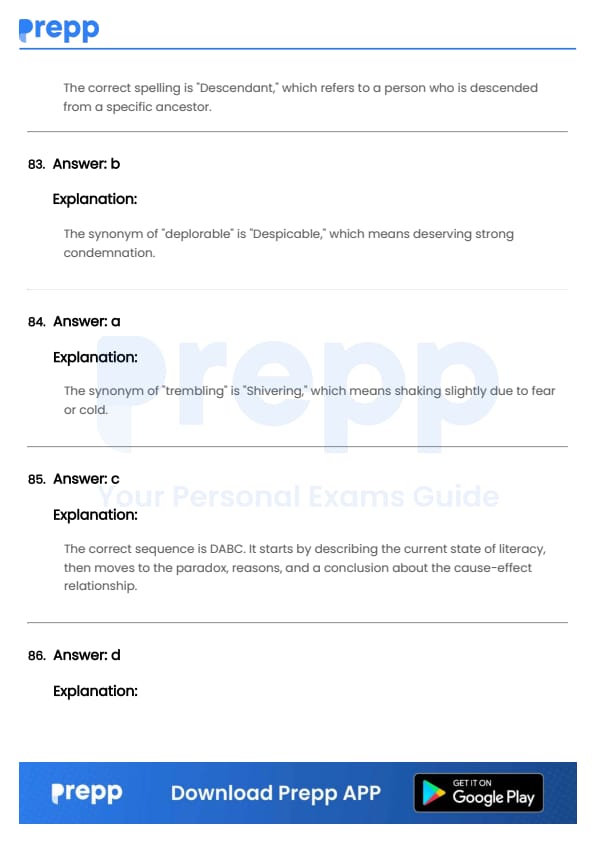
(B) Descendant | The correct spelling is "Descendant," which refers to a person who is descended from a specific ancestor. |
| Select the most appropriate synonym of the underlined word in the given sentence. The Morbi bridge mishap has left Gujarat in a deplorable state. a. Jubilation b. Despicable c. Complaining d. Rejoicing |
(B) Despicable | The synonym of "deplorable" is "Despicable," which means deserving strong condemnation. |
| Select the most appropriate synonym of the underlined word. He was trembling with fear. a. Shivering b. Weeping c. Running d. Intrepid |
(A) Shivering | The synonym of "trembling" is "Shivering," which means shaking slightly due to fear or cold. |
| Sentences of a paragraph are given below in jumbled order. Arrange the sentences in the correct order to form a meaningful and coherent paragraph. Read MoreA. More children go to school than at any time in the past. But morechildren today are out of school than any time in the past. B. But it is not enough to blame the high birth rate for this state of affairs. C. Indeed, it can be reasonably argued that continued mass illiteracy is not the result but the cause of the high birth rate. D. There are more literate people in India today than ever before. But there are also more illiterates than ever before. b. CBAD c. DABC d. BADC |
(C) DABC | The correct sequence is DABC. It starts by describing the current state of literacy, then moves to the paradox, reasons, and a conclusion about the cause-effect relationship. |
| Select the most appropriate synonym of the bold word in the following sentence. He tried to alleviate the sufferings of his neighbours. a. Swell b. Add c. Intensify d. Relieve |
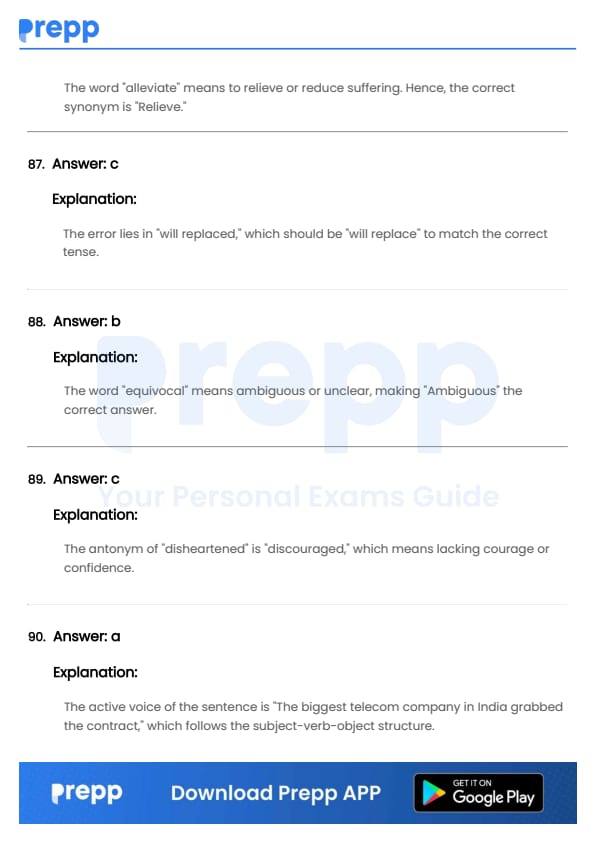
(D) Relieve | The word "alleviate" means to relieve or reduce suffering. Hence, the correct synonym is "Relieve.” |
| The following sentence has been split into four segments. Identify the segment that contains a grammatical error. Renewable energy / sources like solar and wind power / will replaced traditional fossil fuels / and help reduce carbon emissions. a. and help reduce carbon emissions b. Renewable energy c. will replaced traditional fossil fuels d. sources like solar and wind power |
(C) will replaced traditional fossil fuels | The error lies in "will replaced," which should be "will replace" to match the correct tense. |
| Identify from the given options the word which is similar in meaning to the following word. Equivocal a. Clear b. Ambiguous c. Representative d. Balanced |
(B) Ambiguous | The word "equivocal" means ambiguous or unclear, making "Ambiguous" the correct answer. |
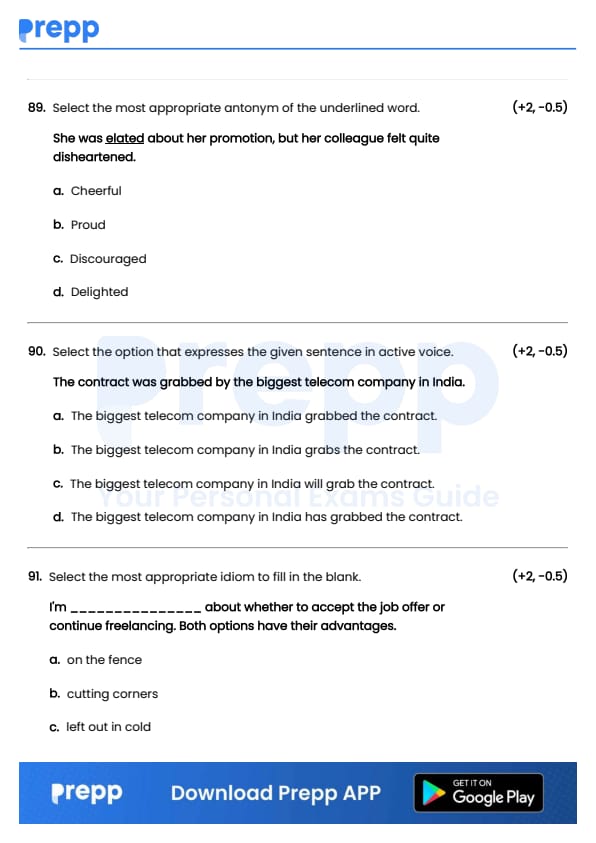
| Select the most appropriate antonym of the underlined word. She was elated about her promotion, but her colleague felt quite disheartened. a. Cheerful b. Proud c. Discouraged d. Delighted |
(C) Discouraged | The antonym of "disheartened" is "discouraged," which means lacking courage or confidence. |
| Select the option that expresses the given sentence in active voice. The contract was grabbed by the biggest telecom company in India. a. The biggest telecom company in India grabbed the contract. b. The biggest telecom company in India grabs the contract. c. The biggest telecom company in India will grab the contract. d. The biggest telecom company in India has grabbed the contract. |
(A) The biggest telecom company in India grabbed the contract. | The active voice of the sentence is "The biggest telecom company in India grabbed the contract," which follows the subject-verb-object structure. |
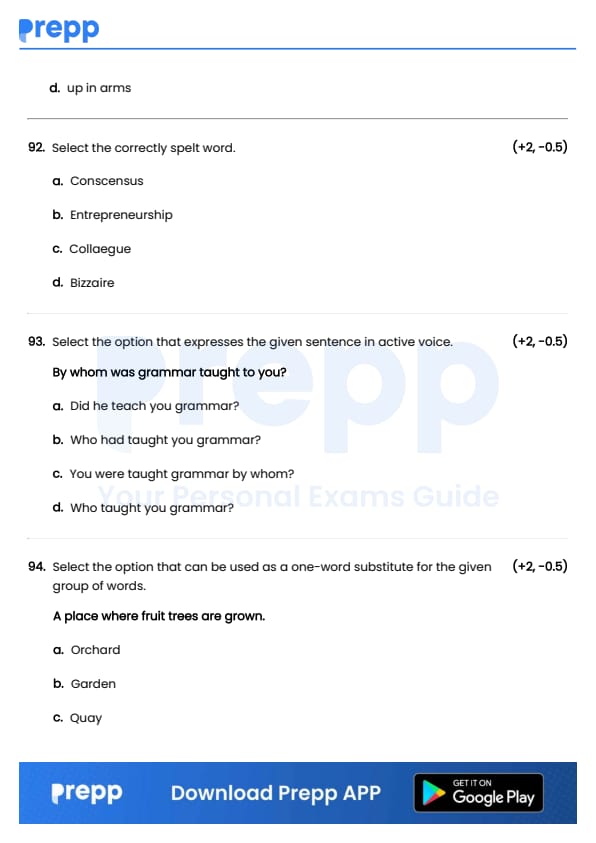
| Select the most appropriate idiom to fill in the blank. I'm _______________ about whether to accept the job offer or continue freelancing. Both options have their advantages. a. on the fence b. cutting corners c. left out in cold d. up in arms |
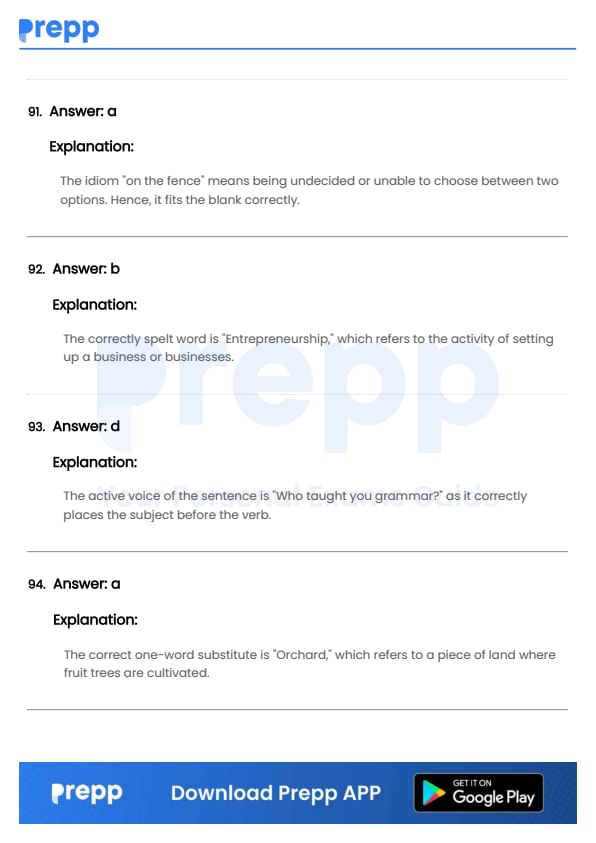
(A) on the fence | The idiom "on the fence" means being undecided or unable to choose between two options. Hence, it fits the blank correctly. |
| Select the correctly spelt word. a. Conscensus b. Entrepreneurship c. Collaegue d. Bizzaire |
(B) Entrepreneurship | The correctly spelt word is "Entrepreneurship," which refers to the activity of setting up a business or businesses. |
| Select the option that expresses the given sentence in active voice. By whom was grammar taught to you? a. Did he teach you grammar? b. Who had taught you grammar? c. You were taught grammar by whom? d. Who taught you grammar? |
(D) Who taught you grammar? | The active voice of the sentence is "Who taught you grammar?" as it correctly places the subject before the verb. |
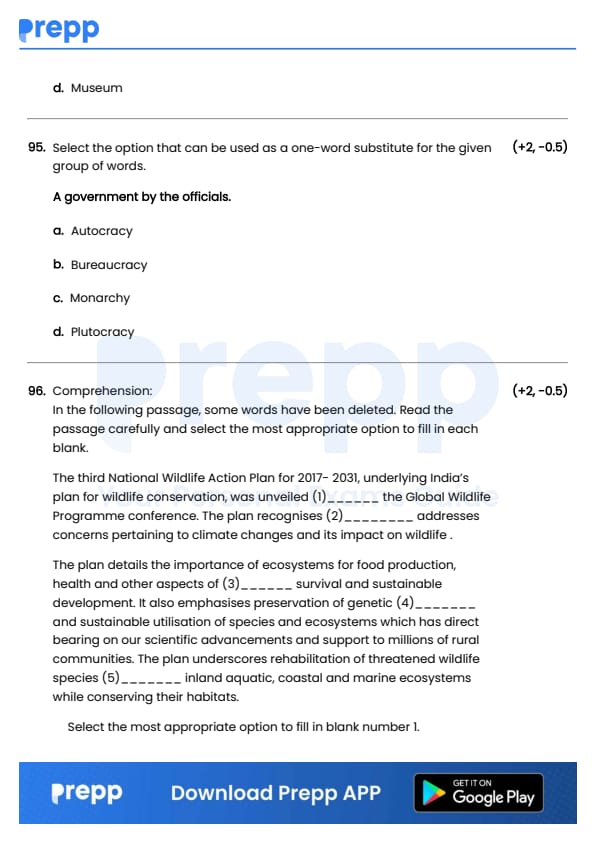
| Select the option that can be used as a one-word substitute for the given group of words. A place where fruit trees are grown. a. Orchard b. Garden c. Quay d. Museum |
(A) Orchard | The correct one-word substitute is "Orchard," which refers to a piece of land where fruit trees are cultivated. |
| Select the option that can be used as a one-word substitute for the given group of words. A government by the officials. a. Autocracy b. Bureaucracy c. Monarchy d. Plutocracy |
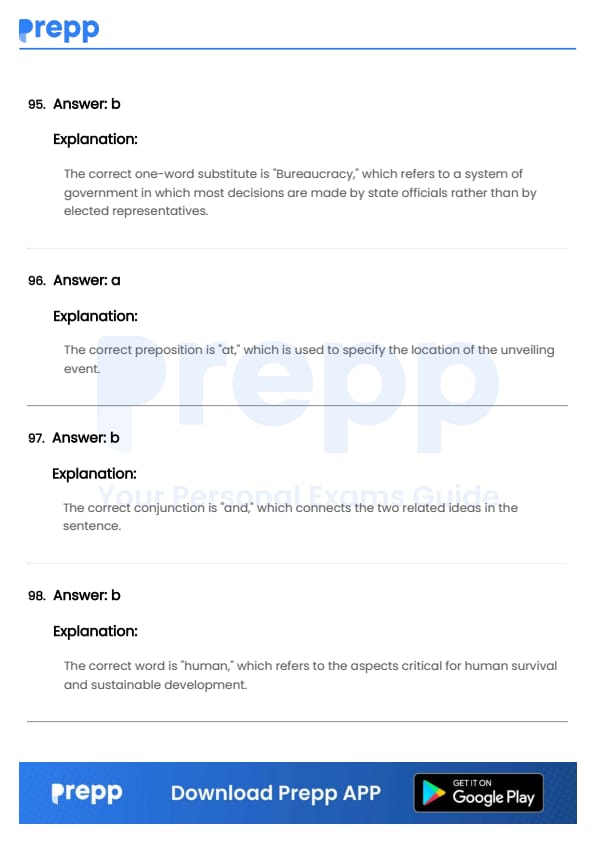
(B) Bureaucracy | The correct one-word substitute is "Bureaucracy," which refers to a system of government in which most decisions are made by state officials rather than by elected representatives. |
|
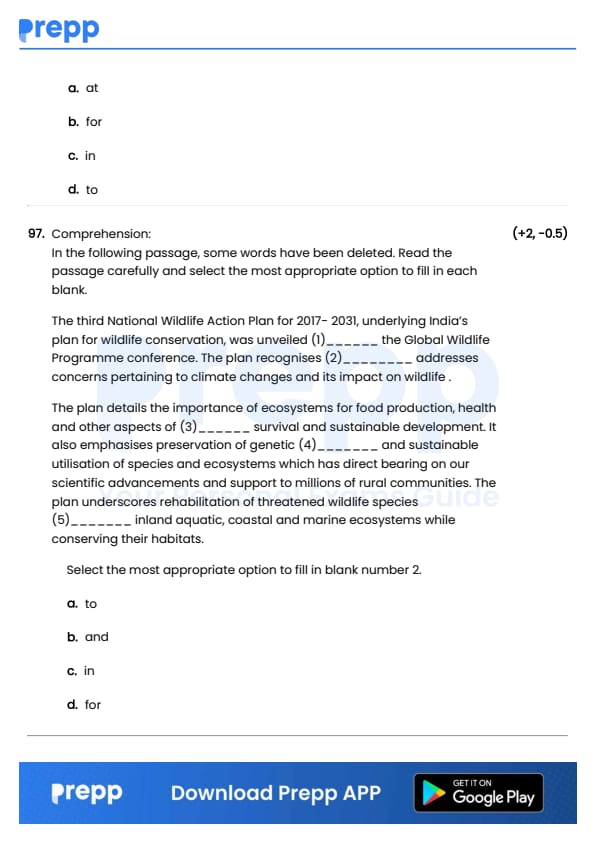
Comprehension: Read MoreThe third National Wildlife Action Plan for 2017- 2031, underlying India’splan for wildlife conservation, was unveiled (1)______ the Global Wildlife Programme conference. The plan recognises (2)________ addresses concerns pertaining to climate changes and its impact on wildlife . The plan details the importance of ecosystems for food production, health and other aspects of (3)______ survival and sustainable development. It also emphasises preservation of genetic (4)_______ and sustainable utilisation of species and ecosystems which has direct bearing on our scientific advancements and support to millions of rural communities. The plan underscores rehabilitation of threatened wildlife species (5)_______ inland aquatic, coastal and marine ecosystems while conserving their habitats. Select the most appropriate option to fill in blank number 1. a. atb. for c. in d. to |
(A) at | The correct preposition is "at," which is used to specify the location of the unveiling event. |
|
Comprehension: Read MoreThe third National Wildlife Action Plan for 2017- 2031, underlying India’splan for wildlife conservation, was unveiled (1)______ the Global Wildlife Programme conference. The plan recognises (2)________ addresses concerns pertaining to climate changes and its impact on wildlife . The plan details the importance of ecosystems for food production, health and other aspects of (3)______ survival and sustainable development. It also emphasises preservation of genetic (4)_______ and sustainable utilisation of species and ecosystems which has direct bearing on our scientific advancements and support to millions of rural communities. The plan underscores rehabilitation of threatened wildlife species (5)_______ inland aquatic, coastal and marine ecosystems while conserving their habitats. a. to b. and c. in d. for |
(B) and | The correct conjunction is "and," which connects the two related ideas in the sentence |
|
Comprehension: Read MoreThe third National Wildlife Action Plan for 2017- 2031, underlying India’splan for wildlife conservation, was unveiled (1)______ the Global Wildlife Programme conference. The plan recognises (2)________ addresses concerns pertaining to climate changes and its impact on wildlife . The plan details the importance of ecosystems for food production, health and other aspects of (3)______ survival and sustainable development. It also emphasises preservation of genetic (4)_______ and sustainable utilisation of species and ecosystems which has direct bearing on our scientific advancements and support to millions of rural communities. The plan underscores rehabilitation of threatened wildlife species (5)_______ inland aquatic, coastal and marine ecosystems while conserving their habitats. a. group b. human c. species d. breed |
(B) human | The correct word is "human," which refers to the aspects critical for human survival and sustainable development. |
|
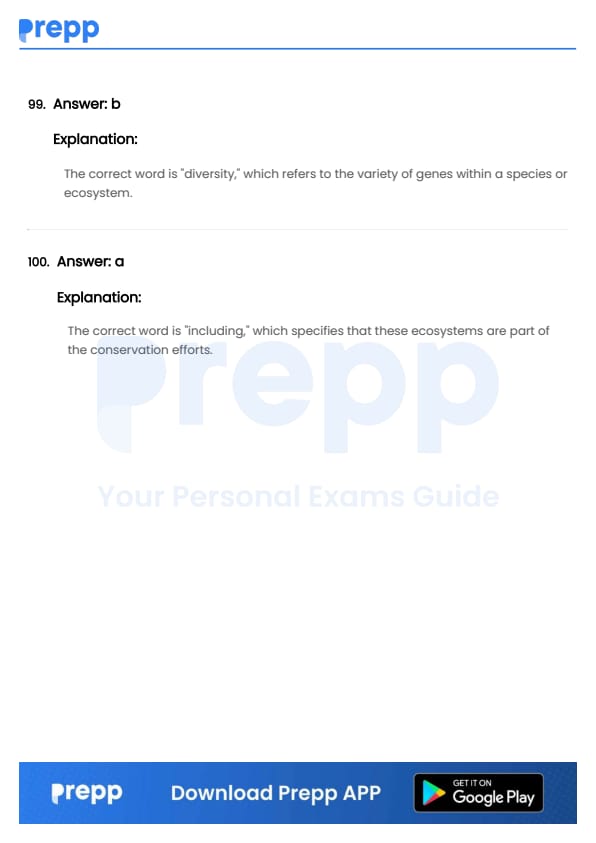
Comprehension: Read MoreThe third National Wildlife Action Plan for 2017- 2031, underlying India’splan for wildlife conservation, was unveiled (1)______ the Global Wildlife Programme conference. The plan recognises (2)________ addresses concerns pertaining to climate changes and its impact on wildlife . The plan details the importance of ecosystems for food production, health and other aspects of (3)______ survival and sustainable development. It also emphasises preservation of genetic (4)_______ and sustainable utilisation of species and ecosystems which has direct bearing on our scientific advancements and support to millions of rural communities. The plan underscores rehabilitation of threatened wildlife species (5)_______ inland aquatic, coastal and marine ecosystems while conserving their habitats. a. conflict b. diversity c. focus d. rejection |
(B) diversity | The correct word is "diversity," which refers to the variety of genes within a species or ecosystem. |
|
Comprehension: Read MoreThe third National Wildlife Action Plan for 2017- 2031, underlying India’splan for wildlife conservation, was unveiled (1)______ the Global Wildlife Programme conference. The plan recognises (2)________ addresses concerns pertaining to climate changes and its impact on wildlife . The plan details the importance of ecosystems for food production, health and other aspects of (3)______ survival and sustainable development. It also emphasises preservation of genetic (4)_______ and sustainable utilisation of species and ecosystems which has direct bearing on our scientific advancements and support to millions of rural communities. The plan underscores rehabilitation of threatened wildlife species (5)_______ inland aquatic, coastal and marine ecosystems while conserving their habitats. a. including b. gathering c. counting d. mixing |
(A) including | The correct word is "including," which specifies that these ecosystems are part of the conservation efforts. |













Download the PREPP App and attempt FREE SSC CGL Mock Tests and get complete study material!
SSC CGL (Tier-I) : Quantitative Aptitude - Topper Edition

Live Test : SSC CGL 2026 (Tier-I) (Aug 09 - 12)
SSC CGL Tier II — Full Mock 06 (2026)
SSC CGL Tier II — Full Mock 05 (2026)
SSC CGL 2025 Tier 1 Question Paper (25-Sep-2025) (Shift 3)
SSC CGL 2025 Tier 1 Question Paper (12-Sep-2025) (Shift 1)

17 February 2025 | The Hindu Must Read Articles | Current Affairs

16 February 2026 | The Hindu Must Read Articles | Current Affairs

13 February 2026 | The Hindu Must Read Articles | Current Affairs









Comments