APSET 2026 Notification Out, Apply Online, Check Exam Dates
What's New in APSET?
- January 20, 2026: APSET 2026 application process has started from January 9, 2026. Eligible candidates can now fill and submit APSET application form 2026 online for Assistant Professor/Lecturer posts in Andhra Pradesh.
APSET 2026 Notification has been released by Andhra University, Visakhapatnam on January 2, 2026 for APSET (Andhra Pradesh State Eligibility Test) 2026. APSET 2026 application process began on January 9, 2026 and will continue until February 9, 2026, for eligible candidates applying for Assistant Professor/Lecturer posts. APSET notification 2026 provides complete details about eligibility criteria, exam syllabus, test centres, application process, and fee structure. Candidates are advised to read APSET 2026 notification carefully before applying to avoid any mistakes during APSET application form 2026.
APSET Exam Date 2026
| Event | Date |
|---|---|
| APSET 2026 Official Short Notice Release | December 31, 2025 |
| AP SET 2026 Online Application Starts | January 9, 2026 |
| Last Date to Submit AP SET 2026 Applications | February 9, 2026 |
| Last Date to Pay AP SET 2026 Application Fee | February 9, 2026 |
| Last Date to Apply with Late Fee of Rs. 2,000 + Registration Fee | February 25, 2026 |
| Last Date to Apply with Late Fee of Rs. 5,000 + Registration Fee | March 5, 2026 |
| AP SET 2026 Hall Ticket Release Date | March 19, 2026 |
| APSET 2026 Exam Dates | March 28 and 29, 2026 |
|
Table of Contents |
APSET Notification 2025-26
APSET short notice was released on December 31, 2025. It contains information related to the registration fee,, exam pattern, test centers, exam day guidelines, important dates for online submissions etc. The official notification of APSET 2026 has been released on the official website.
APSET Exam Pattern 2026
APSET exam is conducted at two levels- Paper 1 and Paper 2. Paper 1 will be general in nature, while Paper 2 will be based on the subject opted by the applicant. The expected exam pattern for APSET 2026, based on notifications from previous years, is mentioned in the table below:
| Paper | Paper 1 | Paper 2 |
|---|---|---|
| Mode of Exam | Offline | Offline |
| Questions in each paper | 50 | 100 |
| Duration of the exam | 60 minutes | 120 minutes |
| Type of Questions | Objective-based | Objective-based |
| Maximum number of marks | 100 | 200 |
| Marking Scheme | 2 marks each for the correct answer. 0 mark for incorrect answer marked | 2 marks each for a correct answer. 0 mark for incorrect answer marked |
| Language of Paper | Bilingual, i.e., in English and Telugu, | Bilingual in subjects such as History, Political Science, Commerce, Economics, Education, Public Administration, and Sociology. |
APSET Syllabus 2026
Knowing the syllabus of the exam is one of the primary steps in preparation for that exam. With a proper understanding of the syllabus, candidates can rightly direct their preparation. From the below table, candidates can check out the latest syllabus for each section.
APSET Syllabus for Paper 1
The detailed syllabus covering major units for Paper 1 is given below:
| Sections | Topics |
|---|---|
| Teaching aptitude |
|
| Research Aptitude |
|
| Comprehension | An unseen passage is provided, based on which questions are asked. |
| Logical Reasoning: |
|
| Data Interpretation: |
|
| Information and Communication |
|
| People, Development and Environment |
|
| Higher Education System |
|
APSET Syllabus for Paper 2
Paper 2 of APSET exam is conducted for a total of 30 subjects as tabulated below. Refer to the following table for the syllabus of some most sought subjects.
| Section | Topics |
|---|---|
| History |
|
| Commerce |
|
| Economics |
|
| English |
|
| Geography |
|
| Political Science: |
|
| Life Sciences: |
|
| Philosophy |
|
| Sociology |
|
APSET Study Notes
APSET exam is conducted for candidates who wish to make a career as Assistant Professors and Lecturers. According to APSET exam pattern, there is a written exam for two levels - Paper 1 and Paper 2.
Thus to clear the exam it's important the candidates follow the study notes which are relevant only. There are many study materials and good books available, which can be a good source for study. Check APSET Previous Question Papers here.
APSET Eligibility Criteria 2026
Candidates are required to fulfill APSET Eligibility Criteria mentioned in that year’s notification to appear for the exam.
- Applicants must have secured at least 55% marks (without rounding off) in their Master’s Degree or equivalent exam from universities/institutions recognized by UGC. The candidates belonging to reserved categories-(Backwards Classes (BC) /Scheduled Caste (SC)/Scheduled Tribe (ST)/Transgender/persons with disability (PwD)) must have secured at least 50% marks (without rounding off) in a Master’s degree or equivalent exam, to apply for this exam.
- Candidates who have appeared for the final year exam of their master’s degree and the result is still awaited or candidates whose qualifying exams have been delayed are also eligible to apply for this test. However, such candidates will be given provisional admittance with the condition to produce their mark sheet within a set duration, failing which they will be declared disqualified.
- The applicant holding a Ph.D. degree, with his master's degree completed by September 1991(regardless of the day of the announcement of the result) will be eligible for a 5% relaxation in the aggregate marks, to appear for the exam.
- Candidates belonging to the transgender category would be given the same relaxation in fee, age, and qualifying criteria for APSET as are available to SC/ST/PwD categories.
- Candidates can appear in the subject of their masters only. However, the candidates whose post-graduation subject is not mentioned in the list of APSET subjects may appear in a related subject.
Note- There is no upper age limit for applying to APSET.
APSET 2026 Application Form
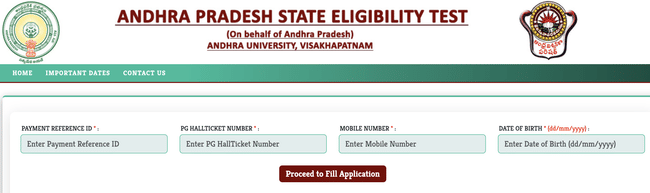
APSET Application form 2026 has started from 09 January 2026. The candidates aspiring to appear for APSET exam are advised to go through the eligibility criteria before applying for the exam. Candidates must fill out and submit APSET application form via online mode. Candidates need to follow the following steps to apply for APSET exam.
- Step 1: Visit the Official Website- https://apset.net.in/ and click on APSET registration link.
- Step 2: Fill in all the required details in the registration form such as the Name of the candidate, Father’s Name, Mother’s Name, Date of Birth, Gender, Category, Contact details, and password.
- Step 3: Candidates need to verify all the required details after they have filled the same. Thereafter they need to click on Submit to submit their registration form.
- Step 4: Once the registration is successful, the candidate will receive an email containing his Email ID and password on his registered email address.
- Step 5: Candidates are then required to log in with their email ID and password to fill out the application form and log in with the registration ID and Password on the MAHA TET official website.
- Step 6: Applicants have to fill in their personal details, educational qualifications, and preference for the exam center in the application form.
- Step 7: Thereafter, candidates have to upload the scanned images of their signature, passport-sized photograph, category, or PwD certificate as per need.
- Step 8: Review the application form before submitting it and make corrections, if any.
- Step 9: As a final step, candidates are required to pay the application fee via online mode(Credit/Debit cards or net banking) for submitting the form successfully.
- Candidates are advised to take a printout of the application form for future references.
APSET 2026 Application Form (Active Link)
APSET Application Fee
In order to complete the registration process, candidates need to make a payment for the application fee. The application fee for candidates of different categories is mentioned below:
| Category | Application Fee |
|---|---|
| General & EWS | Rs. 1600/- |
| BC/EWS Category | Rs. 1300/- |
| SC/ST/PWD/Transgender | Rs. 900/- |
Candidates can use credit/debit cards and net banking for the payment of the application fee. Candidates are advised to download and take a printout of the payment receipt for future reference.
APSET Admit Card 2026
The candidates who applied for APSET 2026 are eligible to download the admit card, which will be released on the official website of APSET. The admit card is generally released 10 -15 days prior to the exam. Candidates are required to download and take a printout of the admit card. APSET admit card 2026 would contain the following details related to the candidate:
- Name
- Date of Birth
- Photograph
- Registration number
- Date of Exam
- Venue of Exam(Exam center address)
- Reporting time
To download APSET admit card, candidates have to follow the steps listed below:
- Step 1: Visit the official website of APSET.
- Step 2: Click on the link displaying- download APSET 2026 admit card.
- Step 3: Enter the registration ID and password to log in.
- Step 4: APSET 2026 admit card will appear on the screen. Click on it and download the admit card.
- Step 5: Take a printout of the admit card for the purpose of exam.
- Candidates are advised to go through all the guidelines mentioned in the admit card and act accordingly.
APSET Answer Key 2026
APSET answer key will be released by Andhra University on the official website, post the exam. Candidates can raise their objection to APSET Answer Key, through the objection window, which remains open for a few days post-release of the answer key. It consists of all the answers to the questions asked in the exam. The answer key can help the candidates estimate their expected marks in the exam.
APSET Result 2026
APSET result will be published soon after evaluation and will be released on the official website of APSET. Candidates qualifying for APSET exam will receive a qualifying certificate with lifetime validity and eligibility to get recruited for the post of assistant professor or lecturer in colleges and universities of Andhra Pradesh.
Candidates have to follow the steps given below to check their APSET result:
- Step 1: Visit the official website of APSET
- Step 2: Click on the link displaying- APSET 2026 Result
- Step 3: Enter your application number/roll number
- Step 4: APSET result will appear on the screen. It can be downloaded and printed for future reference.
APSET Cut-Off Marks 2026
To qualify for APSET exam, candidates need to obtain minimum qualifying marks. The cut-off list is prepared category-wise, for each subject. Category-wise minimum qualifying percentage for candidates is tabulated below.
| Category | Qualifying Marks |
|---|---|
| General | 40% |
| SC/ST/BC/PWD | 35% |
APSET Salary and Benefits 2026
An APSET-qualified assistant professor receives a minimum salary of INR 2,61,500 per annum to the highest salary of INR 9,50,000 per annum. In India, the average salary of an assistant professor is INR 5,47,800 per annum. Apart from the basic salary, they are entitled to numerous benefits and perks like Dearness Allowance, House Rent Allowance, Travelling Allowance, Medical Allowance, etc. The salary depends on the post and gets revised with each promotion. Other benefits include-
- Good work environment
- Convenient work timings
- Paid holidays
- Easy leave applicability
- Paid sick leave
- Renewal of salary on a fixed date
Candidates will be shortlisted based on their total obtained marks in both papers. Successful candidates will get a call for counselling and document verification. Candidates can choose their postings according to their preferences, in the counseling. After the complete APSET 2026 selection process, the finally selected candidates will receive their appointment letters at their communication address, via post.
APSET 2026FAQs
Ques. What is the validity of an APSET exam certificate?
Ans. APSET exam certificate validates the eligibility of a successful candidate to be appointed as an Assistant professor in a college or university in Andhra Pradesh. This certificate has lifetime validity.
Ques. Are there any limits on the number of attempts in APSET Exam?
Ans. There is no upper limit to the number of attempts an aspirant can make. It means that aspirants can attempt APSET exam a number of times.
Ques. What should be the minimum qualification to apply for APSET 2026 ?
Ans. A candidate applying for APSET exam should at least possess a Master's Degree with 55% marks in any subject from a UGC-approved university. However, there is a relaxation for reserved category students. The minimum percentage required in a master's degree is relaxed to 50% the same.
Ques. Can a Ph.D. degree holder sit for APSET exam?
Ans. Yes, a Ph.D. degree holder is eligible to appear for APSET, minimum educational eligibility being a master's degree. Also, candidates with a Ph.D. degree who have finished their post-graduation by 19 September 1991 are eligible for a 5% relaxation in the aggregate marks for appearing in APSET.
Ques. When will APSET Exam be conducted in 2026?
Ans: The Andhra University conducts APSET once a year.
Ques. How to Apply for APSET 2026 Exam?
Ans. APSET application process is done through online mode. Candidates have to fill up the application form available on the official website of APSET and pay the mentioned registration fee.
Download the PREPP App and attempt FREE APSET Mock Tests and get complete study material!

French revolution
Full Test-03: AP SET Paper 1
APSET 2019 General Paper Previous Year Paper (20-Oct-2019)
AP SET Paper 1: Held on 2019

17 February 2025 | The Hindu Must Read Articles | Current Affairs

16 February 2026 | The Hindu Must Read Articles | Current Affairs

13 February 2026 | The Hindu Must Read Articles | Current Affairs









Comments