CTET 2026 Preparation Tips, Check Last Minute Strategy
The Central Teacher Eligibility Test (CTET) 2026, conducted by CBSE, is a highly competitive exam for aspiring teachers in India. With lakhs of candidates appearing each year, success in CTET demands a smart strategy, clear concepts, and regular practice. Since the exam is held in offline OMR mode, accuracy and speed are equally important. Aspirants should focus on Child Development and Pedagogy, strengthen NCERT-based topics, and consistently practice CTET 2026 mock tests and CTET Previous Year Papers. Continuous revision boosts confidence and performance.
Table of Contents
- How to Clear CTET in First Attempt
- CTET Paper 1 (Classes I–V): Best Books
- CTET Paper 2 (Classes VI–VIII): Best Books
- CTET Last-Minute Preparation Strategy
- Previous Year Question Papers with Solution PDF
- CTET Mock Test Practice 2026
- CTET 2026 Last-Minute Active Recall Timetable
- CTET 2026 Daily “Emergency” Revision Routine
- Mistakes to Avoid Before & During CTET Exam
- CTET Preparation 2026 FAQs
How to Clear CTET in First Attempt?
Clearing CTET in the first attempt is completely achievable with disciplined preparation and a focused mindset. Aspirants must create a realistic study timetable and strictly follow it.
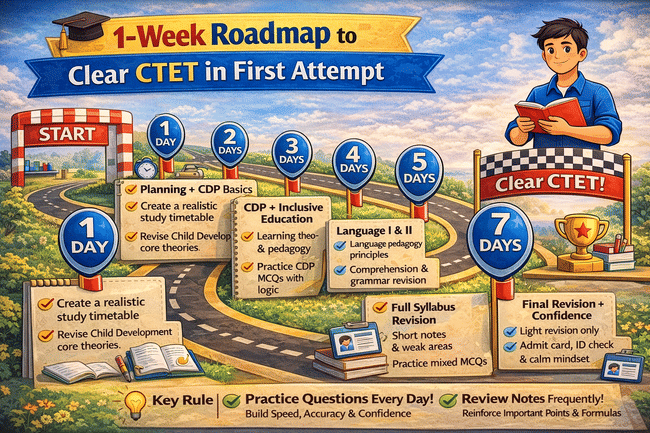
Note: Smart planning and regular evaluation are the keys to first-attempt success.
Understand CTET Exam Pattern & Syllabus
CTET Paper 1 (Classes I–V): Best Books
Sections: CDP, Language I, Language II, Maths, EVS - Total 150 marks
| Section | Best Books (Top Picks) | Why is it best for CTET | How to use |
|---|---|---|---|
| Child Development & Pedagogy (CDP) | “A Complete Resource for CTET: Child Development & Pedagogy” (Pearson, Sundeep Kumar); Arihant “CTET & TETs Child Development & Pedagogy (Paper I & II)” | CDP is scoring if concepts (Piaget/Vygotsky, inclusive education, learning theories, pedagogy) are clear | Read 1 chapter → solve MCQs → revise notes weekly |
| Language I (your teaching medium) | Arihant language-specific CTET books (e.g., Hindi Bhasha/Shikshashastra) or equivalent for your language choice | CTET checks comprehension + pedagogy of language development | Daily: 1 passage + 15–20 MCQs + grammar rules notebook |
| Language II (other language) | Language-specific CTET guide (Arihant/Wiley-type exam guides) | Helps with unseen passages + language pedagogy | Focus more on comprehension + error spotting |
| Mathematics | “A Complete Resource for CTET: Mathematics & Pedagogy” (Pearson, Haneet Gandhi); Arihant “Mathematics & Pedagogy for Class I–V” | Matches CTET style: concept + teaching approach questions | NCERT first → then guide MCQs → timed practice sets |
| Environmental Studies (EVS) | Arihant “CTET & TETs Environmental Studies & Pedagogy” + NCERT EVS (Classes 1–5) | EVS questions are NCERT-aligned and concept-based | Make short notes from NCERT + practice objective MCQs |
| Full Practice / PYQs | CTET Solved Papers / Practice Sets (Arihant-type) + CTET Previous Year Papers (PDF/sets) | PYQs teach the exact level, repeated themes, and time management | Do 1 PYQ/week → analyze mistakes → reattempt weak topics |
CTET Paper 2 (Classes VI–VIII): Best Books
Sections: CDP, Language I, Language II + either Maths & Science or Social Studies - Total 150 marks
| Section | Best Books (Top Picks) | Why is it best for CTET | How to use |
|---|---|---|---|
| Child Development & Pedagogy (CDP) | Pearson (Sundeep Kumar) CDP; Arihant CDP (Paper I & II) | Paper 2 CDP is for the age group 11–14 and focuses on learning + inclusive education | Same strategy: concept → MCQs → weekly revision |
| Language I | Language-specific CTET guide (as per your chosen language) | Strong weightage + improves overall score quickly | 30–40 min daily comprehension + pedagogy |
| Language II | Language-specific CTET guide | Regular practice boosts accuracy | Alternate days: long passage practice |
| Maths & Science (choose if you’re opting for M/S) | Arihant “CTET Success Master Paper-II (Maths & Science)”; Disha / similar CTET practice workbook (Maths & Science); NCERT (Classes 6–8 Maths + Science) | This section is 60 marks and includes pedagogy-style questions | NCERT concepts → chapterwise MCQs → 60-mark sectional tests |
| Social Studies/Social Science (choose if you’re opting for SST) | Arihant “CTET Success Master Social Science/Studies (Paper-II)”Pearson “CTET Social Sciences & Pedagogy (Paper-II)”; NCERT (Classes 6–8 SST) | This section is also 60 marks and is very NCERT-driven | NCERT timelines/maps → pedagogy points → daily 25–30 MCQs |
| Full Practice / PYQs | CTET Paper 2 Previous Year Papers + solved sets | Most effective for scoring jump in the last 3–4 weeks |
CTET Last-Minute Preparation Strategy: Smart Revision Before the Exam
As CTET exam approaches, preparation must move away from heavy study and shift towards smart consolidation, accuracy, and confidence-building. These final days are crucial to maximise your score using what you already know. A focused, well-planned last-minute strategy can significantly improve performance and help candidates comfortably achieve CTET qualifying marks.
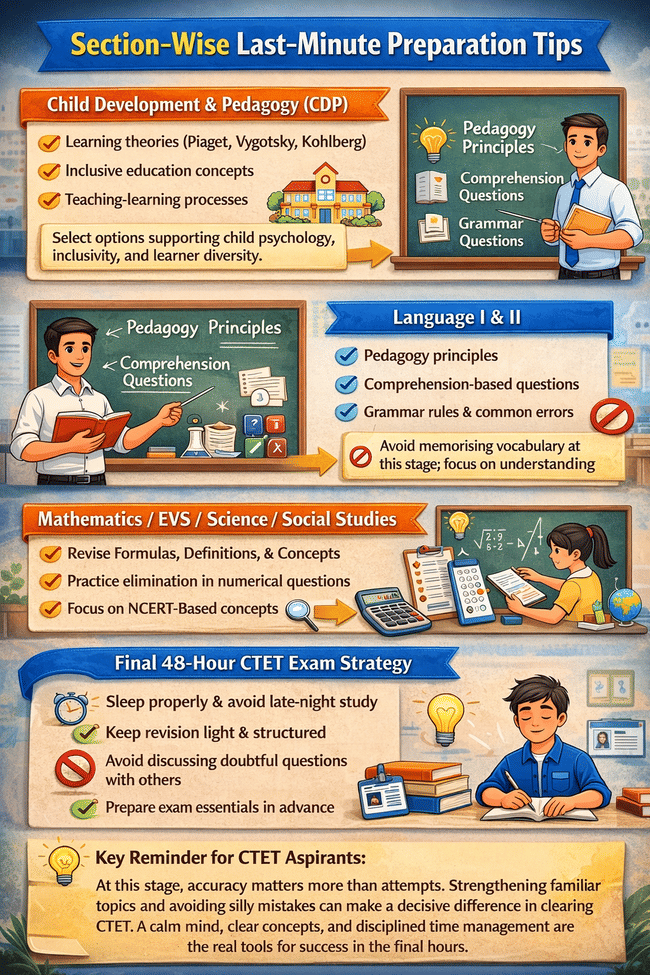
Instead of learning new concepts, candidates should refine concepts, practice smart guessing techniques, and strengthen exam temperament.
Practice Previous Year Papers & Mock Tests
Solving CTET previous year question papers helps candidates understand:
- Repeated question patterns
- Important topics
- Difficulty level of the exam
CTET Previous Year Question Papers
Check Here for more CTET Previous Year papers
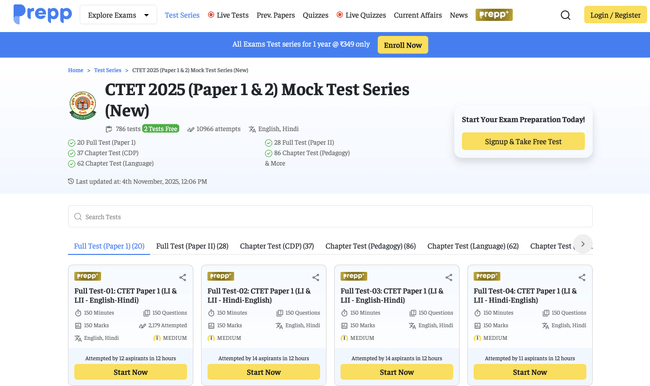
CTET Mock Test Practice 2026 – Boost Speed, Accuracy & Confidence
Regular mock test practice improves time management, accuracy, and exam temperament. After each mock test, candidates should analyse mistakes and revise weak areas.
CTET 2026 Last-Minute Active Recall Timetable
This 8–10 hour CTET revision schedule is built for maximum active recall, fast CTET syllabus coverage, and high-score practice using CTET Previous Year Questions (PYQs). It works for both CTET Paper 1 (Primary) and CTET Paper 2 (Upper Primary)—just swap the practice block with your chosen subject combo (Maths/EVS for Paper 1, or Maths-Science / Social Science for Paper 2).
Use this as your CTET last-minute revision plan, focused on accuracy + speed + mistake reduction.
CTET 2026 Daily “Emergency” Revision Routine
| Time Slot | Activity | Focus Area |
|---|---|---|
| 06:00 AM – 08:30 AM | Prime Recall Session | CDP core theories (Piaget, Vygotsky, learning & development) + Language Pedagogy (methods, assessment, classroom strategies) |
| 08:30 AM – 09:30 AM | Break | Hydration + light breakfast (keep energy steady) |
| 09:30 AM – 12:30 PM | High-Intensity Practice | Solve 60–90 MCQs from Maths / EVS / Social Science / Science (as per your paper) |
| 12:30 PM – 01:30 PM | Error Analysis (Must-Do) | Review every wrong question → note why wrong + correct concept + shortcut in an error notebook |
| 01:30 PM – 02:30 PM | Lunch + Power Nap | Reset focus for the second half (avoid heavy scrolling) |
| 02:30 PM – 05:00 PM | Mixed PYQ Drill | Random CTET PYQs (mixed years + mixed topics) to build exam adaptability |
| 05:00 PM – 06:30 PM | Keyword Flashcards | Rapid revision of pedagogy keywords (formative vs summative, inclusive education, CCE, assessment tools, teaching methods) |
| 06:30 PM – 08:00 PM | Buffer Time | Walk + dinner + light refresh (no heavy study; keep mind calm) |
| 08:00 PM – 09:30 PM | Light Recap Session | Quick scan of formula sheet, key concepts, EVS diagrams/maps, and “most repeated” points from your error notebook |
Critical Mistakes to Avoid Before and During CTET Exam
Even after good CTET preparation, small mistakes in the final stage can reduce your score. Avoid these common errors to stay safe in CTET 2026:
1. Leaving Questions Blank: Many candidates skip tough questions due to fear.
Solution: CTET has no negative marking, so never leave any OMR bubble empty. Eliminate wrong options and make a smart guess.
2. Solving Wrong Language Paper: Attempting the incorrect Language I or II section can lead to zero marks.
Solution: Check your CTET Admit Card language codes carefully before starting the paper.
3. Filling OMR Sheet at the End: Shading all answers in the last 10–15 minutes increases the risk of mistakes.
Solution: Fill the OMR section-wise after completing each subject.
4. Ignoring Pedagogy Questions: Focusing only on subject content and skipping pedagogy costs marks.
Solution: Remember, pedagogy is 50% of the paper. Choose child-friendly and inclusive options.
5. Misreading “NOT / EXCEPT” Questions: Negative words often confuse students.
Solution: Underline or circle words like NOT, EXCEPT, LEAST before answering.
6. Spending Too Much Time on One Math Question: One question equals one mark, no matter how hard it is.
Solution: Follow the 60-second rule—mark it and move on if it’s taking too long.
7. Studying New Topics at the Last Moment: Learning new theories just before the exam creates panic.
Solution: Stop new study 48 hours before CTET. Revise short notes and CTET PYQs instead.
CTET Preparation 2026 FAQs
Ques: Is there negative marking in CTET 2026?
Ans: No, CTET 2026 does not have negative marking. Candidates receive +1 mark for each correct answer, and there is no penalty for incorrect or unanswered questions. This allows candidates to attempt all questions without the fear of losing marks.
Ques: How can I manage my time effectively during CTET 2026 preparation?
Ans: Create a daily schedule based on CTET’s syllabus structure. Allocate fixed time blocks, such as 2 hours for Child Development & Pedagogy (CDP), 1.5 hours for Language I and 2, and 2 hours for Mathematics/EVS. Prioritise weaker sections and complete one pedagogy chapter every day. Weekly mock tests and daily practice questions help build speed and accuracy.
Ques: What are the best books for CTET 2026 preparation?
Ans: Some of the widely recommended books for CTET 2026 include:
- Child Development & Pedagogy: Arihant CTET & TETs CDP, Pearson CTET Pedagogy Guide
- Language I & 2: NCERT Language Books, Arihant Language Guides
- Mathematics & EVS: NCERT Class 1–5 Books, Wiley CTET Maths & EVS
- Social Studies (for Paper 2): NCERT Class 6–8 Books, Himalaya Publication CTET SST
Candidates should rely primarily on NCERT books for conceptual clarity.
Ques: How do I stay updated with current educational trends for CTET?
Ans: CTET does not require general current affairs; instead, it focuses on educational policies, teaching-learning theories, and classroom practices. To stay updated, follow:
- NCERT official website for educational guidelines
- Ministry of Education notifications
- Basic summaries of NEP 2020
- Teacher training platforms like DIKSHA for pedagogy articles
Ques: What is the best way to revise for CTET 2026?
Ans: Start revising at least one month before the exam. Prepare short notes for pedagogy concepts, learning theories, teaching methodologies, and mathematical formulas. Revise NCERT examples regularly. Attempt full-length mock tests twice a week and analyse mistakes. Focus more on high-weightage topics such as CDP, Learning Theories, Problem-Solving, and Environmental Teaching Strategies.
Ques: How do I deal with stress during CTET 2026 preparation?
Ans: Break study sessions into manageable time blocks with short breaks after every hour. Avoid overloading yourself with too many books; stick to NCERT + one reference book. Practice meditation or 10 minutes of breathing exercises daily. Take one day per week for light revision instead of intense study. Regular mock tests also help reduce exam anxiety by building confidence.
Ques: Can I use online platforms and mobile apps for CTET 2026 preparation?
Ans: Yes, there are several online platforms and mobile apps that offer CTET 2026 preparation materials, including mock tests, video lessons, and practice exercises. These can be especially helpful for time management and self-assessment.
Download the PREPP App and attempt FREE CTET Mock Tests and get complete study material!

Live Test : CTET Paper 1 (LI & LII - English-Hindi) (Oct 20 - 23)
Full Test 10: CTET Paper II Social Science (L - I-II: Hindi-English)
Full Test 09: CTET Paper II Social Science (L - I-II: Hindi-English)
CTET 2026 Paper 1 Question Paper (07-Feb-2026)
CTET 2026 Paper 2 Social Science Question Paper (07-Feb-2026)

17 February 2025 | The Hindu Must Read Articles | Current Affairs

16 February 2026 | The Hindu Must Read Articles | Current Affairs

13 February 2026 | The Hindu Must Read Articles | Current Affairs









Comments