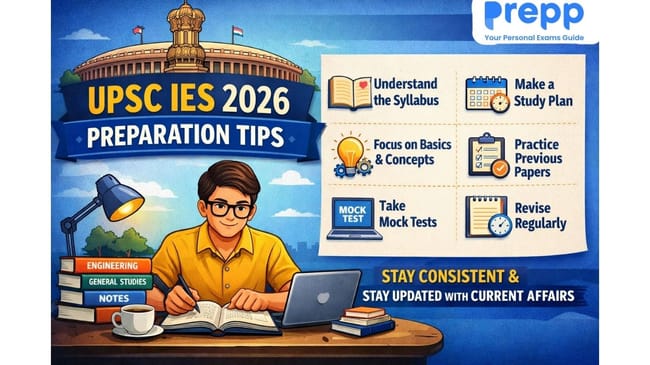
UPSC IES 2026 Preparation Tips, Check Last Week Preparation Strategy
UPSC Engineering Services Examination (IES) 2026, also known as ESE, is a national-level competitive exam conducted annually by UPSC to recruit engineers for technical and managerial posts in various Central Government departments. The exam is conducted in offline (pen-and-paper) mode and consists of three stages: Prelims Exam, Mains Exam, and Personality Test. Prelims include two objective papers- General Studies & Engineering Aptitude and discipline-specific engineering subjects. Mains comprises two conventional (descriptive) papers from the chosen engineering discipline. UPSC IES 2026 syllabus is based on core engineering subjects of Civil, Mechanical, Electrical, or Electronics & Telecommunication Engineering, along with general engineering aptitude topics.
UPSC IES Exam Pattern and Syllabus 2026
UPSC IES 2026 consists of Prelims (objective) and Mains (descriptive) papers, conducted offline, covering general studies, engineering aptitude, and core engineering subjects. The syllabus includes discipline-specific topics in Civil, Mechanical, Electrical, or Electronics & Telecommunication Engineering, along with general engineering concepts.
UPSC IES Exam Pattern 2026
UPSC IES 2026 Prelims consists of two objective papers for screening candidates, carrying a total of 400 marks in 5 hours collectively, while UPSC IES 2026 Mains includes two descriptive papers from the chosen engineering discipline, carrying 600 marks for a total of 6 hours collectively, and Mains marks are counted for final selection.
Check Detailed UPSC IES 2026 Exam Pattern here.
UPSC IES Syllabus 2026
UPSC IES 2026 Syllabus provides brief information related to subjects, sub-subjects, and topics in Civil, Mechanical, Electrical, etc., to be covered for the exam.
| Stage | Paper | Topics |
|---|---|---|
| Prelims | Paper 1 |
|
| Paper 2 |
|
|
| Mains | Paper 1 |
|
| Paper 2(Advanced Topic) |
|
Check Detailed UPSC IES 2026 Syllabus here.
Personalised Study Plan for UPSC IES 2026
A personalised study plan is essential for effective UPSC IES preparation. Since UPSC IES focuses heavily on conceptual clarity and Engineering disciplines, structuring your study routine helps you cover every section systematically.
Time Allocation
Allocate daily study hours based on your strengths and the paper you are appearing for. A balanced schedule can help you maintain consistency across all sections. A typical UPSC IES daily routine may include-
| Time | Activity |
|---|---|
| 2 hours | General Studies / Engineering Aptitude (Prelims) |
| 4 hours | Core Engineering Subject (Discipline) |
| 1 hour | Revision of notes/formulas |
| 1 hour | Practice numerical problems or MCQs |
| 30 mins | Current Affairs / Updates |
Check UPSC IES Question Paper 2024 here.
UPSC IES 2026 Last Minute Weekly Goals
To stay on track, divide the syllabus into weekly targets. Candidates can check the table below to get a detailed revision plan for one week before UPSC IES 2026 Exam-
| Day | Focus Area | Study Plan for the Day | Time |
|---|---|---|---|
| Day 1 | General Studies & Engineering Aptitude | Engineering Mathematics + Current Affairs: make short notes and formulas | 2 hrs |
| Day 2 | Core Engineering Subject | Study theory and concepts from one core discipline topic | 4 hrs |
| Day 3 | Core Engineering Subject | Practice numericals and derivations from the same topic | 4 hrs |
| Day 4 | Core Engineering Subject | Continue next topic; revise previous concepts | 4 hrs |
| Day 5 | Prelims Objective Practice | Solve MCQs from GS & discipline subjects; analyze mistakes | 3 hrs |
| Day 6 | Mains Descriptive Practice | Practice answer writing, numericals, and diagrams | 4 hrs |
| Day 7 | Revision & Mock Test | Revise notes and formulas; attempt a sectional/full mock test | 2-3 hrs |
UPSC IES 2026 Key Topics with High Weightage
Some UPSC IES 2026 topics carry consistently higher importance. Focusing on them early can significantly improve your score.
- Identify and prioritize topics with high weightage in both Prelims and Mains.
- Focus on core engineering subjects based on your discipline (e.g., Thermodynamics, Mechanics, Electrical Machines, Structural Analysis, Electronics & Communication).
- In Prelims, concentrate on Engineering Aptitude, Material Science, Current Affairs, and frequently asked topics from past papers.
- Allocate more time to these high-scoring areas while ensuring coverage of the full syllabus.
- Regularly revise and solve previous year questions from these topics to improve accuracy and confidence.
Check UPSC IES Question Paper 2025 here.
UPSC IES 2026 Study Material
Selecting the right study resources ensures conceptual clarity and reduces confusion.
1. General & Core Subjects (All Branches)-
- Engineering Aptitude & General Studies: Covers Engineering Mathematics, Material Science, Ethics, Project Management, Environment, and Current Affairs for both Prelims and Mains.
- Topic-wise Solved Papers: Helps practice previous objective questions and identify important topics.
2. Branch-wise Standard Books-
Civil Engineering-
- Strength of Materials – Timoshenko & Gere
- Structural Analysis / Theory of Structures – Ramamrutham & Narayan
- Concrete & Steel Structures – Punmia / Duggal
- Hydraulics & Fluid Mechanics – Modi & Seth / R.K. Bansal
- Environmental & Transportation Engineering – Standard university texts
Mechanical Engineering-
- Thermodynamics – Cengel & Boles / P.K. Nag
- Fluid Mechanics – R.K. Bansal / Modi & Seth
- Machine Design – V.D. Bhandari / Shigley
- Strength of Materials & Mechanics – Gere & Timoshenko
- Industrial Engineering & Operations Research – O.P. Khanna / Kanti Swarup
Electrical Engineering-
- Electrical Machines & Power Systems – P.S. Bimbhra / Nagrath & Kothari
- Network Theory & Circuits – Van Valkenburg
- Power Electronics – P.S. Bimbhra
- Control Systems & Measurements – Standard texts with practice questions
Electronics & Telecommunication Engineering-
- Microelectronic Circuits – Sedra & Smith
- Communication Systems – Taub & Schilling / Simon Haykin
- Signals & Systems / Network Analysis – University standard texts
- Digital Logic Design & Integrated Circuits – Morris Mano / K.R. Botkar
3. Previous Year Question Papers- Solve past 20–30 years’ Prelims and Mains questions to understand the pattern and frequently asked topics. Check UPSC IES previous year question paper with solution pdf here.
4. Additional Tips-
- Use concise coaching notes from reputed institutes for quick reference.
- Practice UPSC IES mock tests along with book study to improve speed, accuracy, and exam readiness.
Stay Healthy and Maintain Focus
Maintaining physical and mental health is vital during preparation-
- Physical Activity: A 20-minute walk or short workout can refresh your mind and body. It helps reduce stress and increases focus.
- Balanced Diet: Ensure you are eating nutritious food to keep your energy levels up. Avoid excessive caffeine or junk food.
- Sleep: Ensure you get enough sleep (7-8 hours) each night. A well-rested mind retains information better and works more efficiently.
Keep checking UPSC IES 2026 official website for any updates or changes to the exam schedule. Knowing the exact dates and any last-minute announcements will help you stay organised and calm.
UPSC IES 2026 FAQs
Ques: Is there negative marking in UPSC IES 2026 Exam?
Ans: Yes, UPSC IES 2026 Prelims Exam has negative marking, with 1/3 of the marks deducted for each incorrect answer in the objective papers. Mains Exam is descriptive, so there is no negative marking, making accuracy crucial in Prelims for shortlisting candidates.
Ques: How can I manage my time effectively during UPSC IES preparation?
Ans: To manage time effectively for UPSC IES 2026, create a realistic daily schedule prioritizing high-weightage topics, balancing core engineering subjects, General Studies, revision, and mock tests. Use short notes, formula sheets, and weekly goals to track progress, and take regular breaks to maintain focus and efficiency.
Ques: Should I focus more on UPSC IES 2026 Prelims or Mains?
Ans: UPSC IES 2026 Prelims and Mains, both are important. Prelims require accuracy and speed in objective questions, while Mains demand in-depth understanding and answer-writing practice. Allocate time proportionally, but integrate both throughout preparation.
Ques: How do I stay updated with current exam trends for UPSC IES 2026?
Ans: To stay updated with UPSC IES 2026 exam trends, regularly follow official UPSC notifications, review previous years’ papers, and track coaching institute analyses. Stay current with engineering and general affairs, participate in discussion forums, and use mock test insights to adapt your preparation to changing patterns.
Ques: How can I revise effectively before UPSC IES 2026 Exam?
Ans: For effective revision of UPSC IES 2026 Exam, make short notes, formula sheets, and one-page summaries. Revise them daily, solve previous year papers, and take regular mock tests to improve speed and accuracy.
Download the PREPP App and attempt FREE IES Mock Tests and get complete study material!

French revolution
Full Test - 01 : ESE Prelims Paper 2
UPSC ESE Prelims 2026 Mechanical Engineering Question Paper (08-Feb-2026)
UPSC ESE Prelims 2026 GS & Engineering Aptitude Question Paper (08-Feb-2026)

17 February 2025 | The Hindu Must Read Articles | Current Affairs

16 February 2026 | The Hindu Must Read Articles | Current Affairs

13 February 2026 | The Hindu Must Read Articles | Current Affairs









Comments